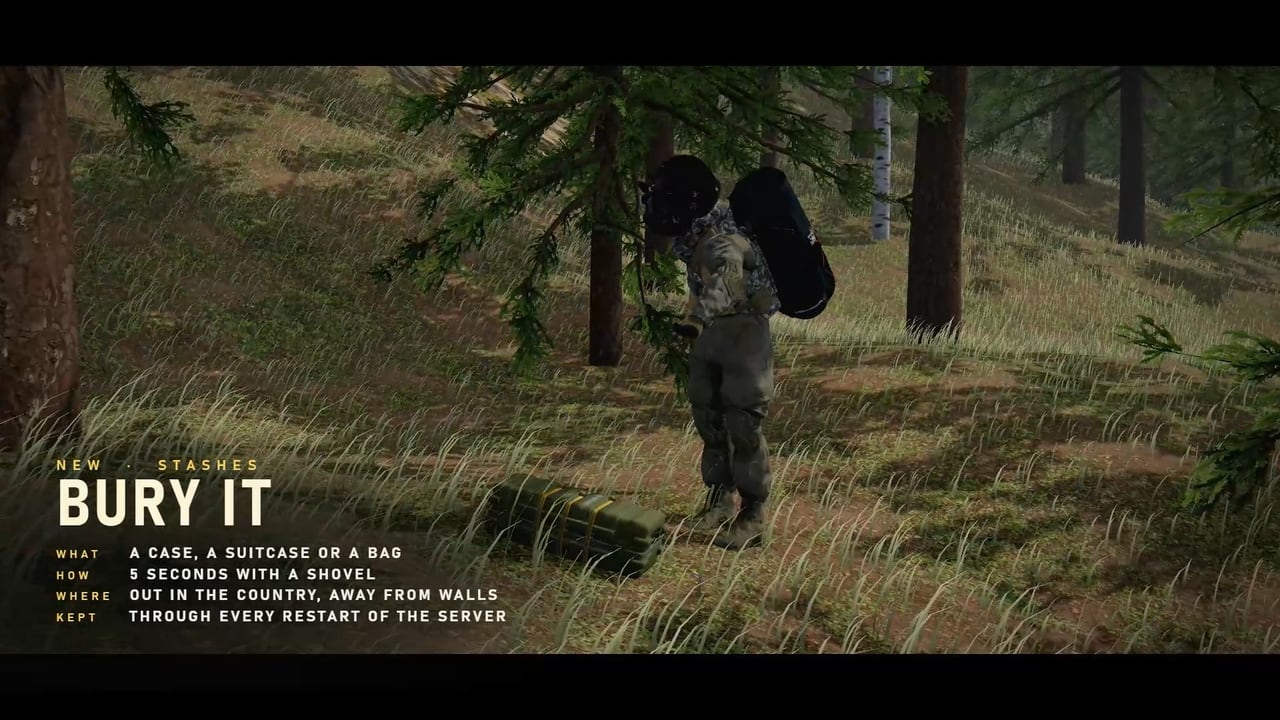
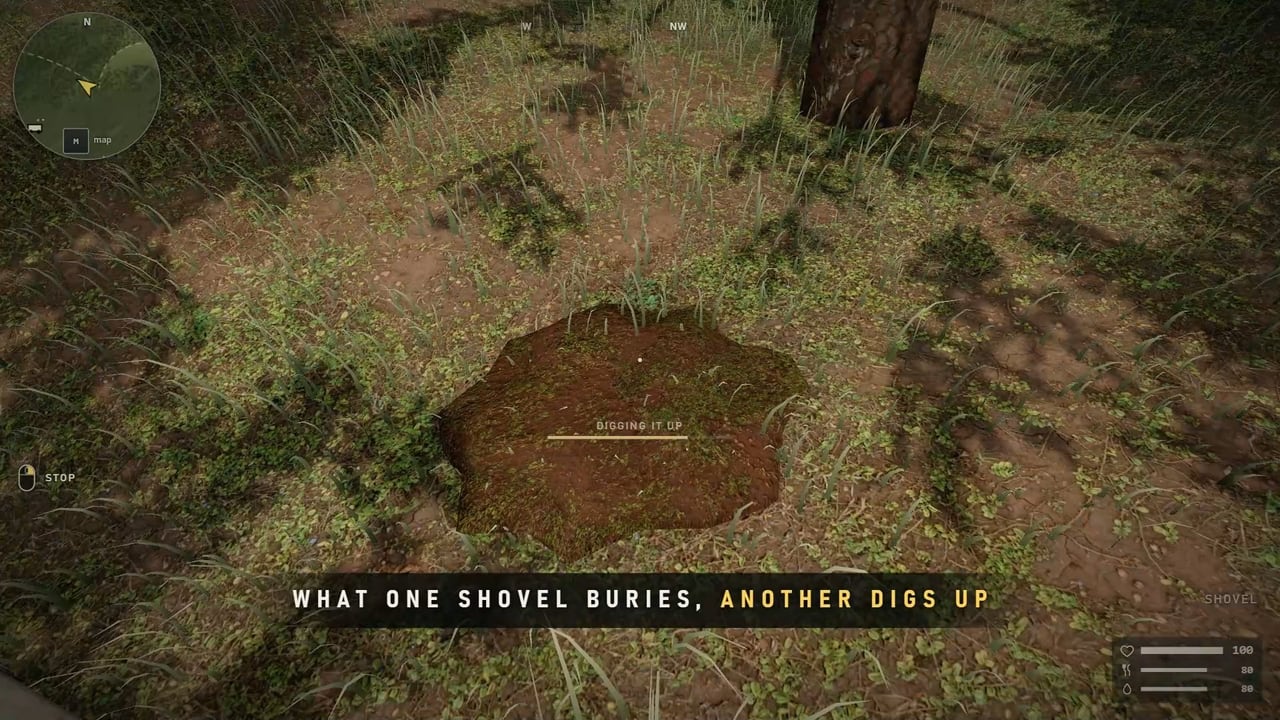
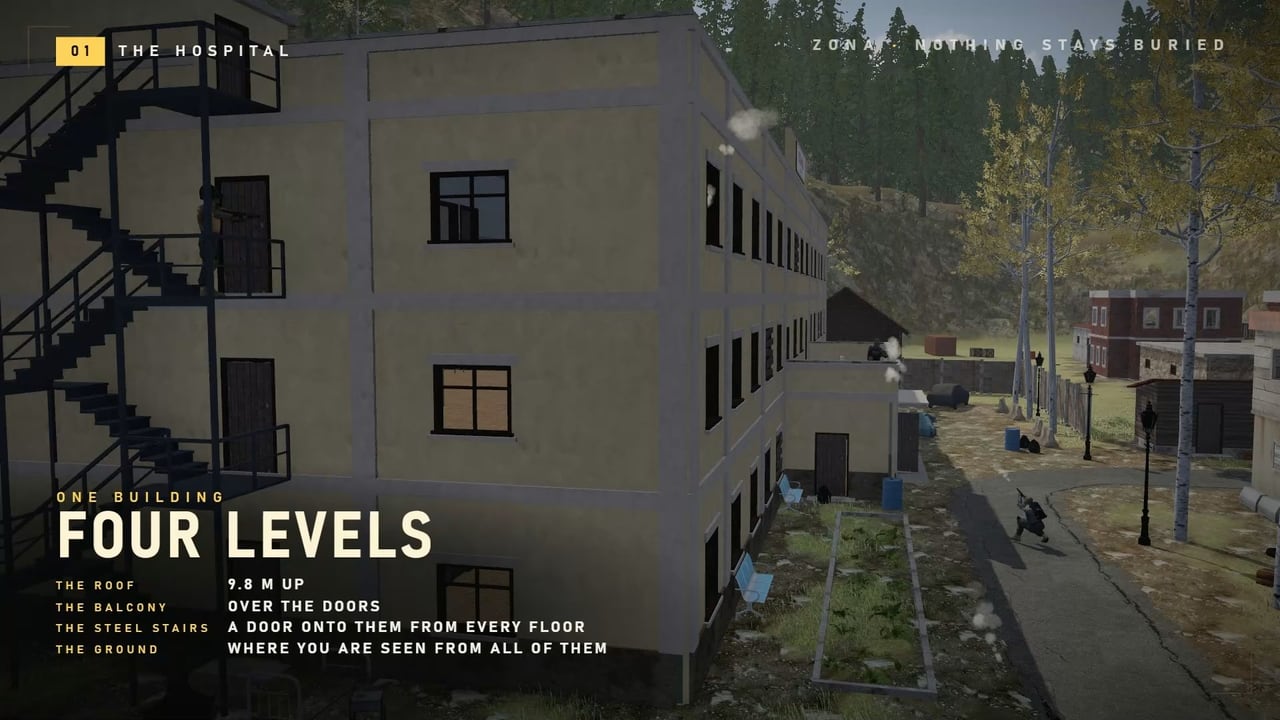
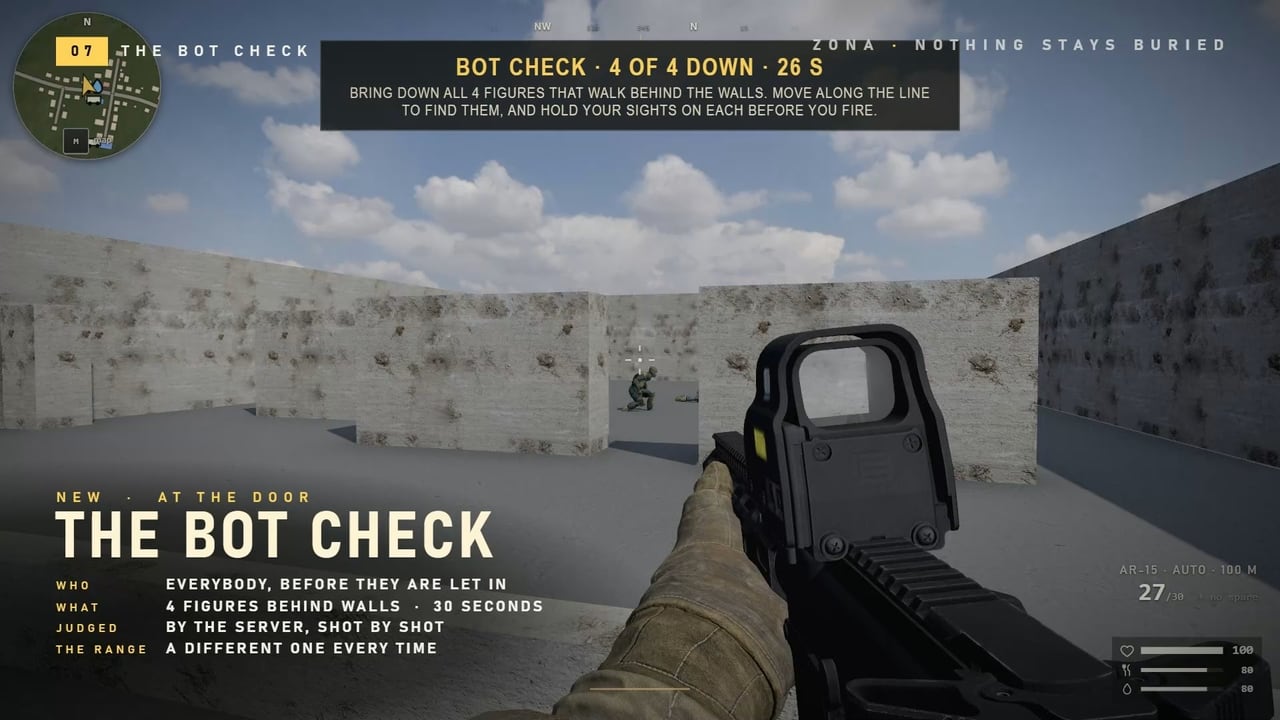
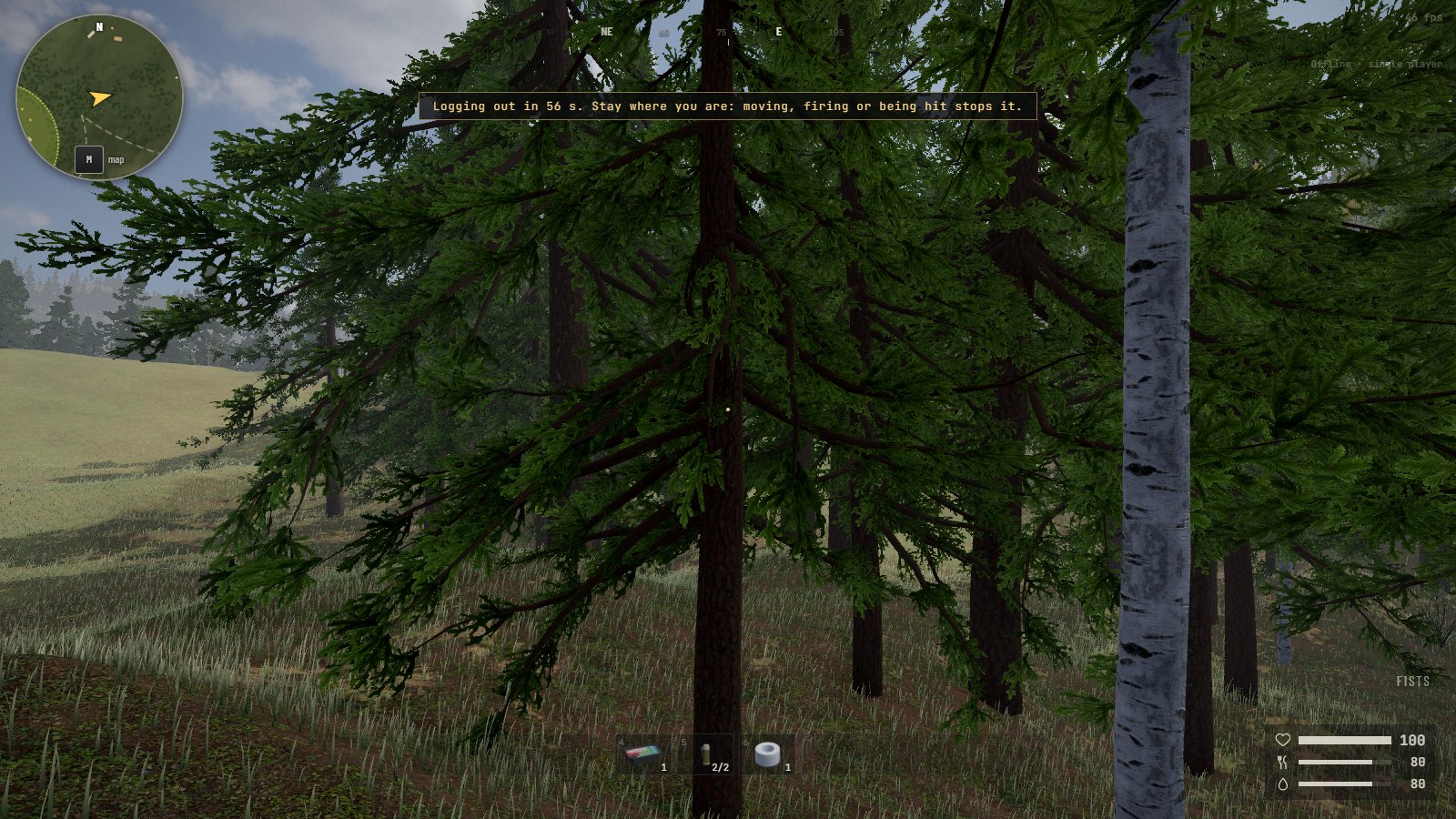
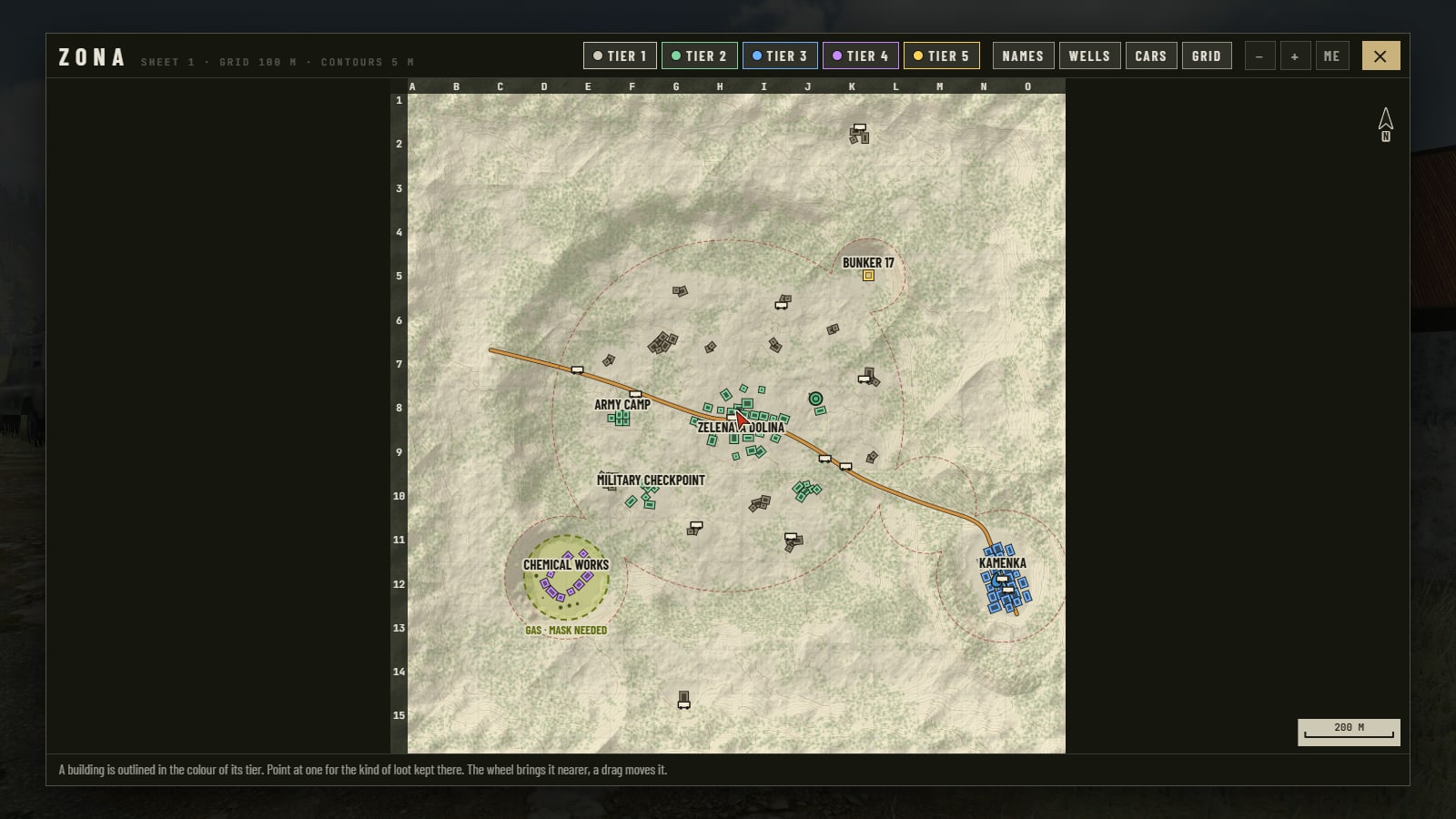
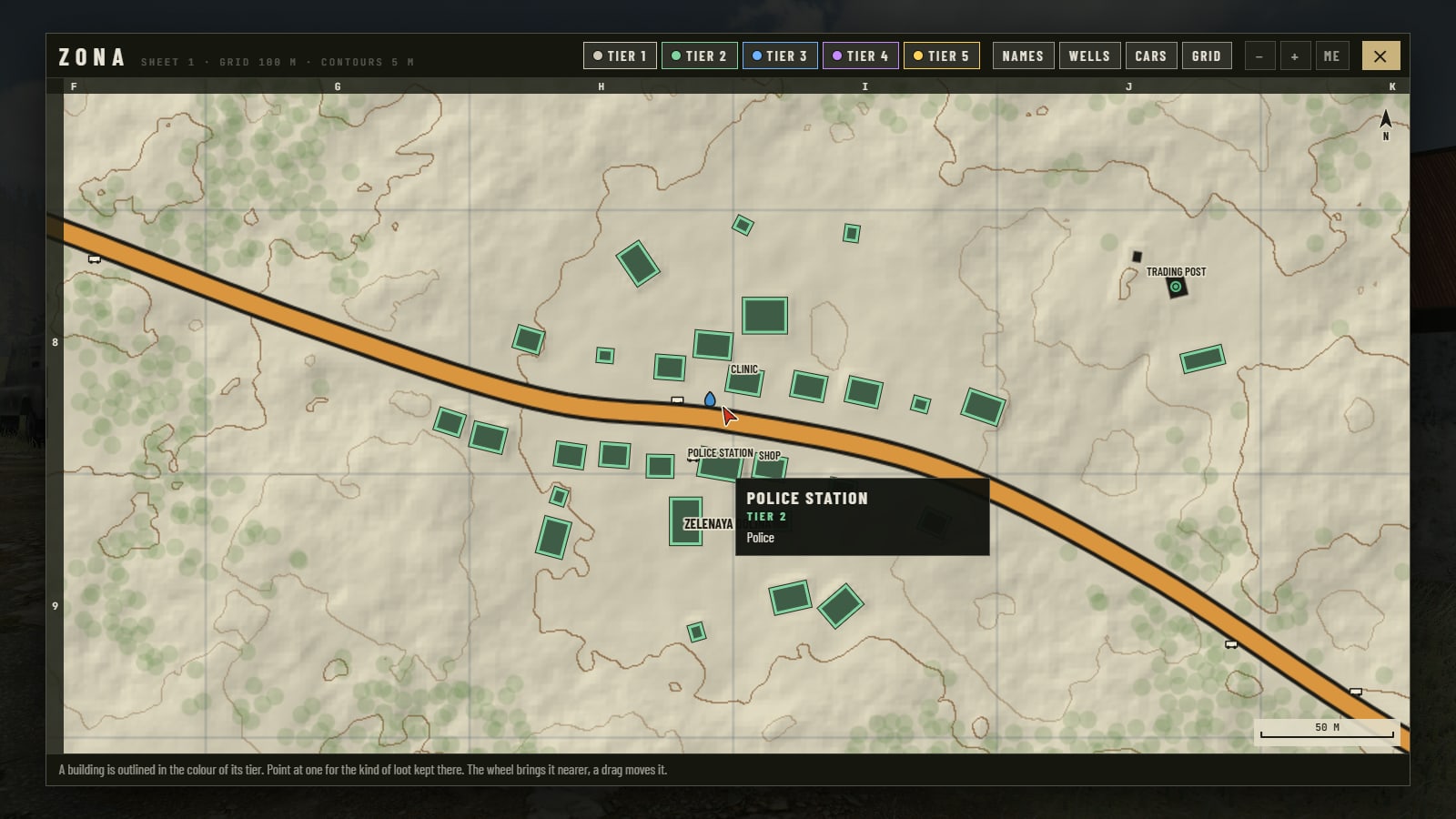
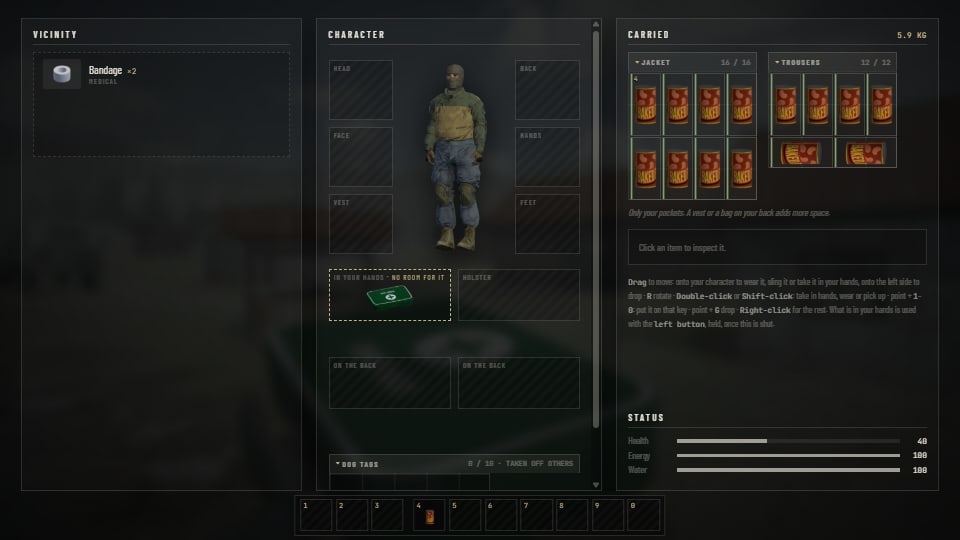
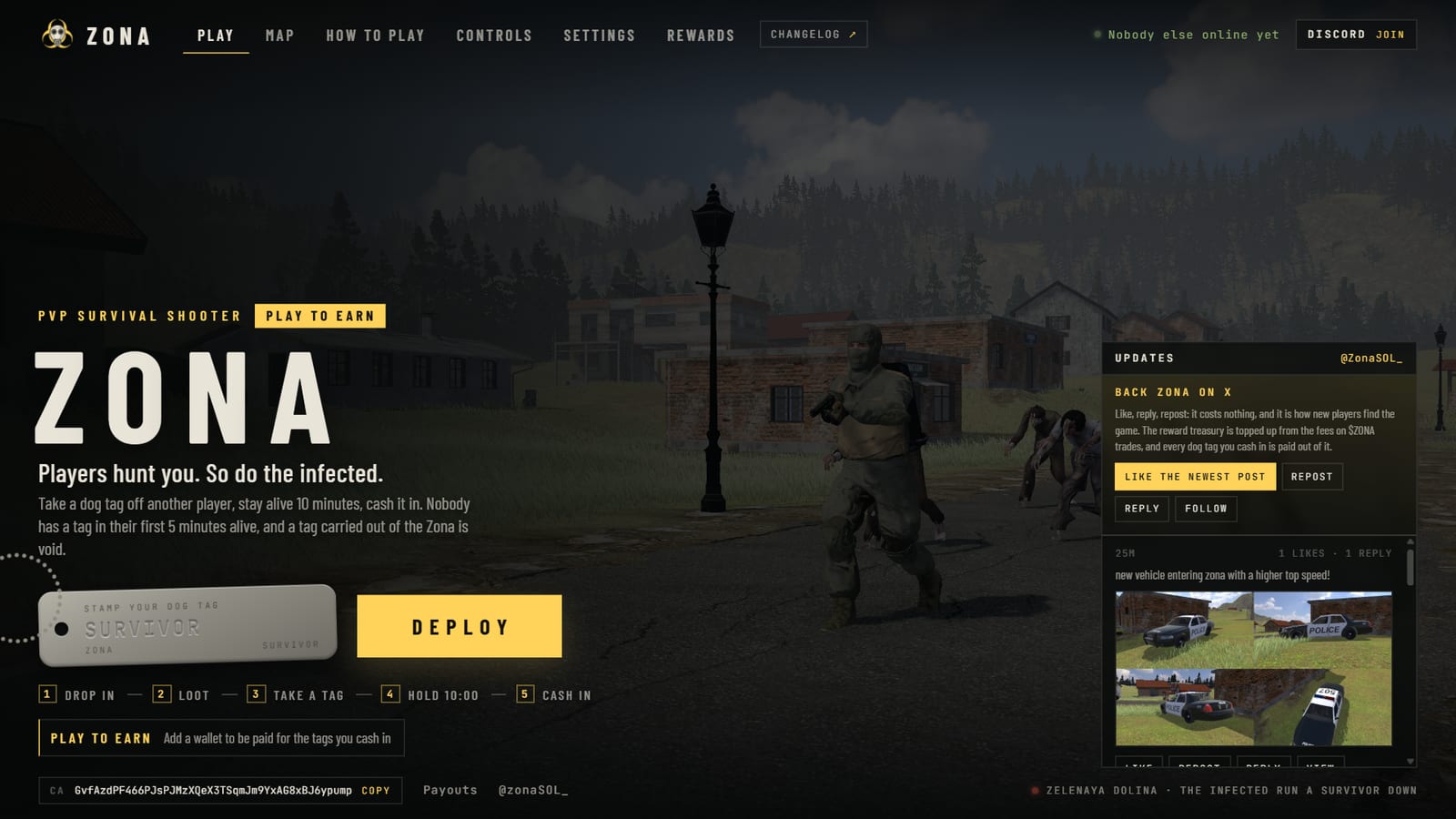
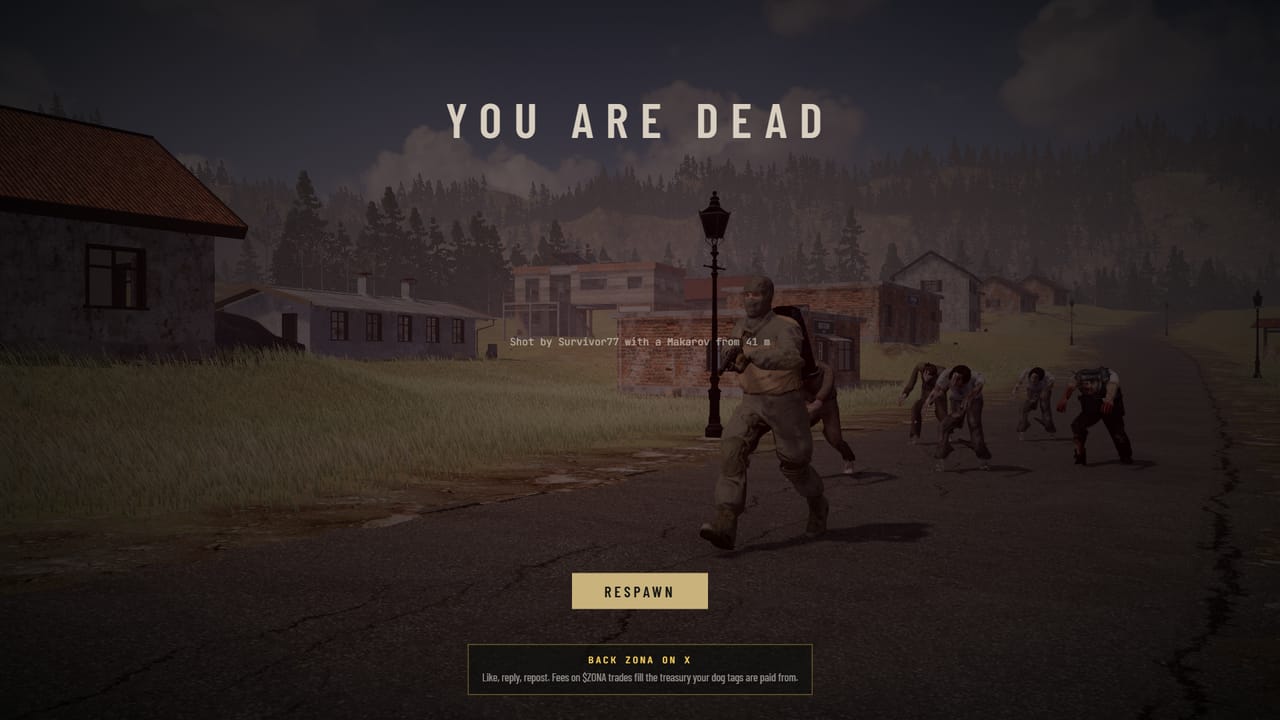
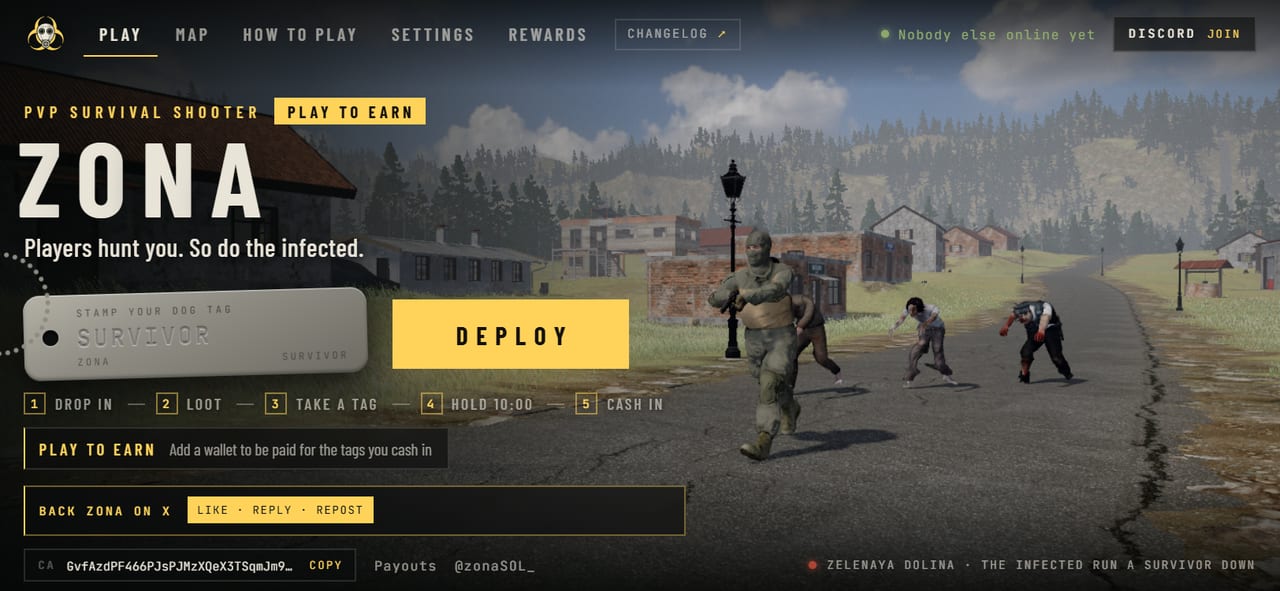
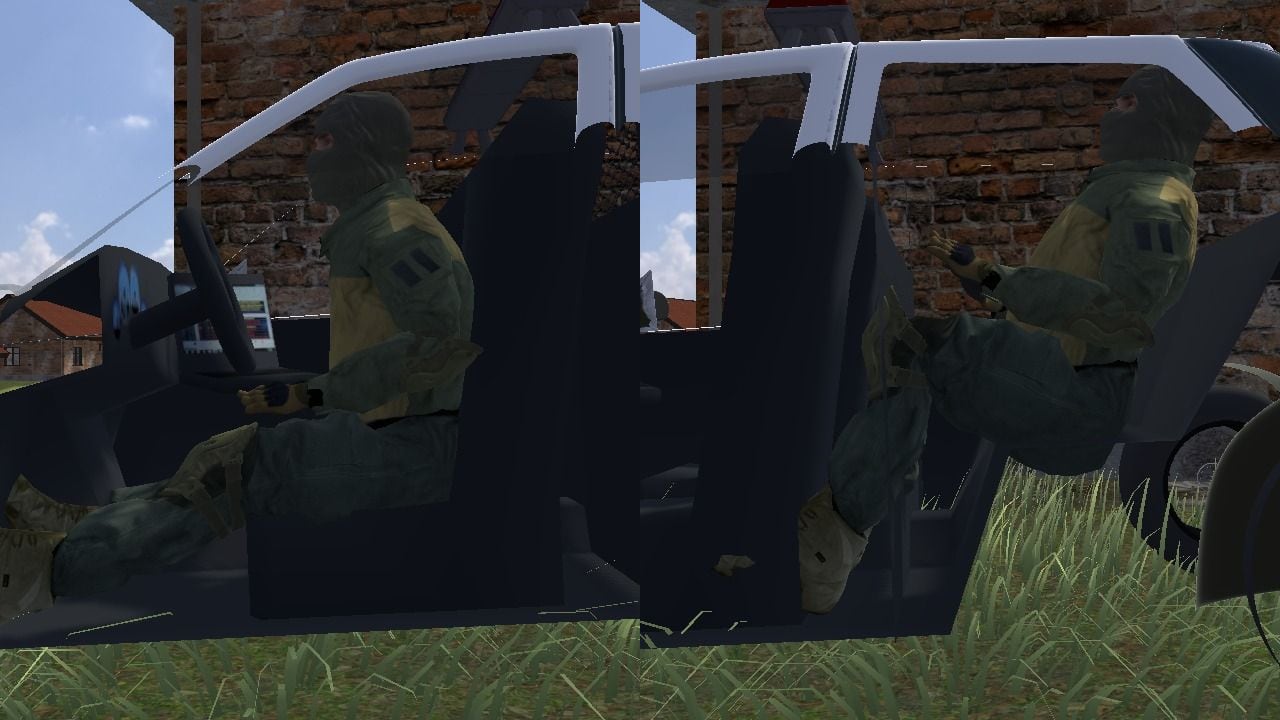
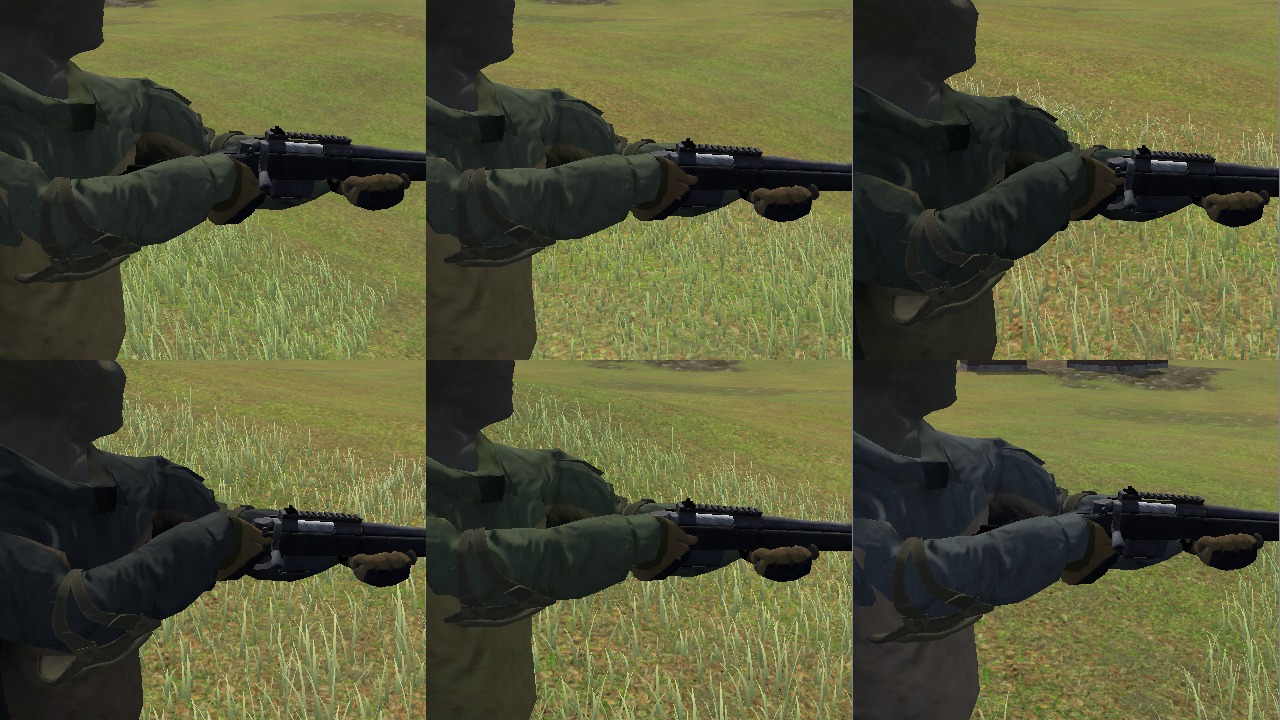
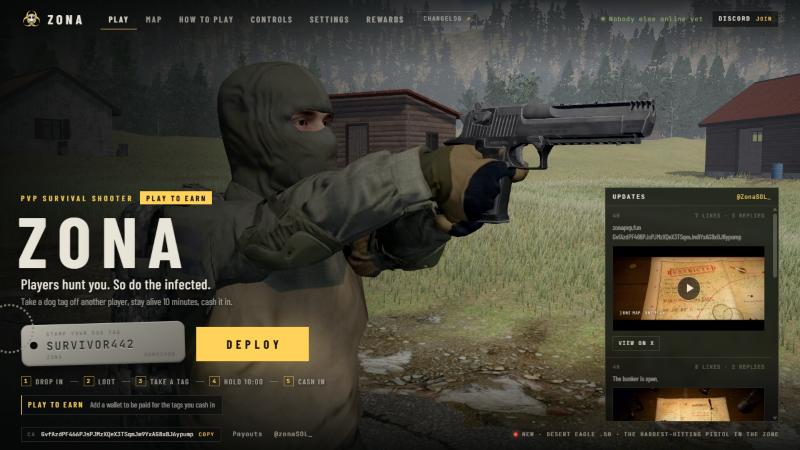
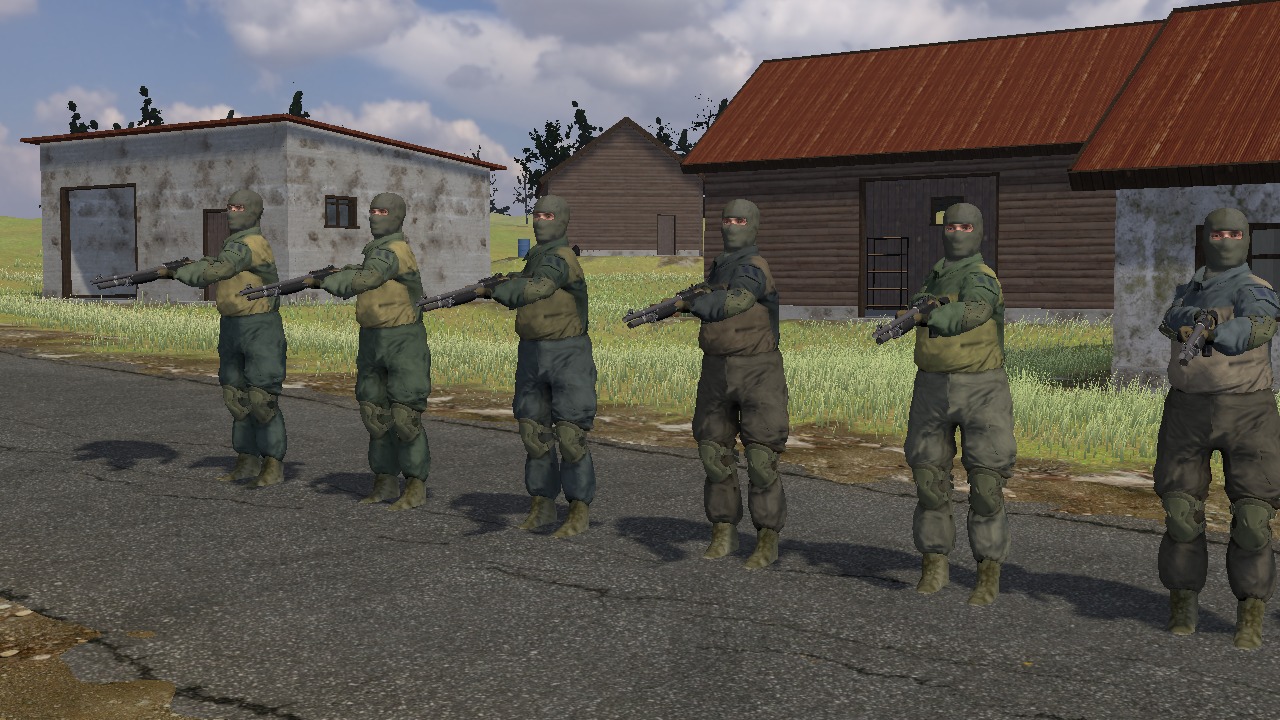
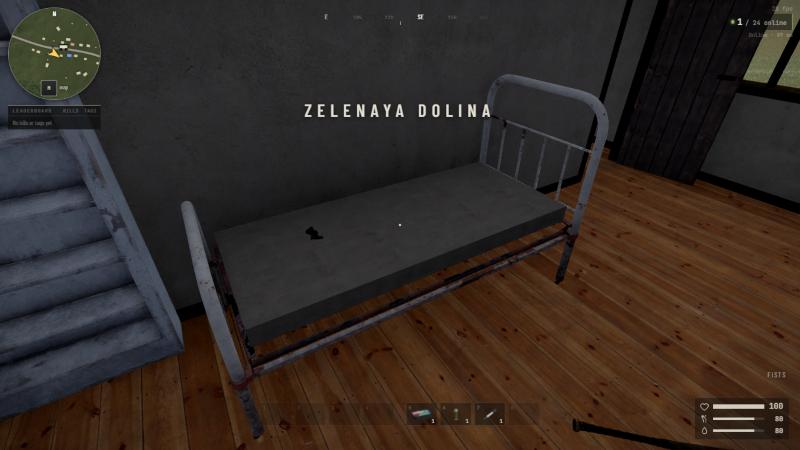
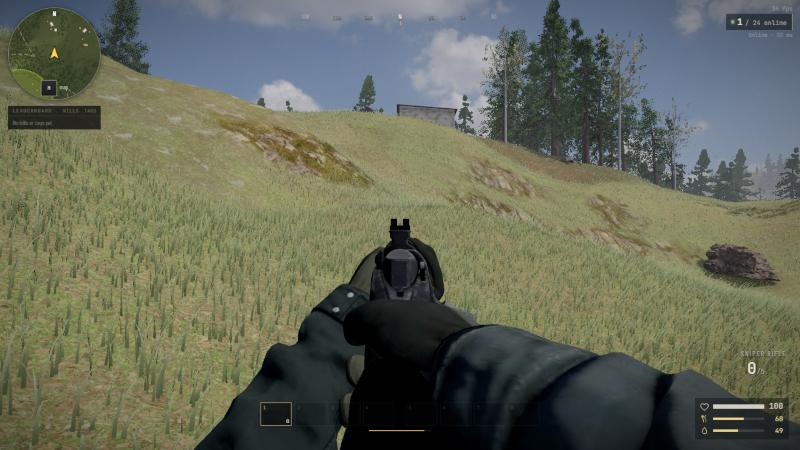
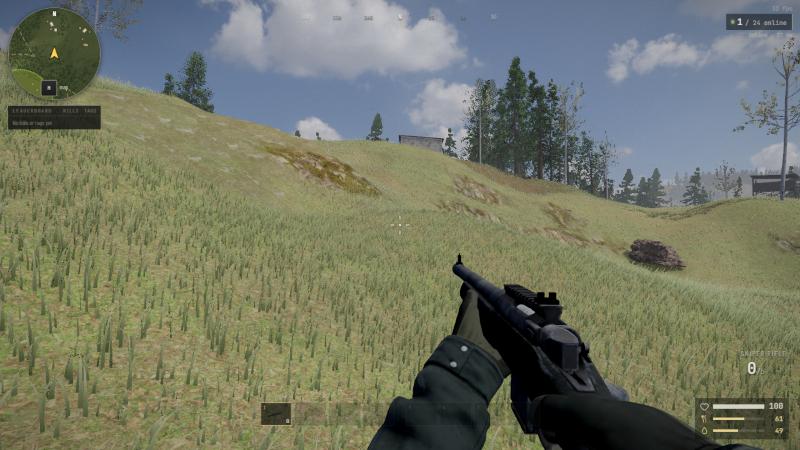
Every update to the Zone, newest first, with pictures and film of what changed. The films in the older entries were made at the time and show the game as it was then.
Three phases are done and the fourth is under way: five of thirteen. The road goes all the way round, over a bridge; the fort Orlinoye is built, with the vaults under it; supply drops come by helicopter and parachute; grenades are cooked and there is a frag grenade; packs and pockets are bigger. What is ticked is in the game today. The rest is the plan, and plans change.
Six phases. The first two are every entry on this page from the bottom up to the bunker, and the third is done too. The fourth is under way, and it is wilder ground: attics and basements, wildlife, weather, a harder fight and a smoother game; five lines of it are built already. The industrial zone, the military base and base building come after it, in the fifth, with what DayZ does not do. The sixth is the Arena: its matches are in already, battle royale, new game modes, its stakes and more maps to come.
Latest
Start on the coast, walk east
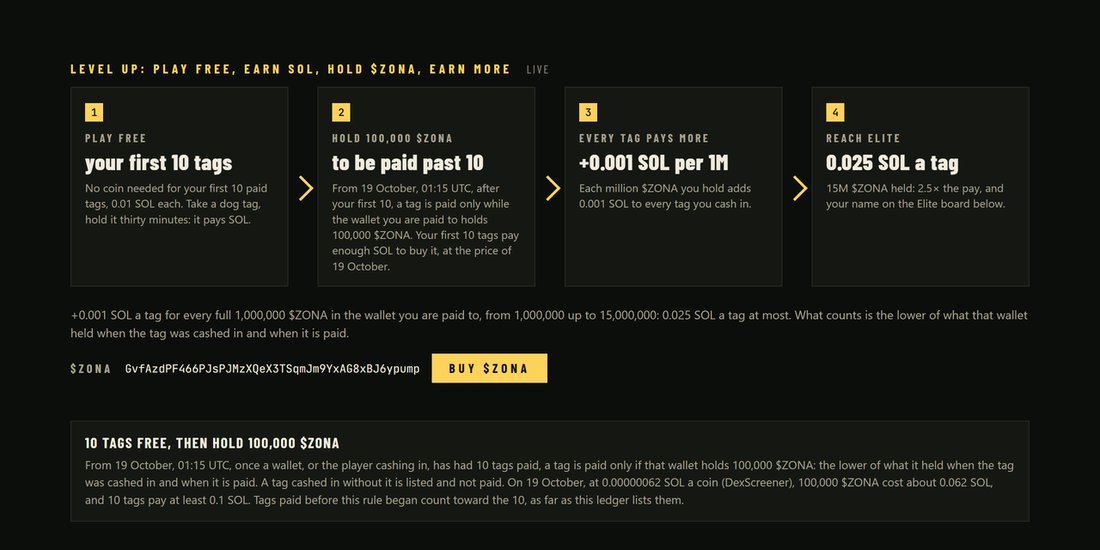
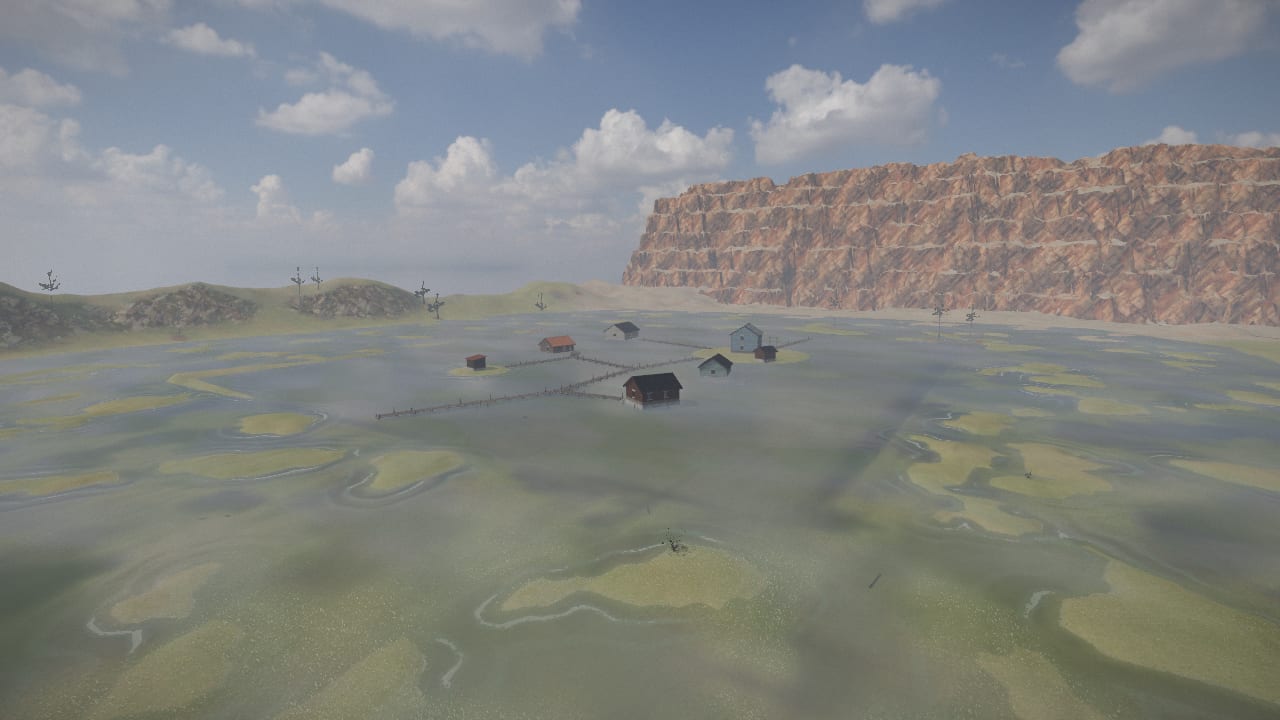
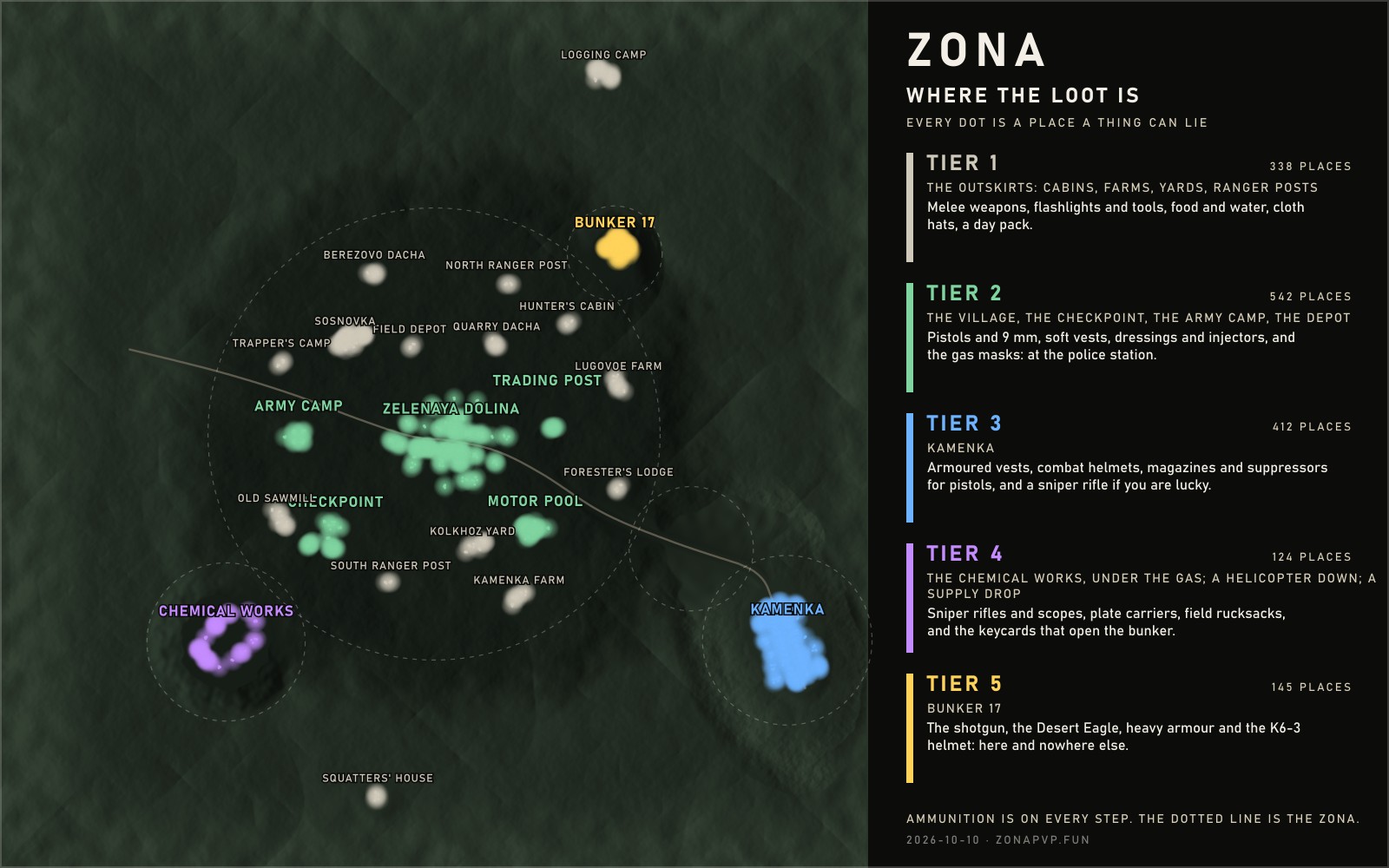
Everybody starts on the beach of the far west coast now, and the loot gets better the further east you go. The desert has places to find your first things, the west has jeeps, and you can drink from the rivers, the lakes and the swamp. Past your first 10 paid tags, a tag now waits for you to hold 100,000 $ZONA.
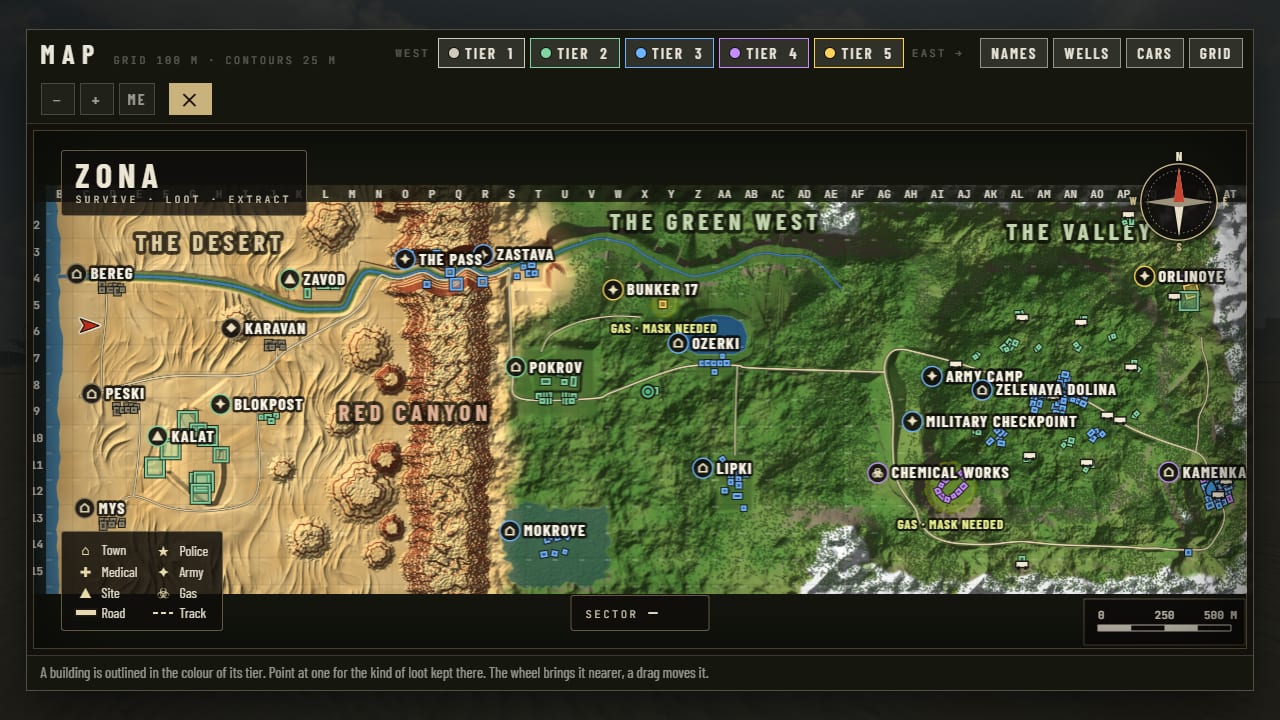
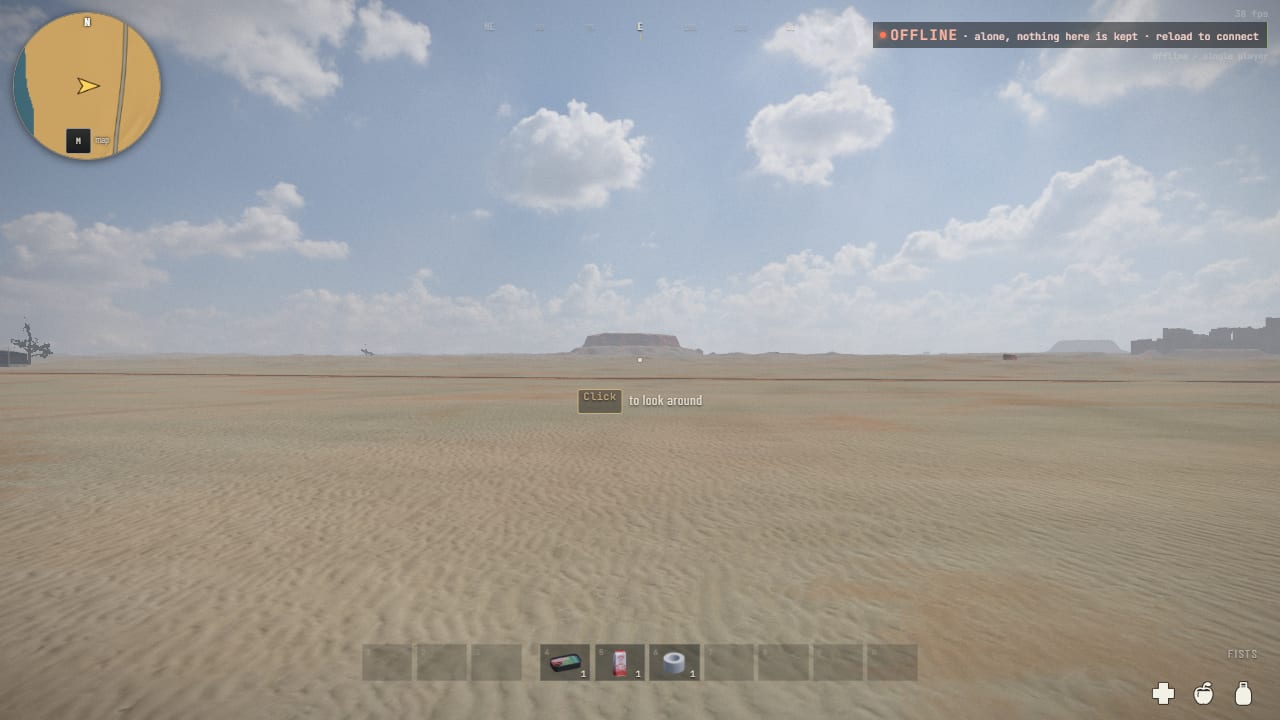
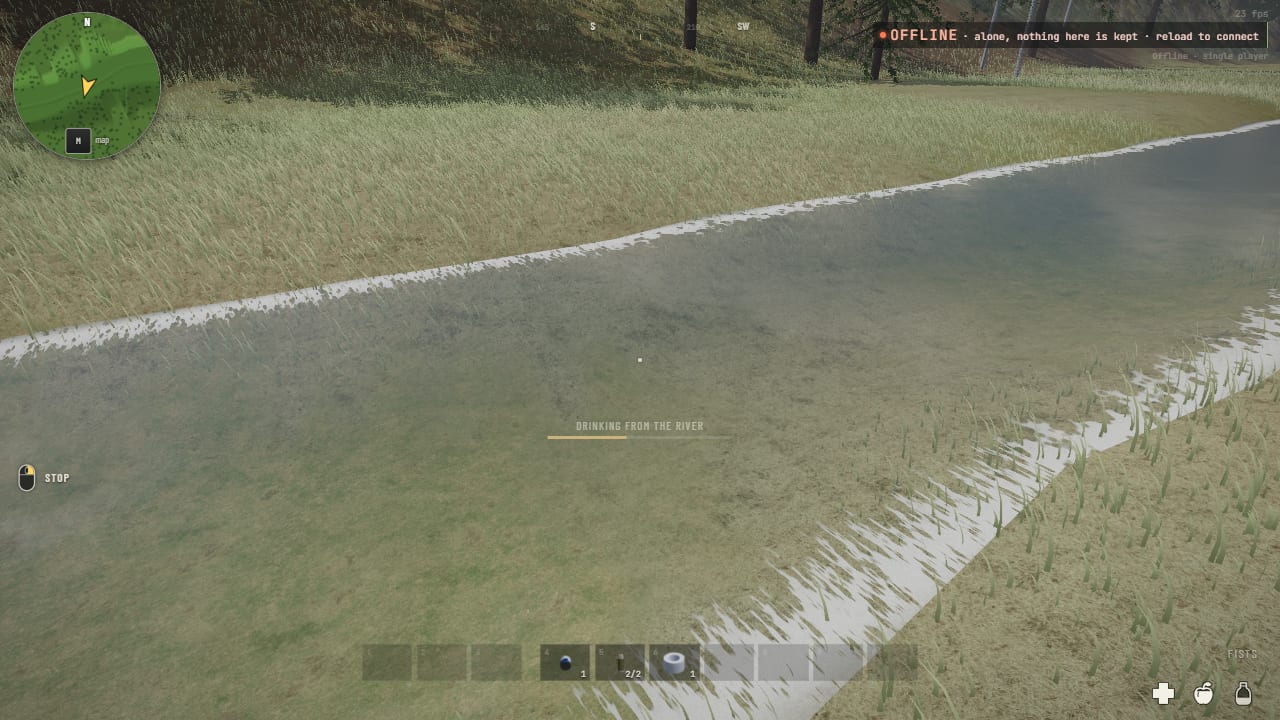
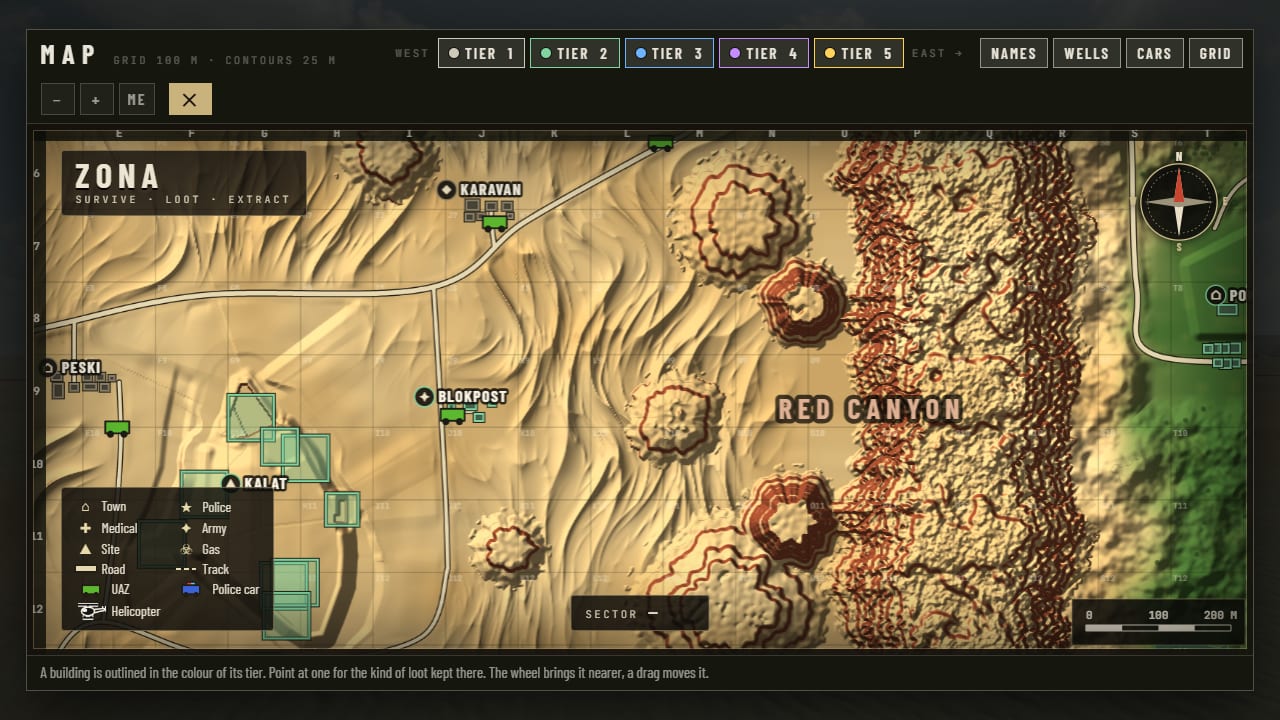
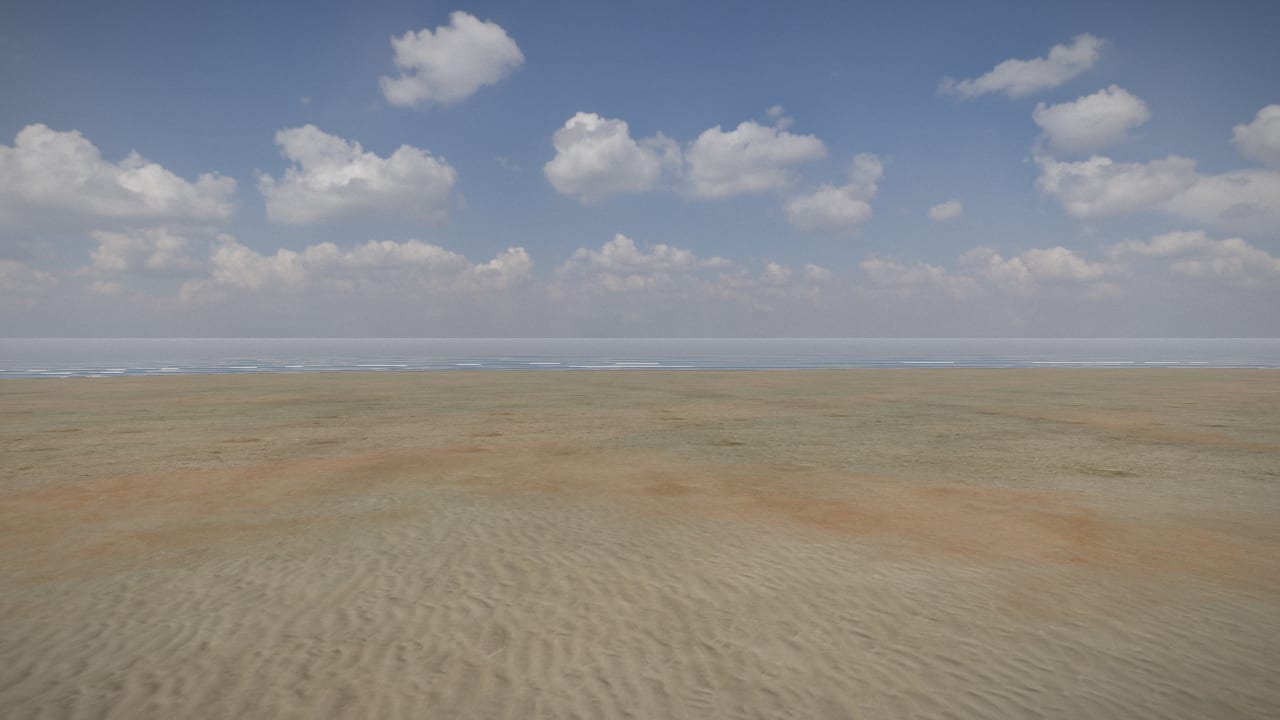
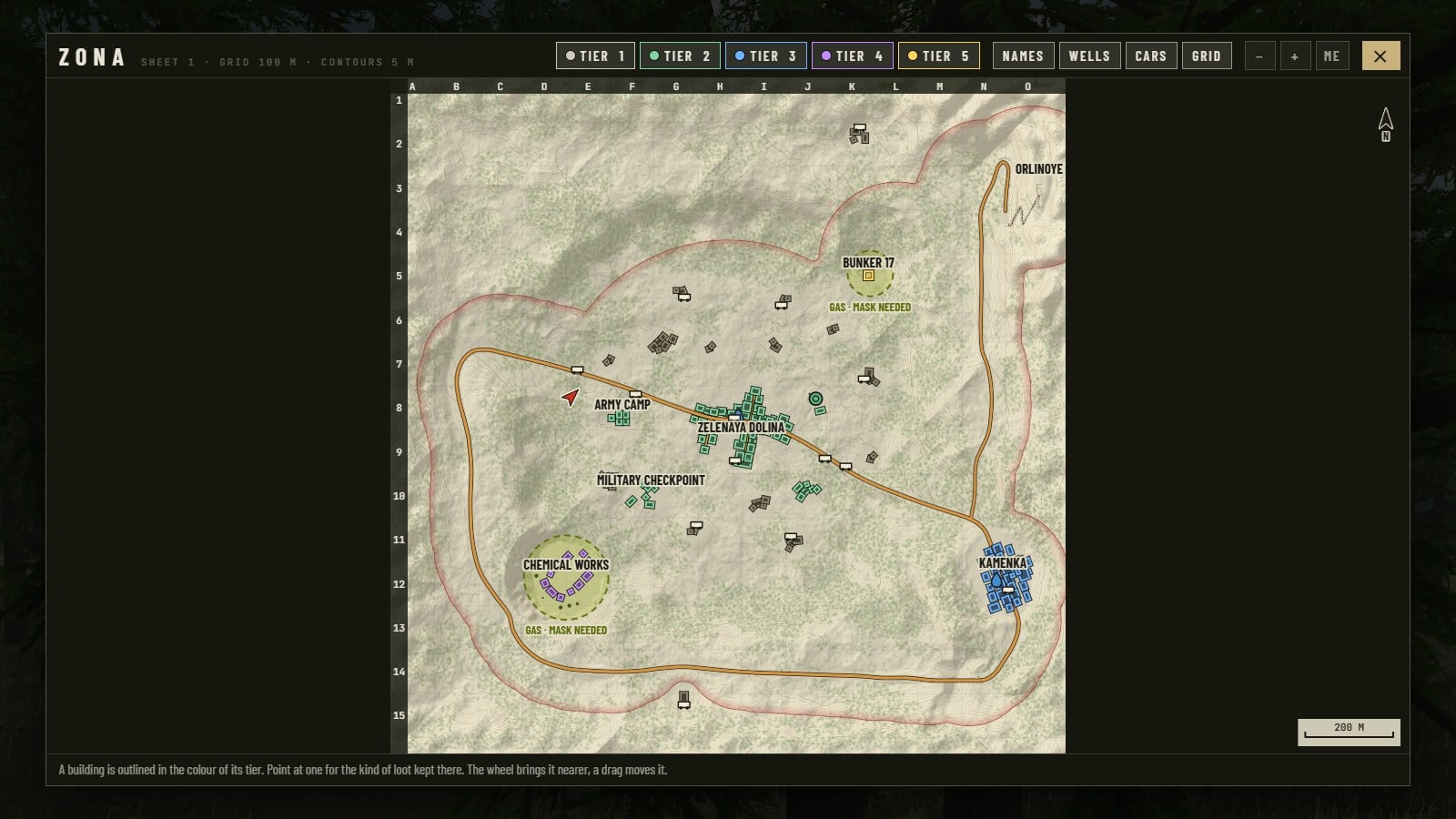
West to east: every place on the map in the colour of its tier, from 1 on the coast to 5 at Bunker 17 and Orlinoye.A fresh start on the west beach, facing inland.Drink from a river, a lake or the swamp, and fill a bottle there.Jeeps in the west: each green mark is one.Every vehicle nobody is in, on both maps.
Starts: on the west coast's beach, facing east.
The desert: Peski by the beach and Karavan on the main road each have a shop; Bereg and Mys are on the coast. All four are tier 1. Blokpost, the army's post on the track to Kalat, is tier 2. Each has its road, and Kalat has more roads round it.
Kamenka: its army and police buildings are tier 4; its houses, shops and hospital stay tier 3.
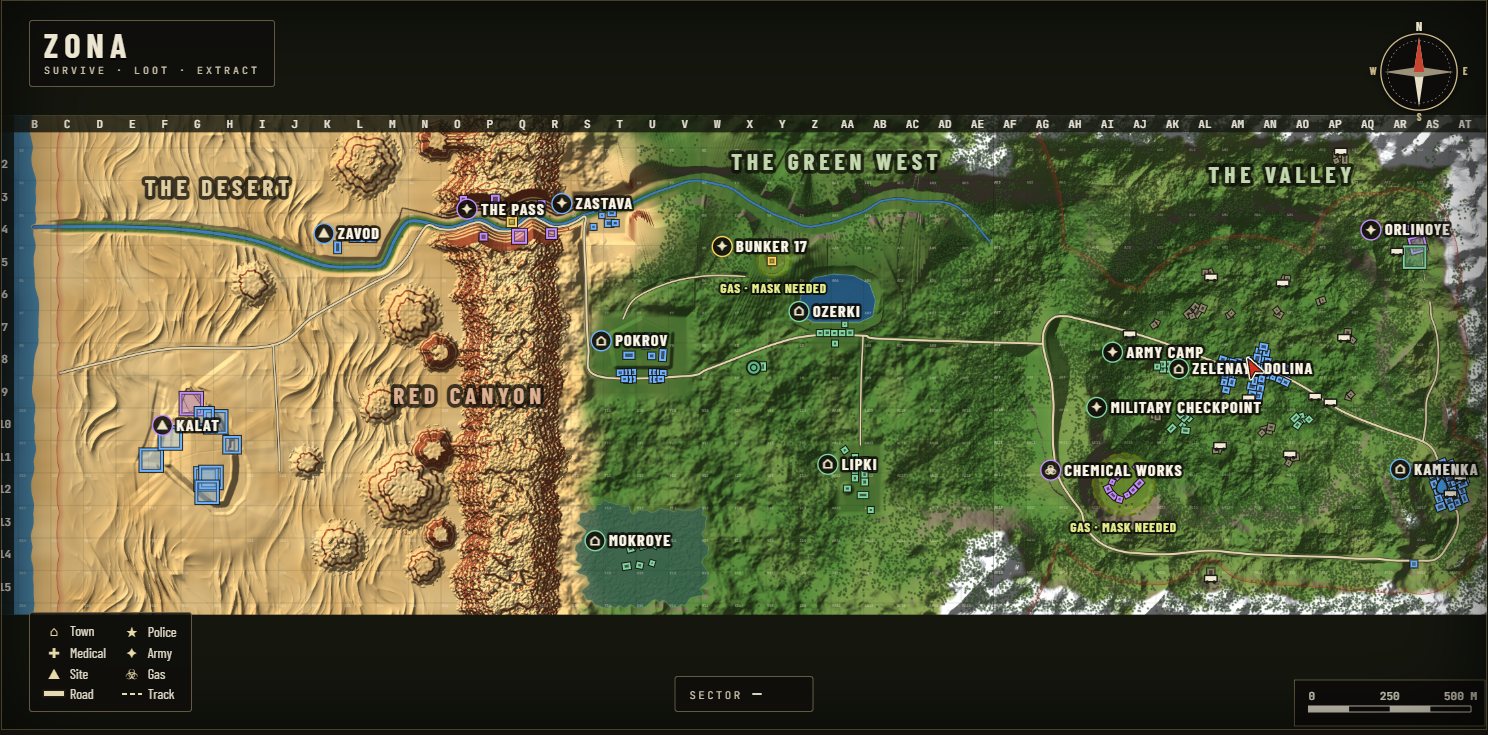
The map: West and East either side of the tier buttons, and every place marked in the colour of the tier its loot is on. The desert's places are named.
Water: drink from the rivers, the lakes and the swamp as at a well, and fill a bottle there; not from the sea. A water jug holds 6 drinks of 30 (it was 4 of 20), a flask 4 of 30 (3 of 18), a thermos 3 of 25 (2 of 20).
Payouts: past your first 10 paid tags, a tag whose wallet holds less than 100,000 $ZONA is no longer refused: it waits up to 12 hours, and is paid as soon as the wallet holds them. A tag refused for this in the 12 hours before the update waits too.
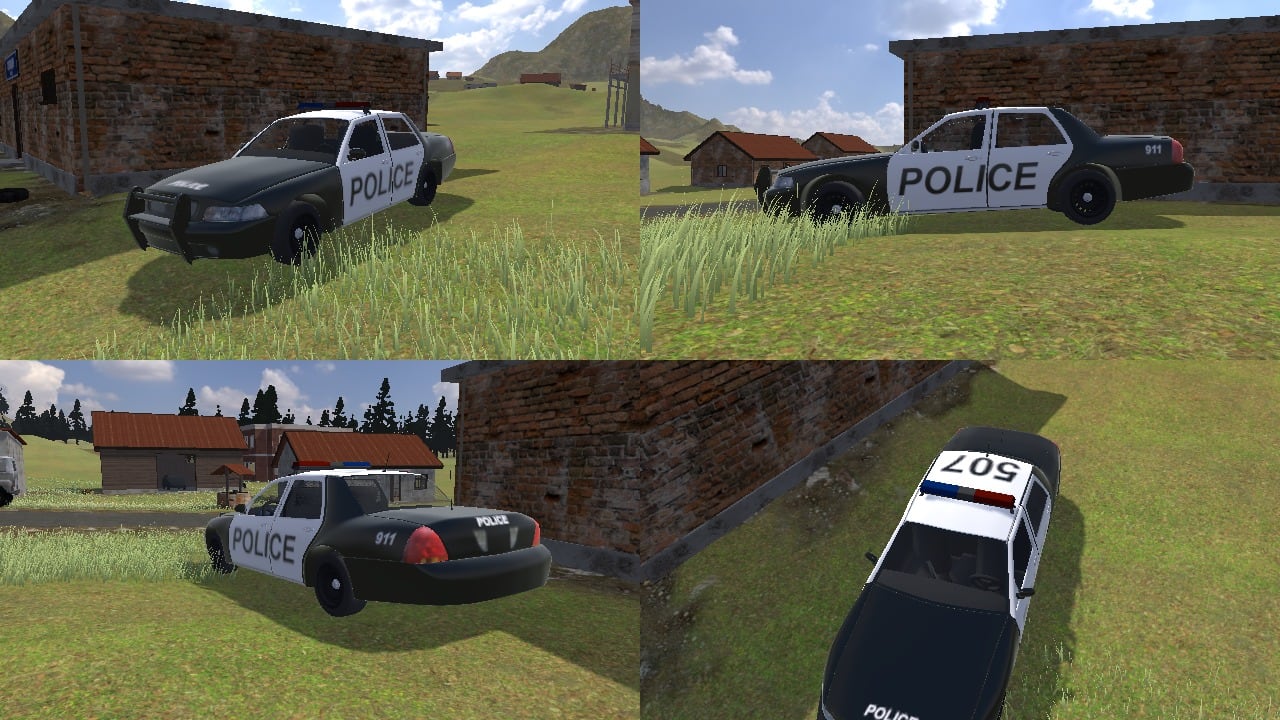
Jeeps: by the road at Pokrov, Zavod, Karavan, Blokpost, Kalat and Peski; at Bereg and Mys on the coast, a jeep or a police car. A car nobody has driven for two hours, with nobody in it or within 150 m, is taken away, and a new one comes to its place.
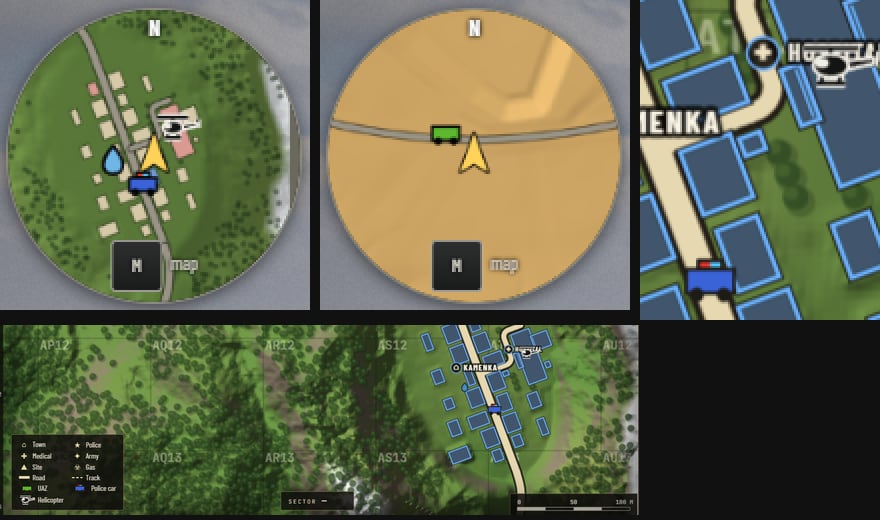
Vehicles on the map: every one nobody is in, on both maps: the UAZ green, the police car blue, the helicopter black with a white window. Admins see every vehicle.
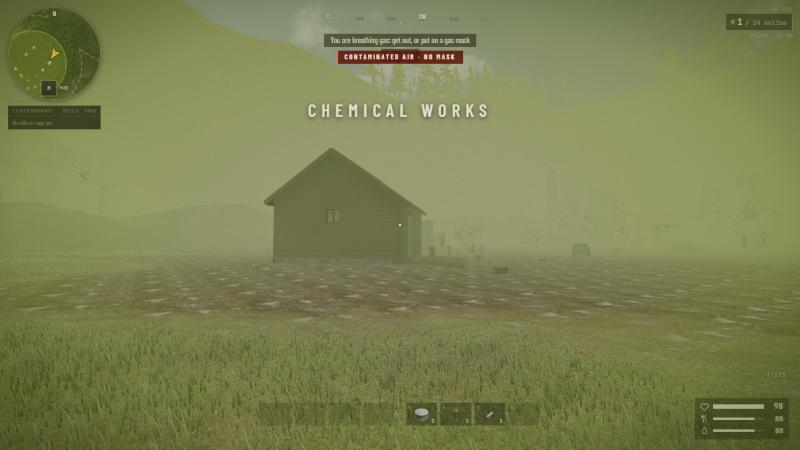
Keycards: only under the gas at the Chemical Works, three at once; one taken is back within five minutes.
Dog tags: a tag you carry is kept through a server restart, with the time you have held it.
Admins: an admin can act against only the admins they made.
After this update: whoever was in the desert starts again on the coast with what they carried, as the ground there was rebuilt; everybody else is where they were.
A harder bot check, new loot tiers, bigger stash crates
The bot check is harder for programs and no harder for people, and out in the world every shot that hits a player is checked too. A dog tag comes only from a kill. Stash crates are bigger, and you can cash a tag in anywhere above ground.
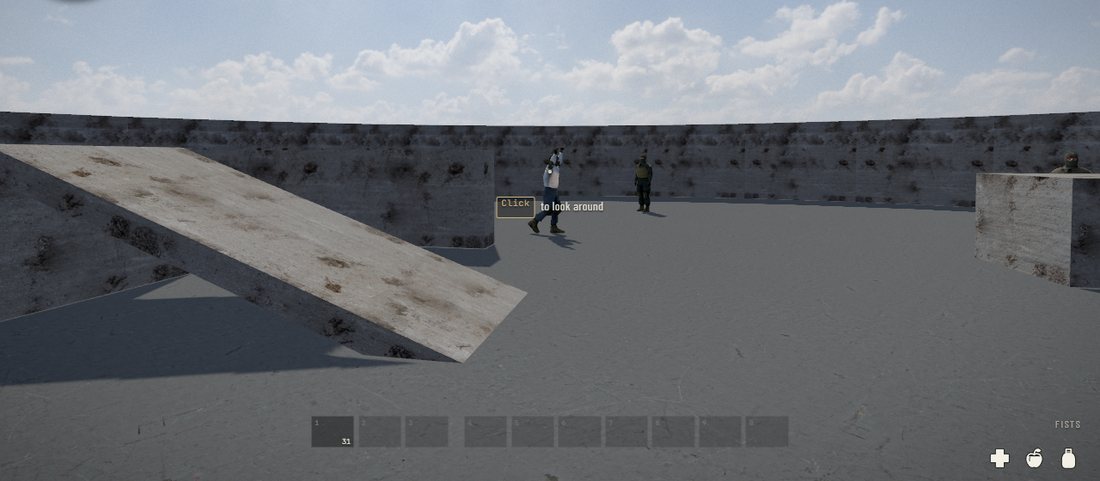
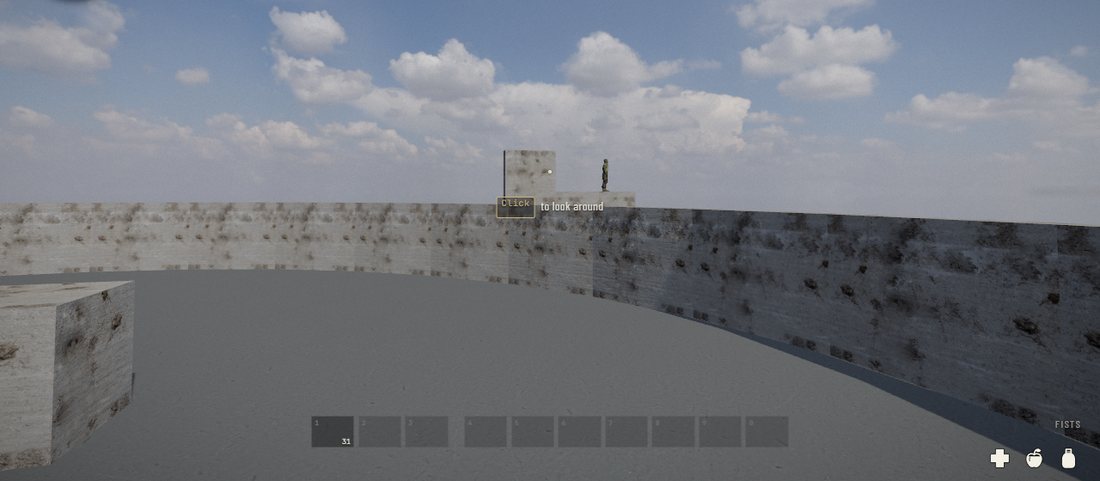
Hands up: somebody walks the yard with their hands raised. Do not shoot them.A wall that slides past the far figure on its plinth, beyond the ring.
Bot check: the yard comes as drawn or mirrored, with its cover moved; somebody with their hands up walks it; a wall slides in front of the far figure. A go that lands its shots more surely than a hand does, or says anything that could not be so, does not pass. A pass holds for one name on one device.
Dog tags: a body leaves its owner's tag only if another player killed them, or they bled out from a player's hits.
Watched: every gun's hit on a player is checked for aim no hand can make; admins are told, and three in ten minutes send the shooter back to the bot check.
Stash crates are ten by fifteen: five Barretts laid flat. A crate buried before comes up as big.
Cashing in: anywhere above ground. A tag carried down a basement is void after fifteen seconds.
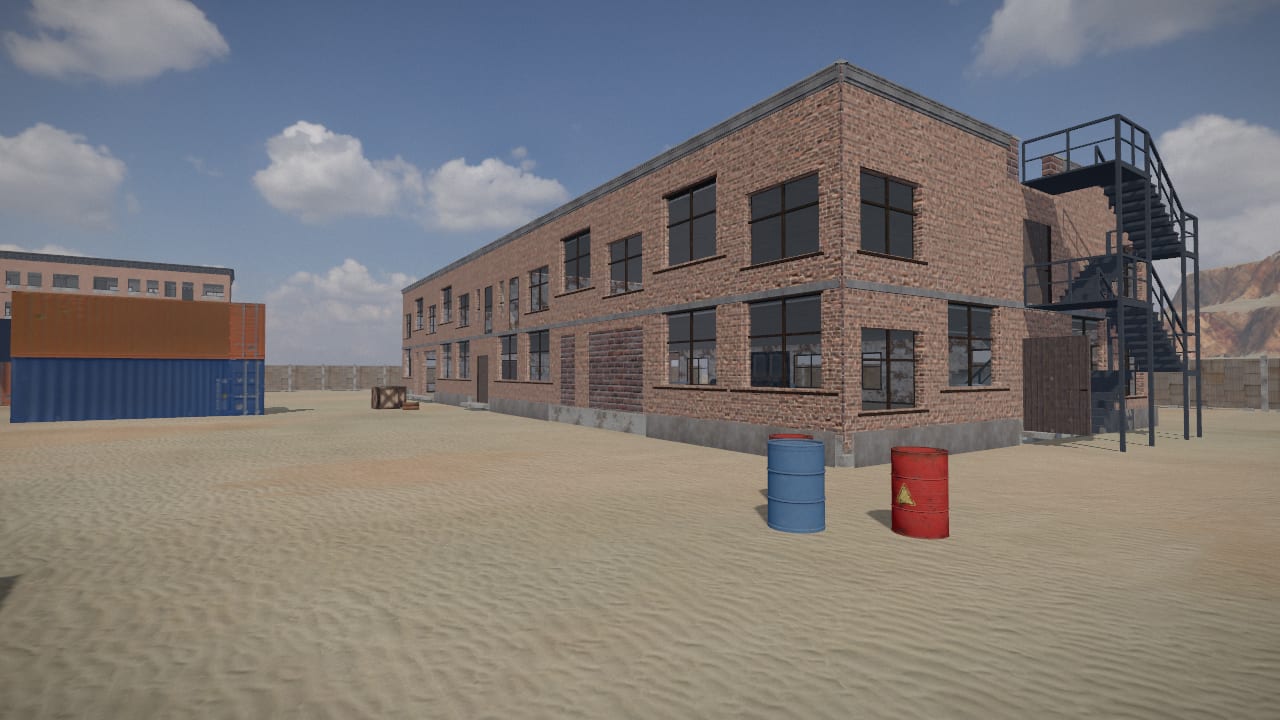
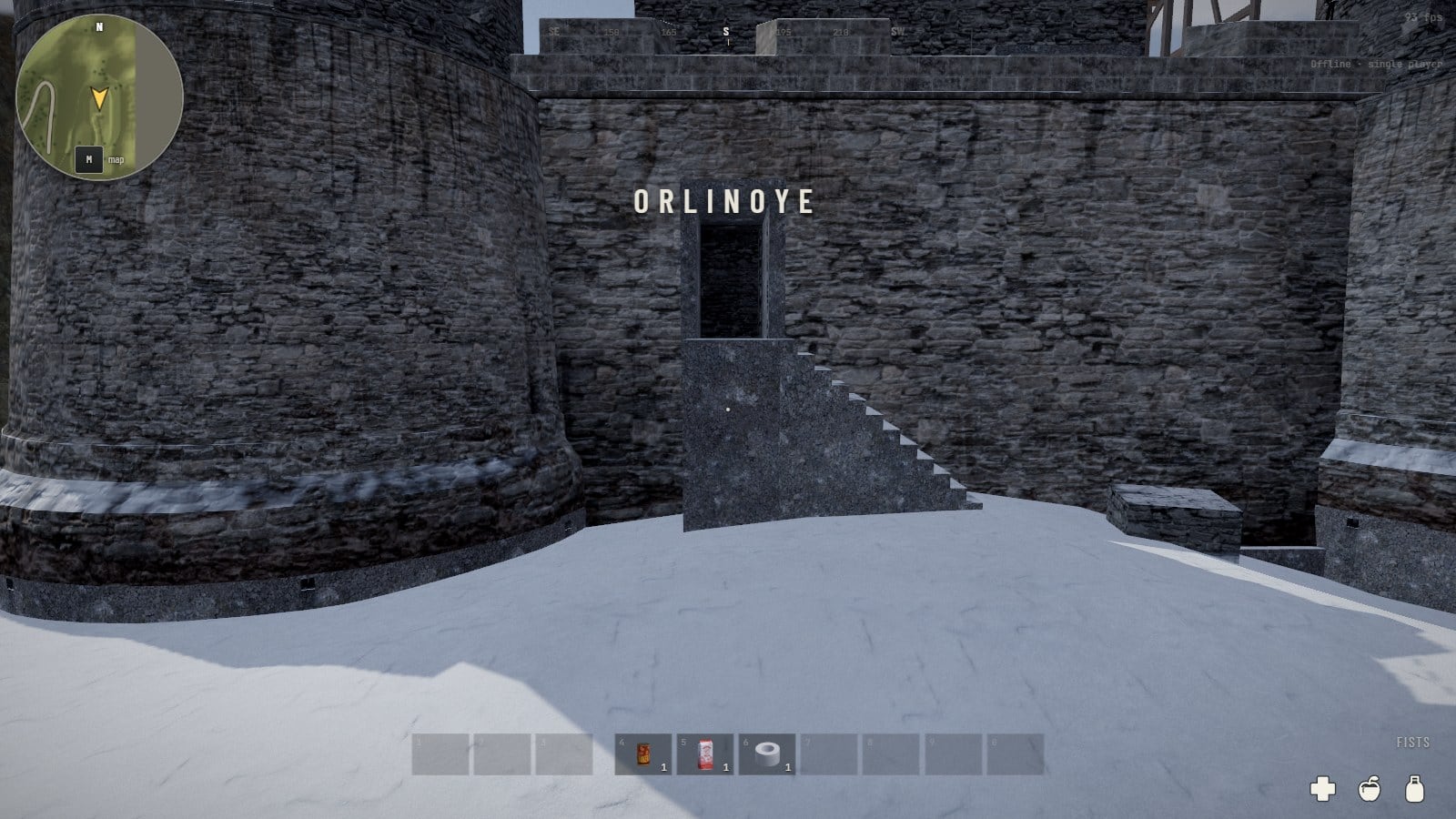
Loot, worse in the west and better to the east: Kalat, Zavod and Pokrov are tier 2; the Pass, Zastava, Ozerki, Lipki and Mokroye tier 3; Orlinoye's fort tier 5, half as thick as Bunker 17 and without what is the bunker's alone.
Names with five numbers or more in a row are not let in.
Ten tags free, then hold $ZONA
Still free to play and earn: your first ten paid tags need no coin. After those, a tag is paid only to a wallet holding 100,000 $ZONA, and your first ten tags pay enough SOL to buy that. A tag now needs its owner alive twenty minutes before it is worth anything, and is cashed in after thirty minutes carried. And the black rocks in the mountains have their pictures again.
The payouts page says the rule, and the wallet check there says how many free tags a wallet has left.Before: rocks, stumps and crates could be drawn black.Now: the same rock with its pictures.
Ten tags free: once a wallet, or the player cashing in, has had ten tags paid, a tag is paid only if that wallet holds 100,000 $ZONA (the lower of what it held when the tag was cashed in and when it is paid). Tags cashed in from 19 October, 01:15 UTC.
Dog tags: a player must be alive twenty minutes before their tag is worth taking (it was ten), and a tag is cashed in after thirty minutes carried (it was fifteen).
Quieter: nobody is told who joined or left, and the kill feed is for admins. You are still told of your own kills, and your death screen says how you died.
Brave: an ad blocker can no longer stop the game from starting.
A third more frames
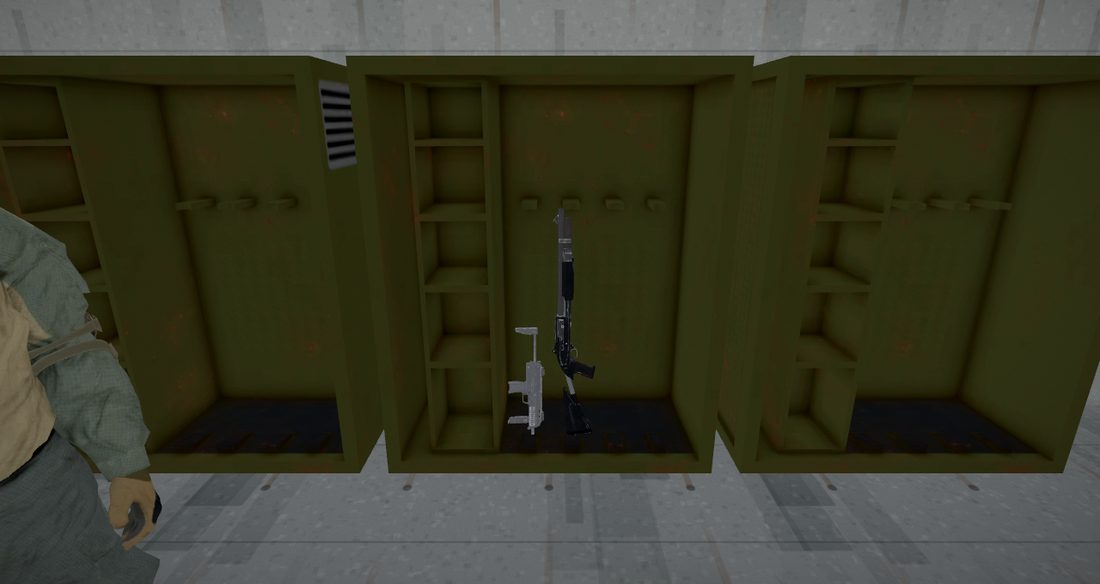
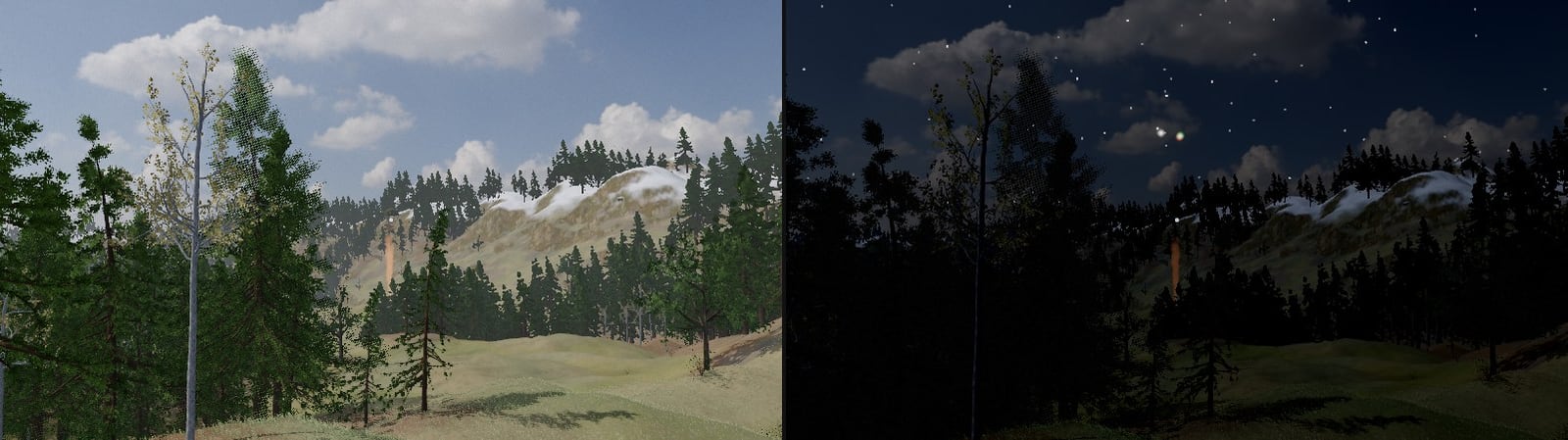
The game draws faster: on our test laptop (an RTX 3070 Ti) a recorded helicopter flight across the map went from 61 to 82 frames a second on average, and no frame of it took more than a tenth of a second. The draw distance now ends the world where you set it. And gun racks show the guns standing in them.
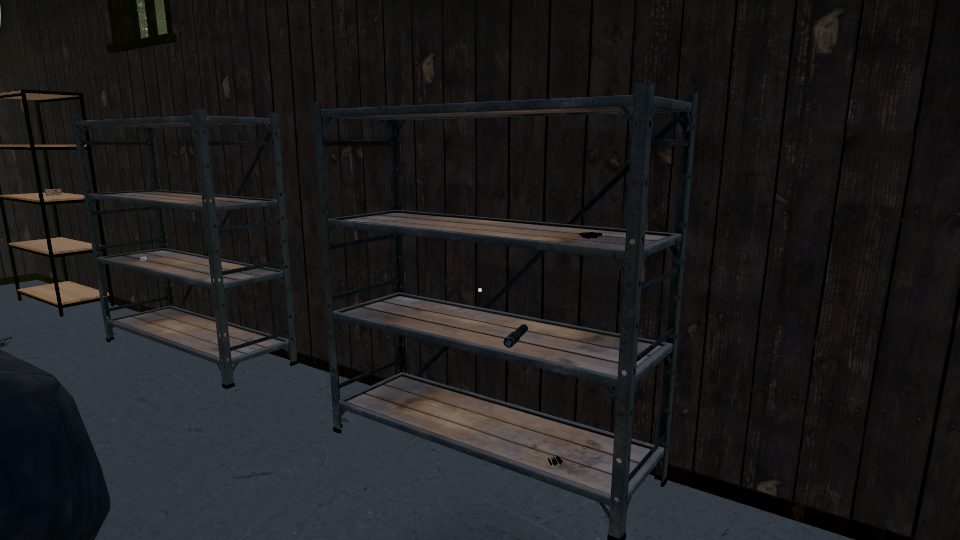
Draw distance 500 m: past it nothing is drawn, the last of it closing in haze.The far view: set the draw distance higher in Settings, Graphics.Gun racks: what is in one stands in it, for everybody to see.
Smoother: the HUD no longer has the page drawn again every frame (the compass, the hotbar with every shot, the beat of a wound), buildings and shadows take less work, flying up to the fort no longer freezes the game, and things come into sight without a stall.
Draw distance is where the world ends, as in Minecraft: past it nothing is drawn.
Gun racks down the bunker, in the barracks' arms rooms and in each field post.
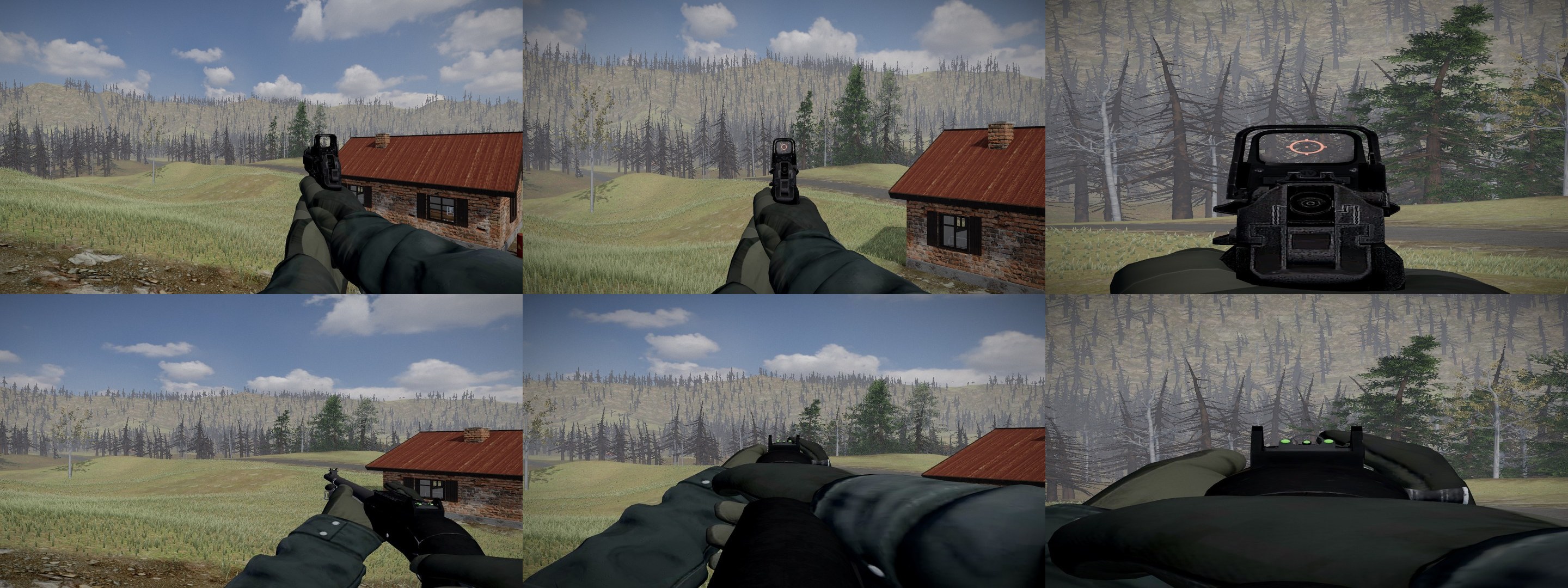
Guns: rounds go through bodies by their calibre, the L96 AWP .50 and the Barrett .50 kill with any hit, the MP7A1 takes the holographic sight, and the double barrel is back without its foregrip.
Controller: the bumpers change what is in your hands.
Every gun its own sound
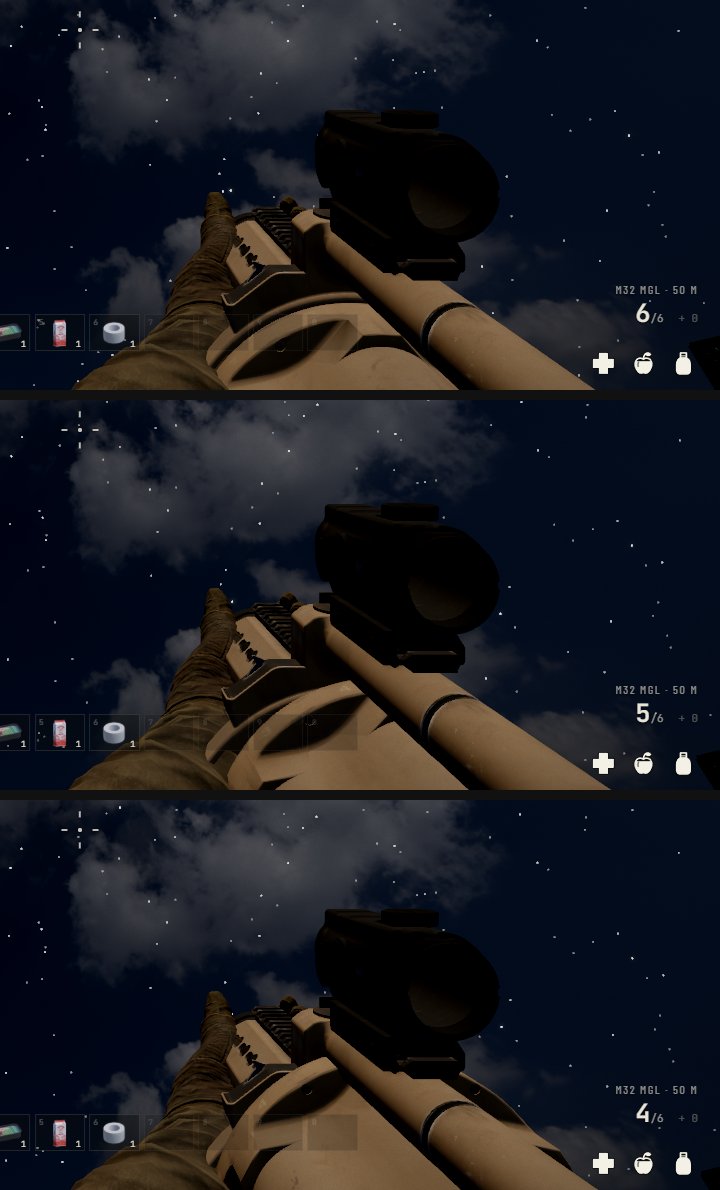
The newer guns no longer borrow the pistol's, the AK's or the sniper's shot: each has a recording of its own. And the M32's cylinder turns as it fires.
The M32: its cylinder turns a chamber with each shot.
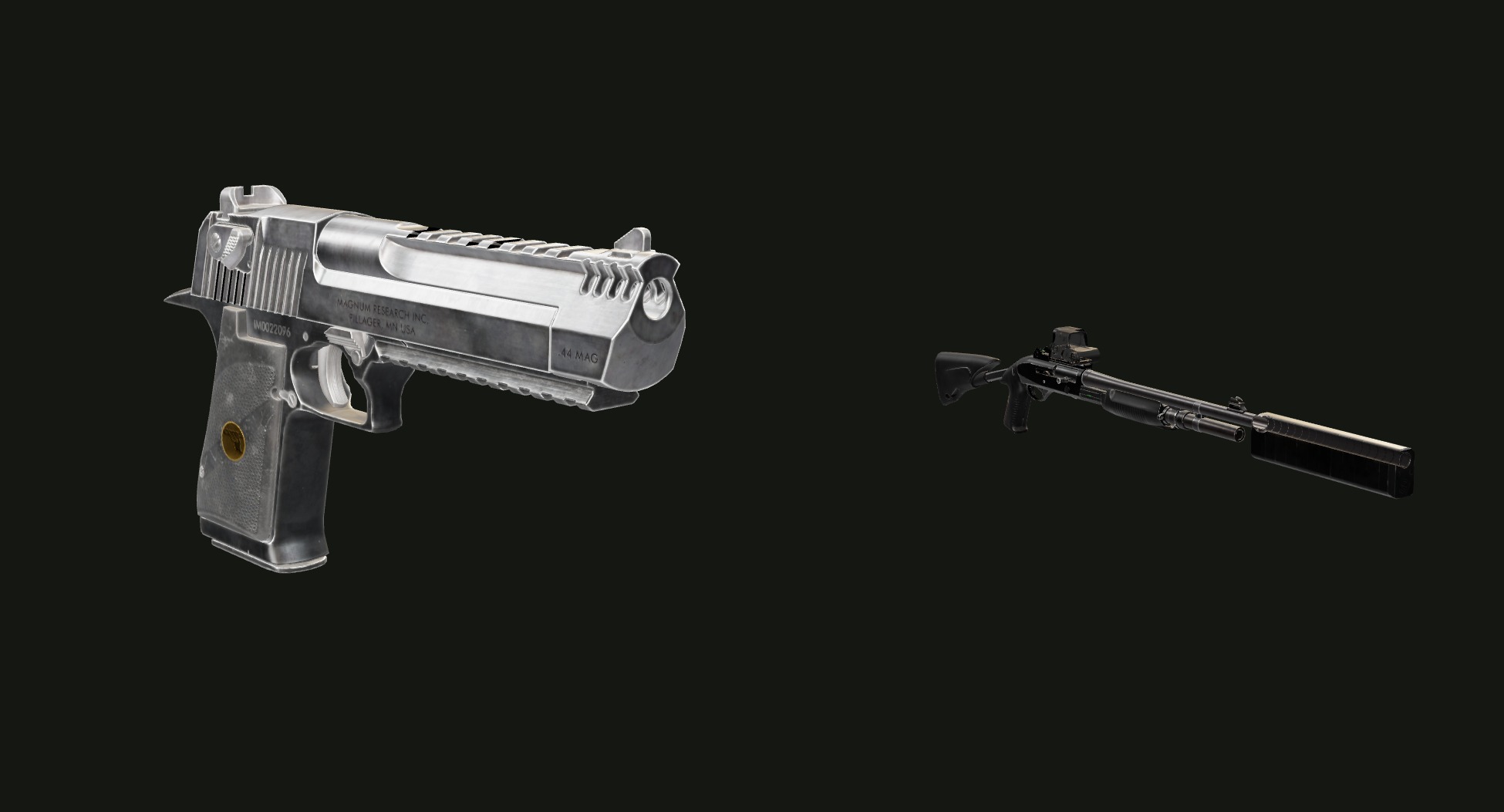
Own shots for the Scorpion, MP7, Dual SMGs, MAC-10s, AKS-74U, .50 sniper, Barrett, VSSK (quieted), DB-12, sawn-offs and M32; a new Desert Eagle shot.
Handling: the submachine guns reload with an SMG's magazine and bolt, the Benelli is pumped after each shot, and spent cases are heard landing.
Around you: a round's crack as it goes by, drinking, a wooden door opened and shut, and the bunker door's and lockers' hinges.
Smoother, and looting is heard
Two freezes are gone, and going through a crate or a body now makes a noise the players near you can hear.
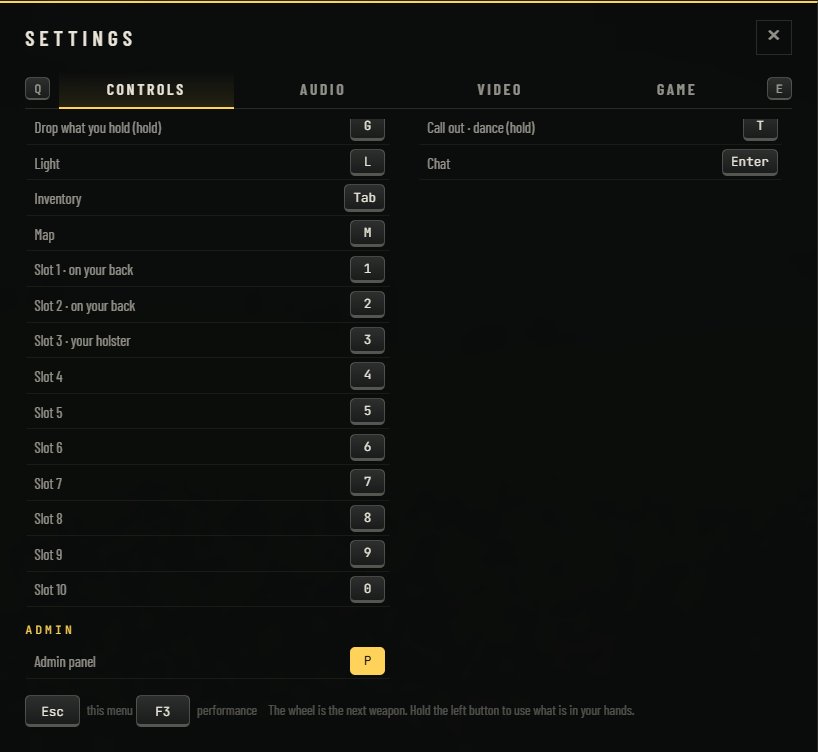
Admins and mods: the panel's key can be moved in Settings, Controls.
No freeze when the lamps come on: at night the lights waited too little for the game to get ready for them, and the screen could stop for several seconds. They now come on when it is ready.
The inventory opens at once the first time (it paused for over half a second): its pictures and backdrop are got ready while you are at the menu.
Looting is heard: opening a crate, a cupboard, a body or a pack to search it is heard by anyone within 18 m, a latch or a rustle and hands going through it.
Admin panel key: admins and mods find it under Admin in Settings, Controls, and can put it on any key.
More loot, and more places for it
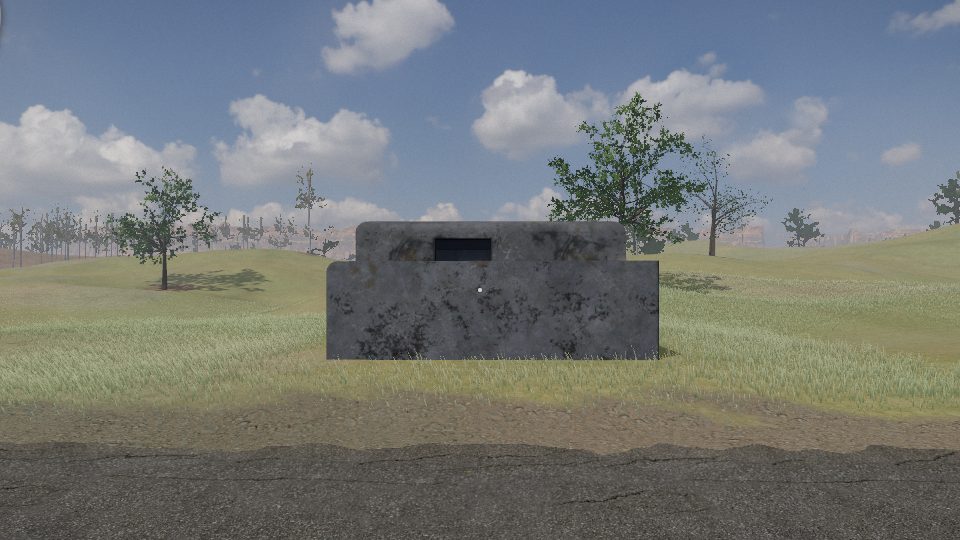
Loot now works the way DayZ's does: every spot rolls what lies there from what its tier and its kind of building keep, leaning to whatever the map is shortest of. And there are new places to find it: field posts in the west, a stash in every canyon cave, racks under the gas and shelves down the bunker.
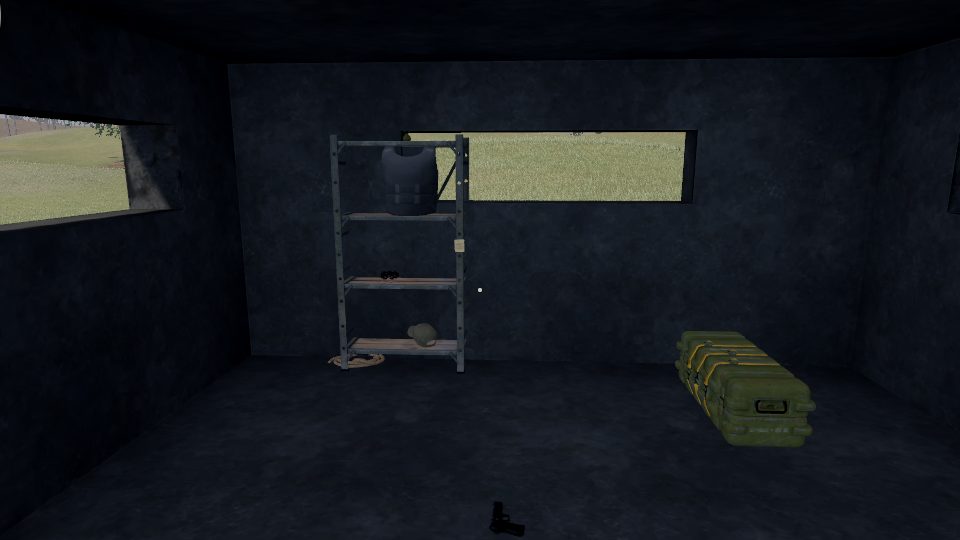
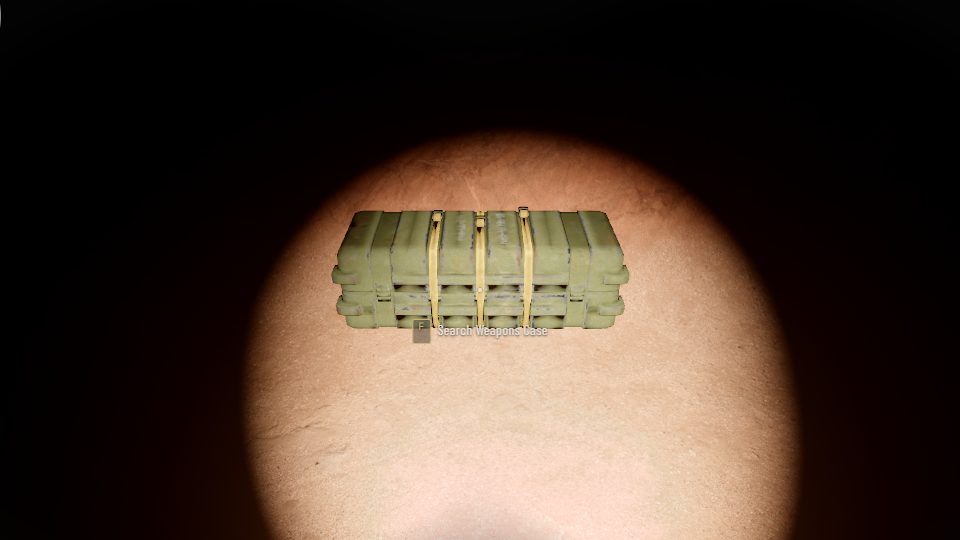
Field posts: four WW2 pillboxes by the roads in the west, tier 3.Inside a post: a rack, an army case to search, and a gun at the slit.A stash in each cave: six cases, with the canyon's tier 4 loot.Under the gas: new racks in the barn, both garages and the barracks' arms room.
The gas works hold all their loot now: 171 places where there were 127, so nothing it keeps is crowded out. Down the bunker, seven more shelves and eleven more places on the floor (177 where there were 145): every shotgun, rucksack and suppressor it keeps now spawns.
Crates and lockers fill from the same rules: army cases still hold pistols, rounds, food and dressings, and a .50 or the VSSK never turns up in one.
Found with something: about one pack or case in three has supplies inside, and the MPA30, the MP7, the MAC-10s and the DB-12 now and then come with a sight, a suppressor or a grip fitted.
Bodies lie an hour, as in DayZ, and are kept through a restart with what is on them.
Dog tags go only in the tag pouch, round the neck or on a body. Your own is put on after ten minutes alive, and one dropped on the ground is gone in ten minutes. A taken tag's fifteen minutes only count while you are in the game.
Sound: the VSSK sounds like the suppressed rifle it is, and every helicopter's rotor is half as loud.
On this restart everybody is set down afresh at a start, with what they had.
Search the furniture
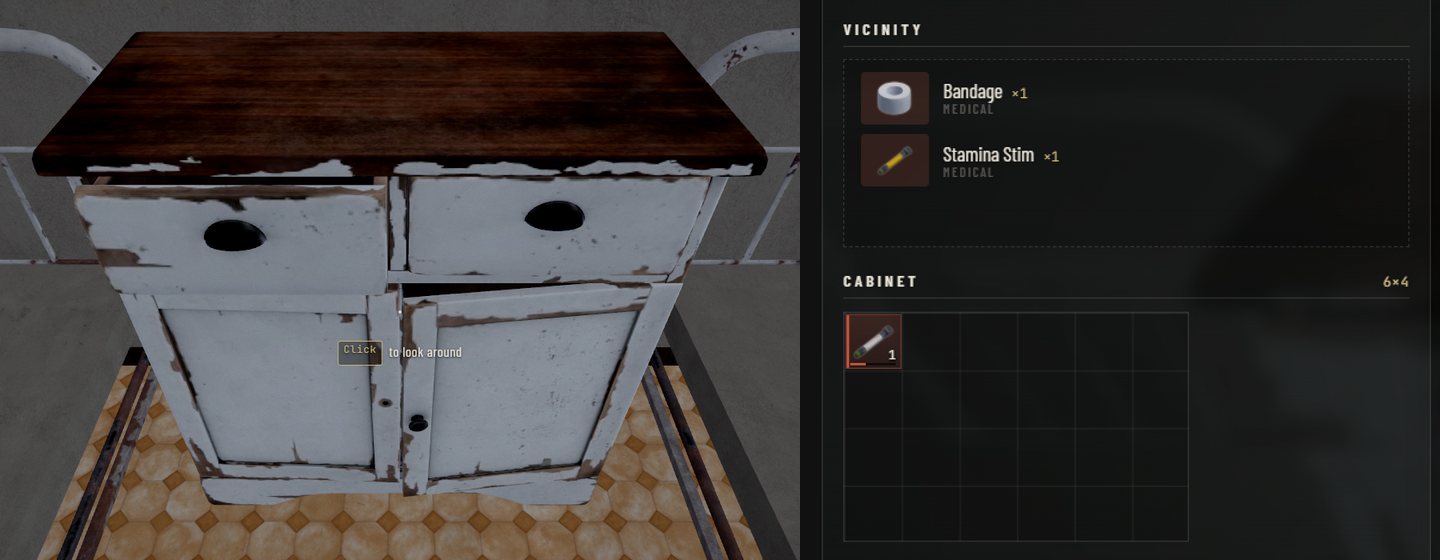
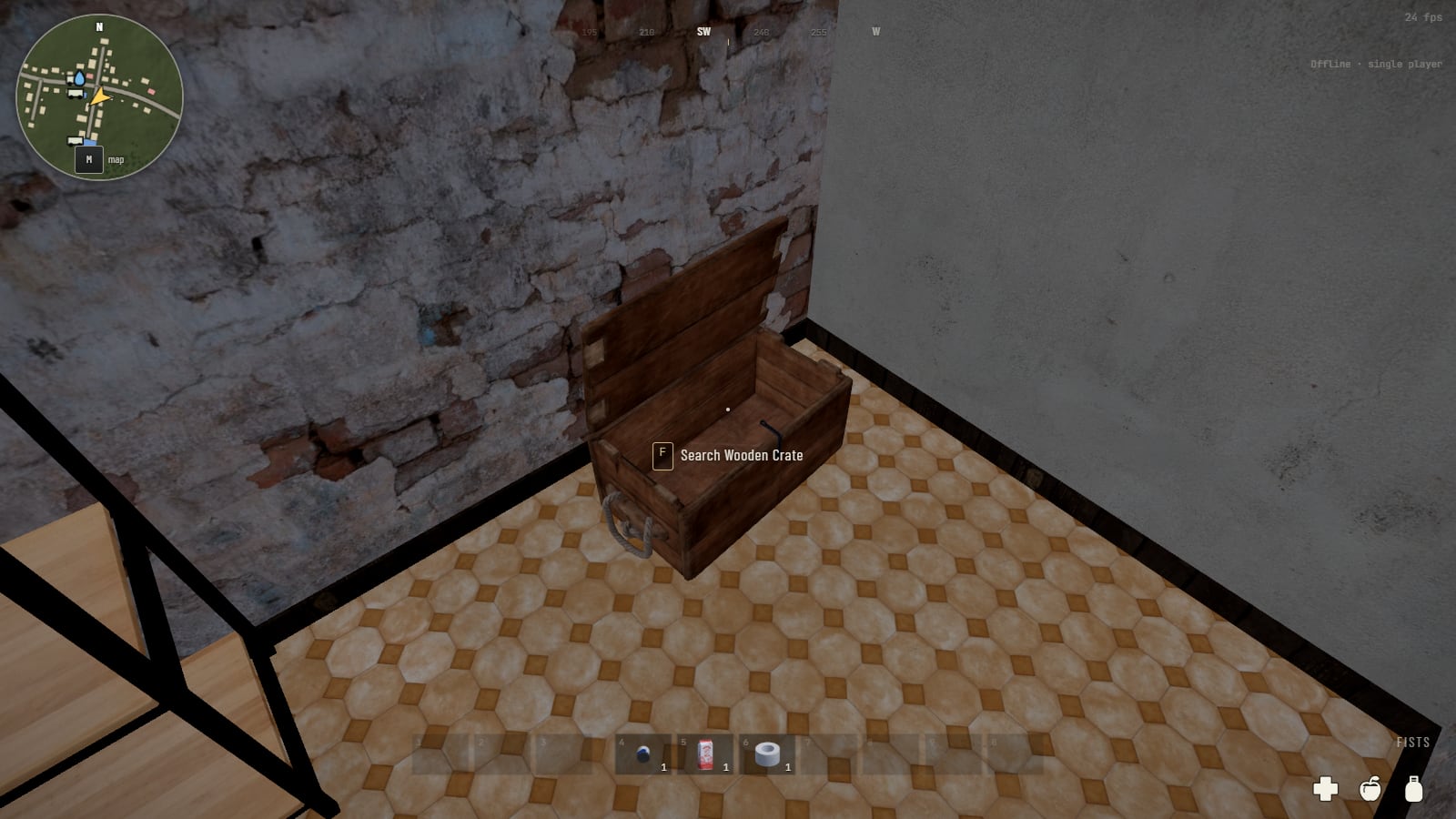
Cabinets, desks, counters, stoves, trolleys and barrels now have their own storage, searched like the bunker's cabinets. The loot that used to lie on top of them is inside them. Cardboard boxes and large crates can be searched too, and you can leave your own things in any of them.
A cabinet, searched: look at it and press F, and its grid opens beside your pockets.
What opens: 681 pieces of furniture across the map (cabinets, office and hospital desks, lab counters, stoves, surgical trolleys, barrels), plus 202 cardboard boxes and 19 large crates.
Same loot, new place: what you find follows the same rules as before (tier, kind of building, how often it comes back); it is inside the furniture instead of on top. A piece with three or more loot spots still shows one on top.
Shelves, racks, beds and tables are unchanged: their loot is still where you can see it.
Smoother towns: loot inside furniture is not drawn until you open it, so fewer things are drawn in every house.
The sniper rifle (the Mosin) no longer kills with one shot to the body. One to a bare head still does, but not one under a combat helmet. The .50 rifles are now the ones that kill with one body shot.
Ten new guns, their own sights, and a richer village
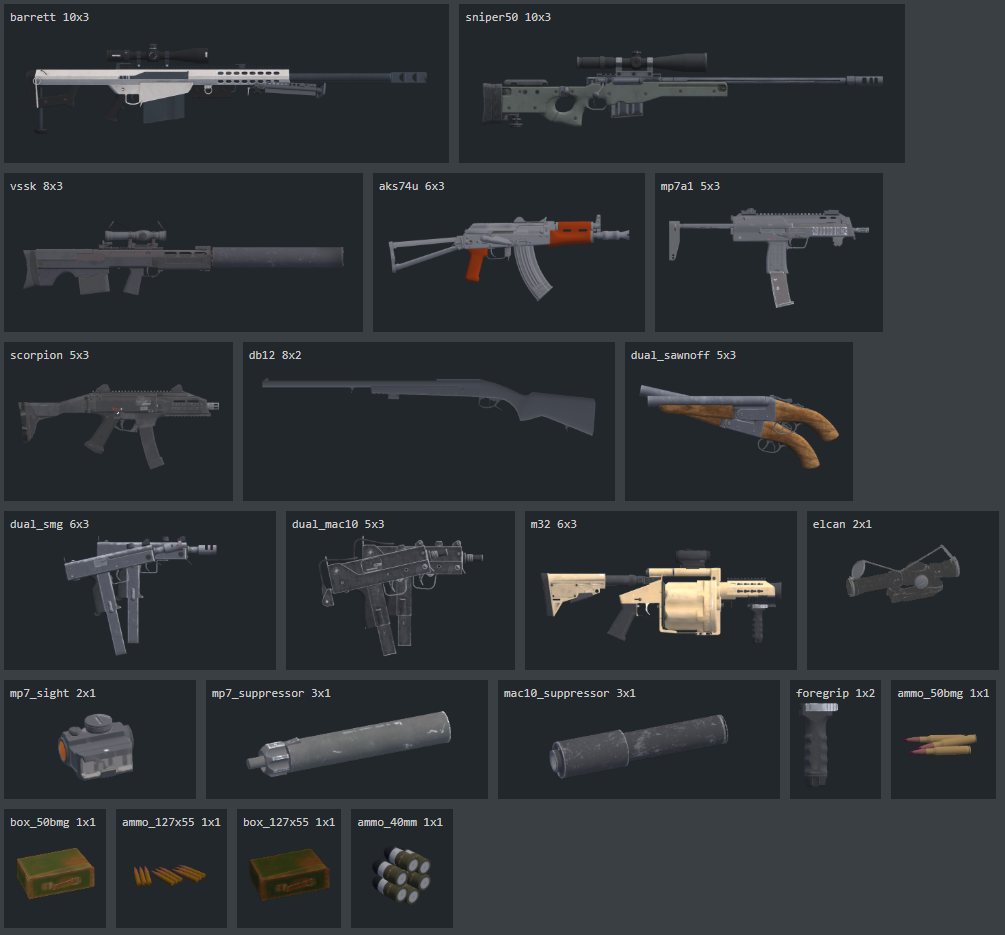
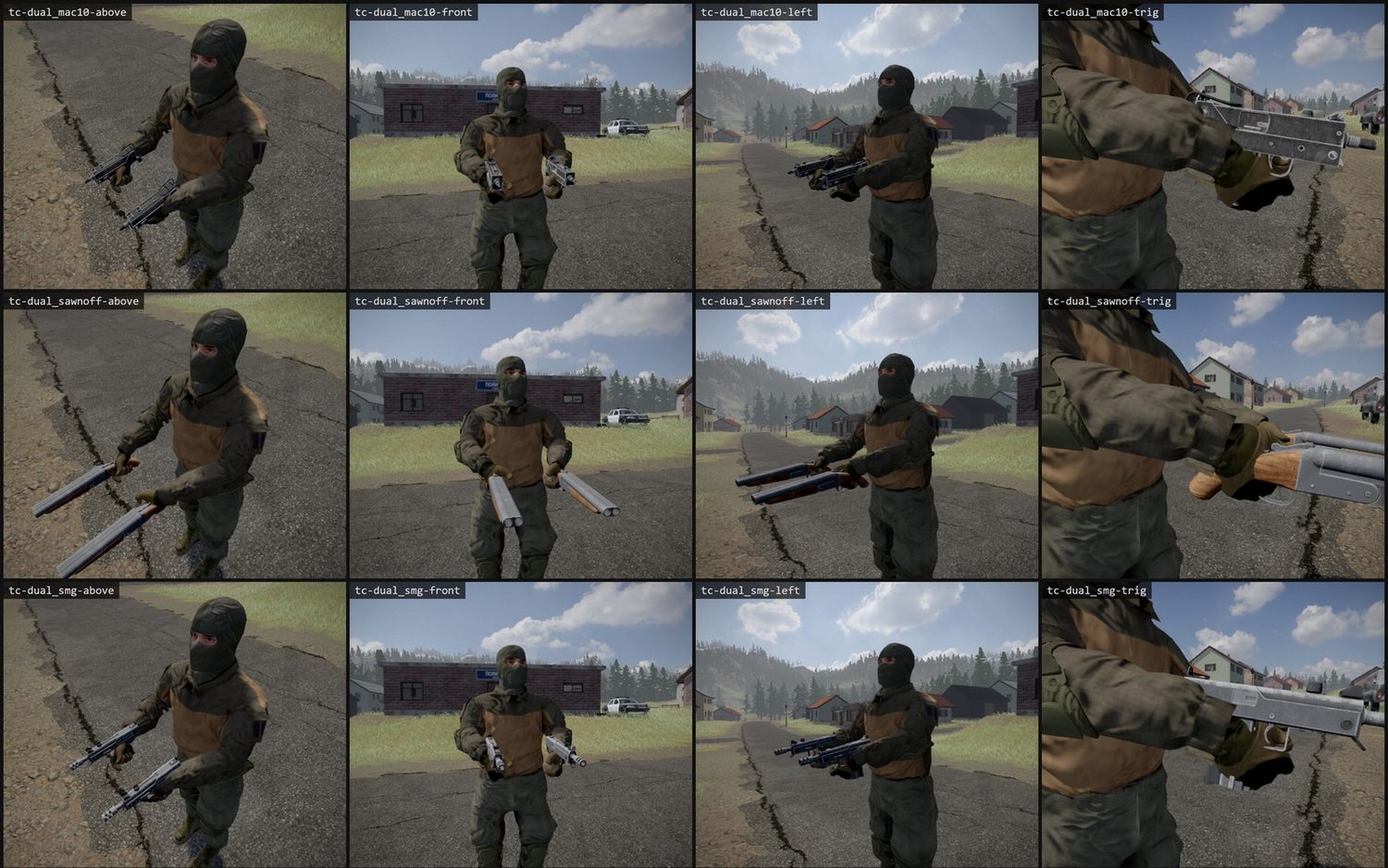
Ten new guns are in the Zone: two .50 rifles, a silenced 12.7 mm sniper rifle, the short AK, the MP7 and the Scorpion, a double-barrel shotgun, and three pairs held one in each hand. The M32 grenade launcher is for admins. Every gun aims through its own sights now, scopes zoom on the mouse wheel, and the village is tier 3 loot.
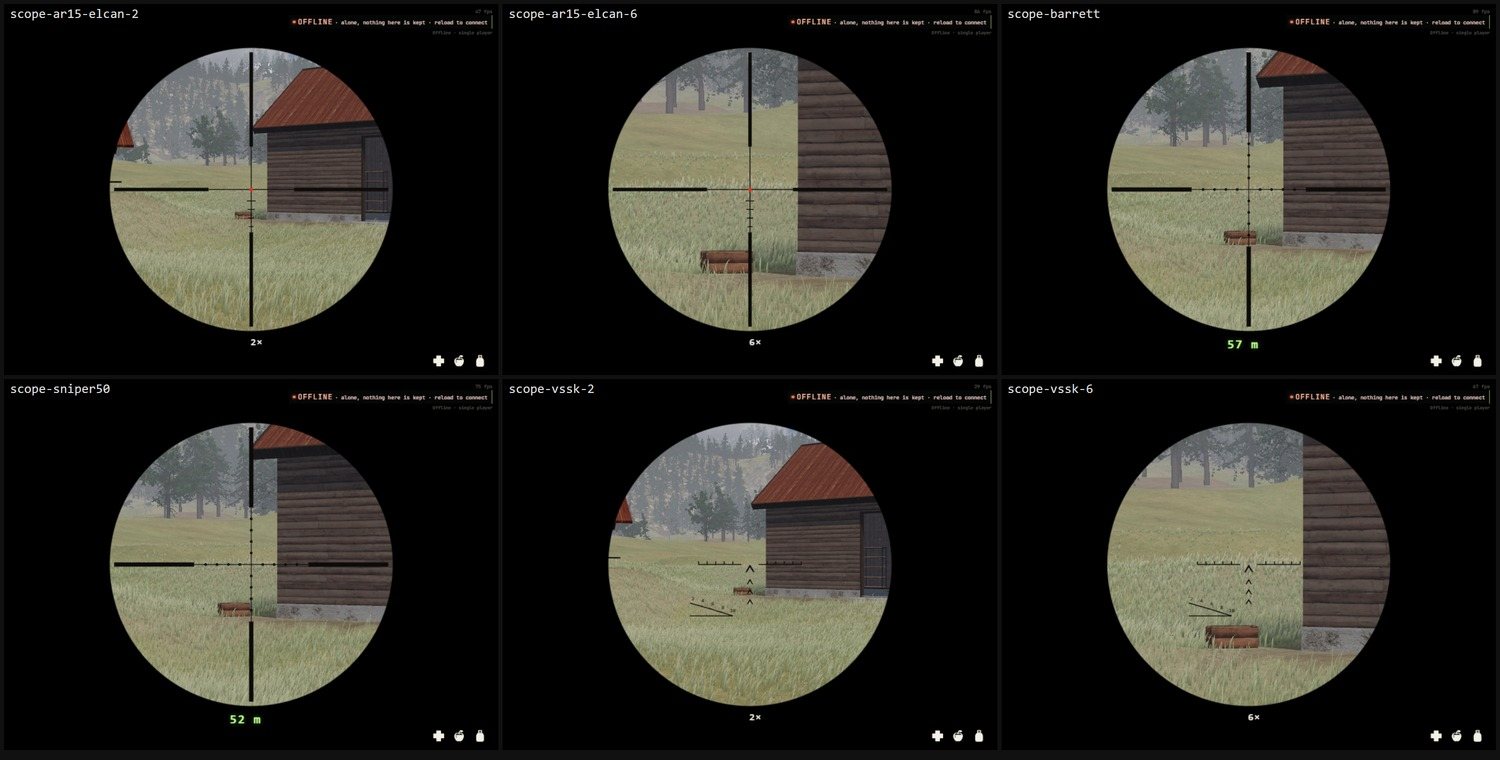
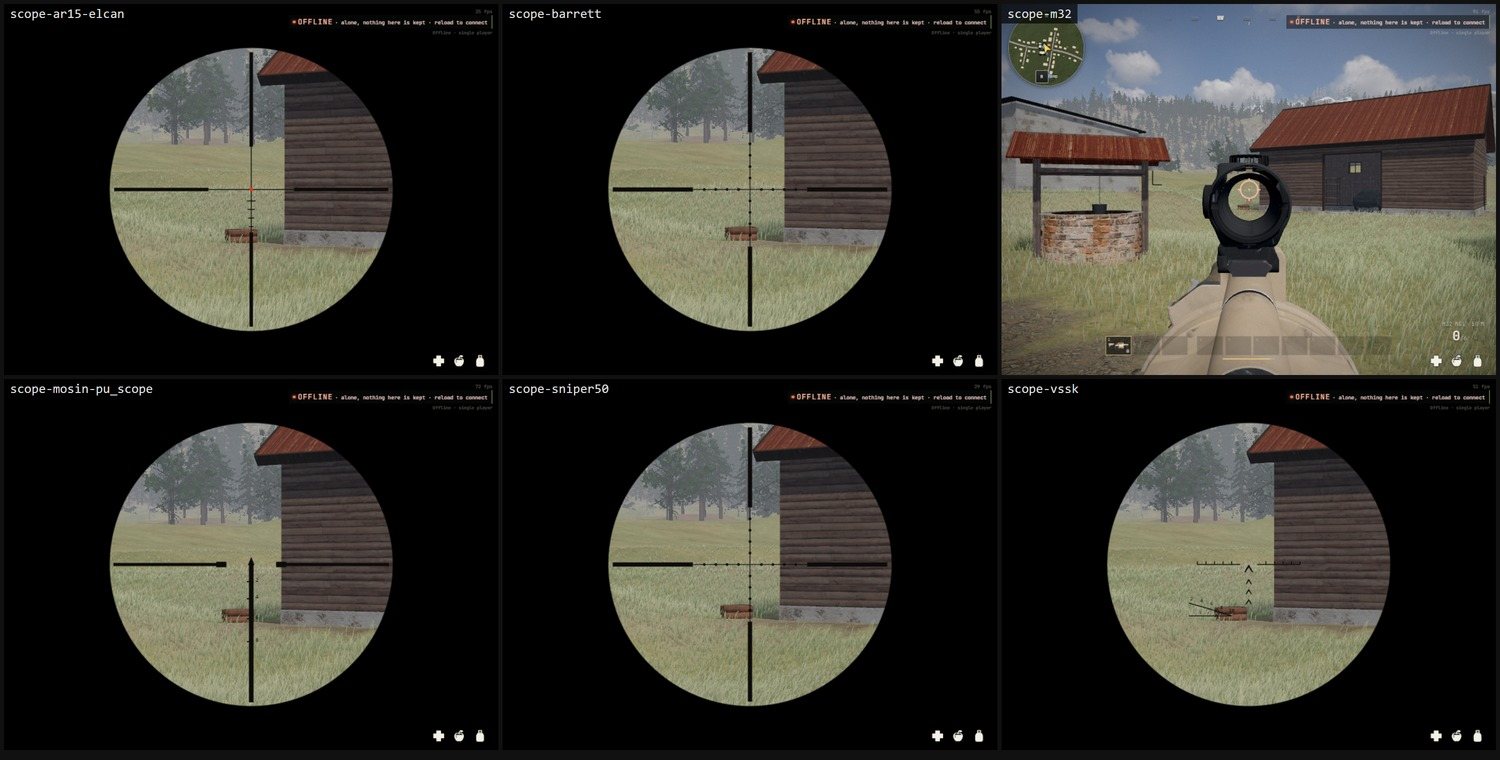
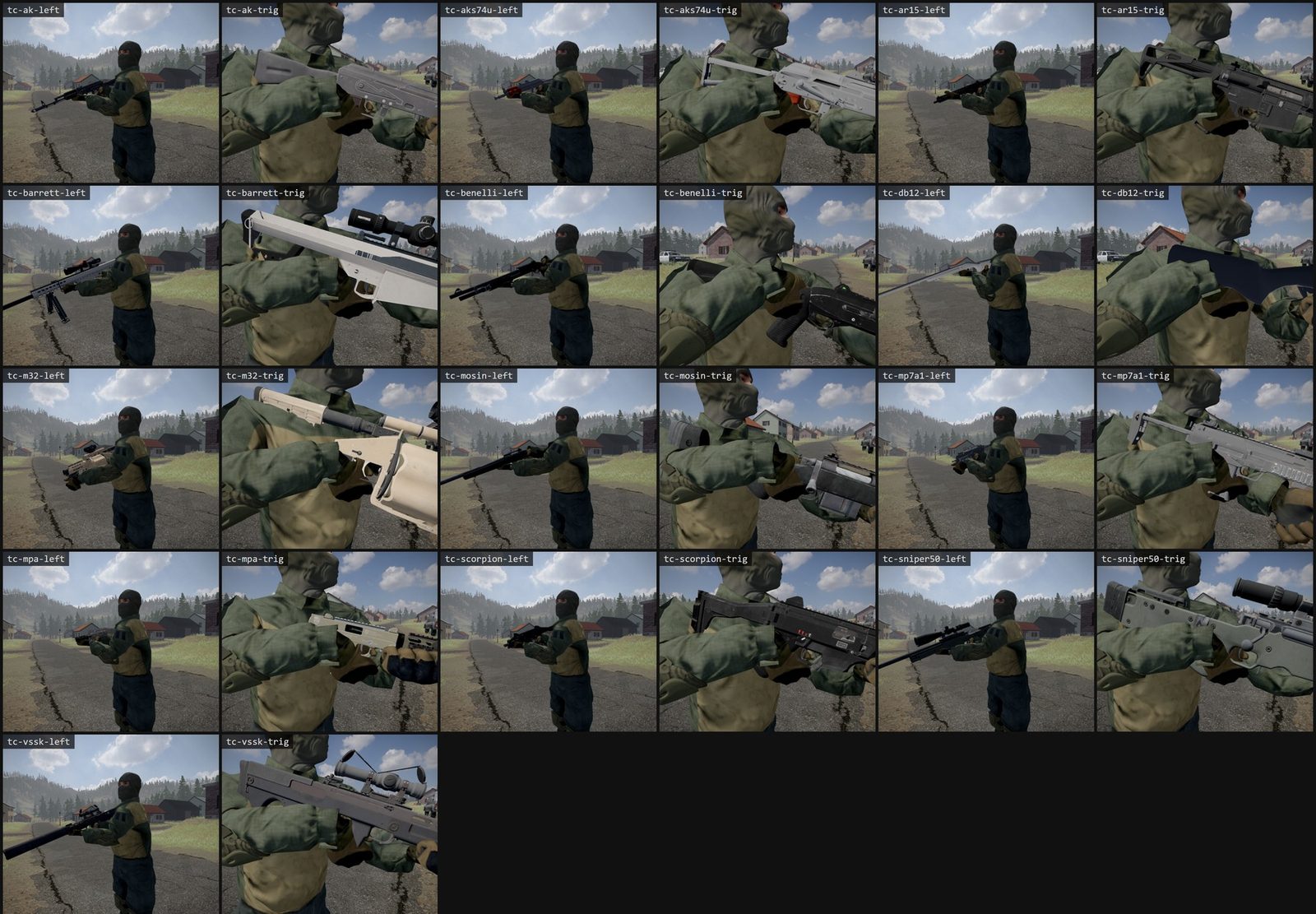
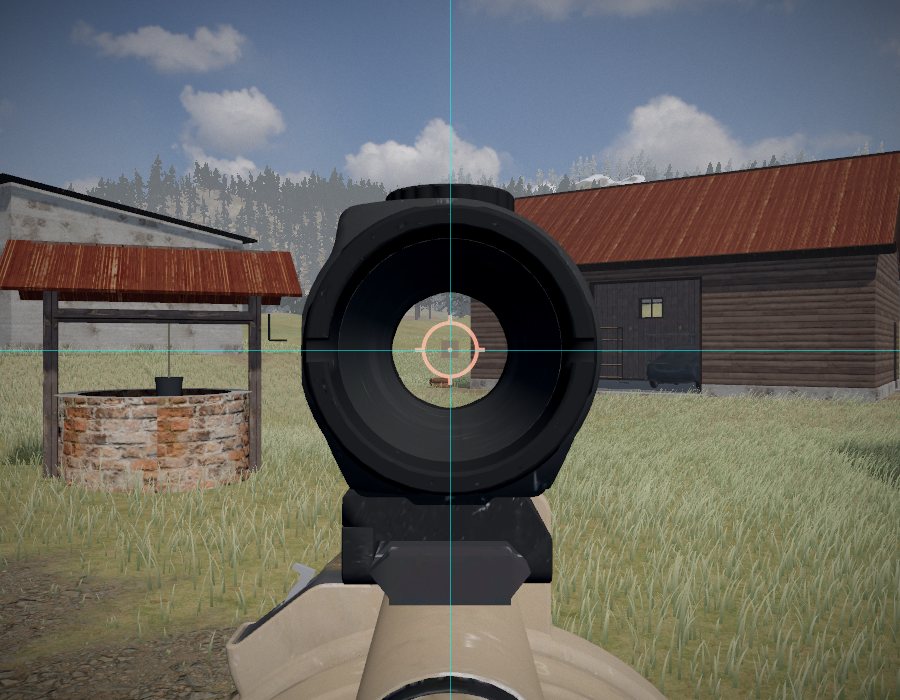
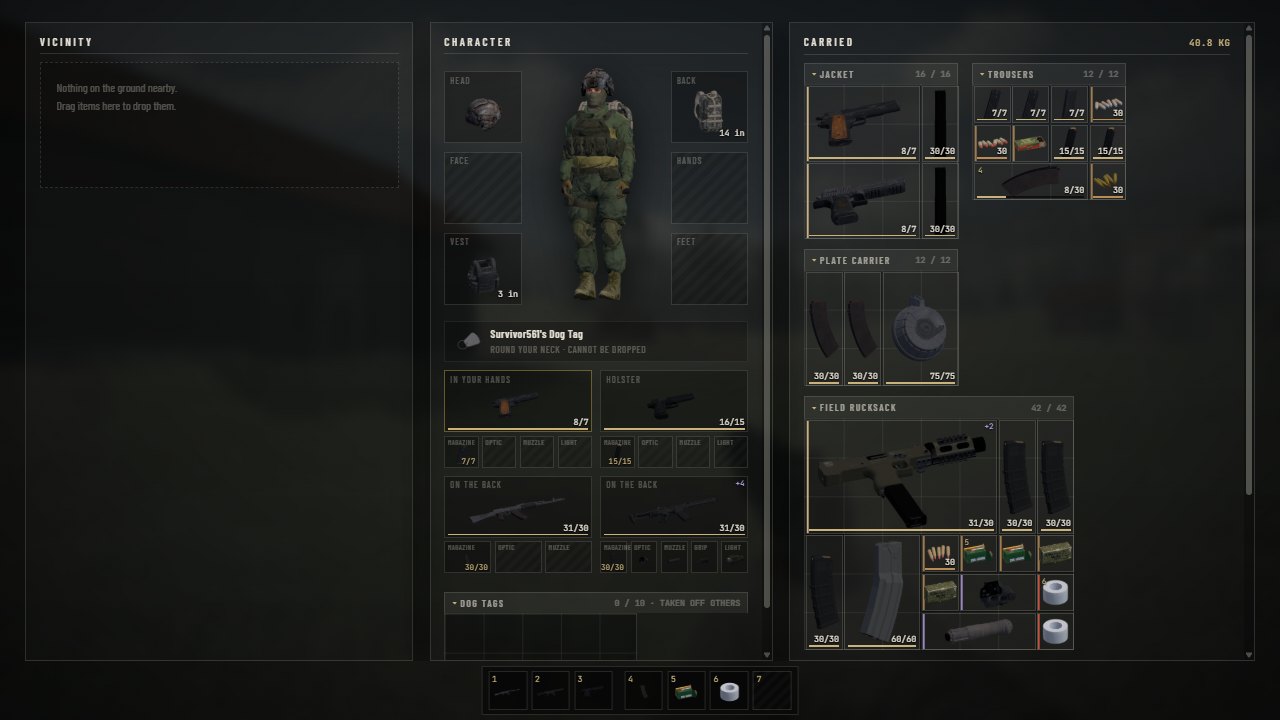
What is new in your pockets, as the inventory draws it: the guns, their parts and their rounds.Scopes that zoom: the VSSK's and the Elcan from 2x to 6x, the .50s' from 4x to 12x, on the mouse wheel. The .50s read the range to whatever is under the cross.Each scope its own mark: mil-dots for the .50s, the PSO's chevrons for the VSSK, the Elcan's lit cross. The M32 is aimed through its own sight.Hands on the guns as other players see them: the forward hand on the fore-end or its grip, the gun hand at the trigger.Pairs, one gun in each fist. Left click fires the left, right click the right, and both can be held at once.The map (M), redrawn: the land in relief and in colour, every wood as forest, named regions, an icon by each place, a compass, a legend, and the square under your pointer. It opens on the whole Zone.The M32 aimed through its own holographic sight. Admins only.
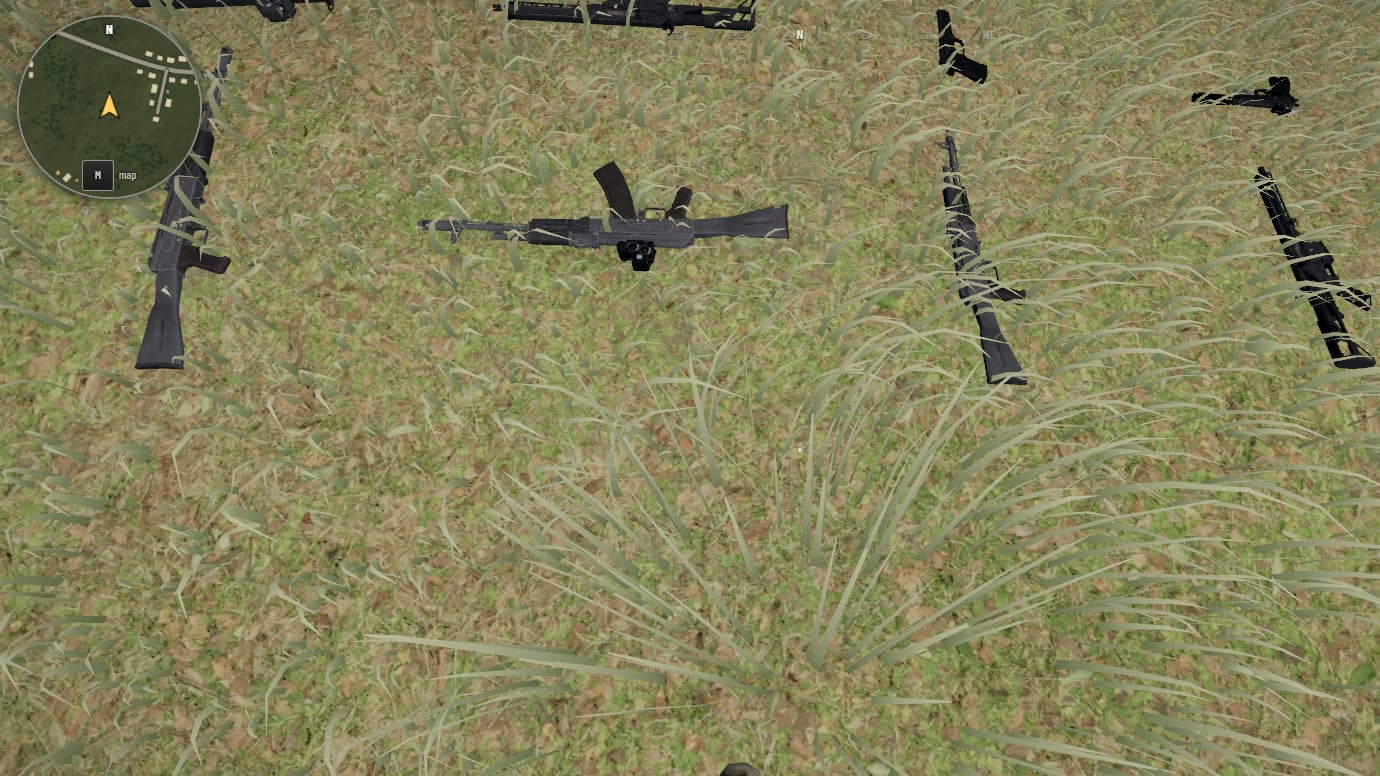
Where they are: the double-barrel and the Sawn-Offs in the village and Kamenka, in homes and hunters' places. The Scorpion, the Dual SMGs and the Dual MAC-10s in Kamenka and the village (tier 3) and under the gas. The MP7 and the AKS-74U under the gas (tier 4). The VSSK, the .50 sniper rifle and the Barrett in Bunker 17 (tier 5). The fort's racks can hold the VSSK, the .50s, the AKS-74U and the MP7.
Their parts: the MP7's own sight and suppressor, the MAC-10s' suppressor, and the Elcan for the AR-15. The foregrip is now the M32's vertical grip, and it fits the AR-15, the MPA30 and the double-barrel.
Their rounds: .50 BMG and 12.7x55 lie in tens under the gas and in the bunker, and in cans of 25 in the bunker.
The Barrett's bipod: B lets it down or folds it away.
The village is tier 3 now, as Kamenka is: submachine guns, armoured vests, sights, and gas masks at its police station. Tier 2 is the checkpoints, the army camp, the depot and the market. There is more loot on the map than before.
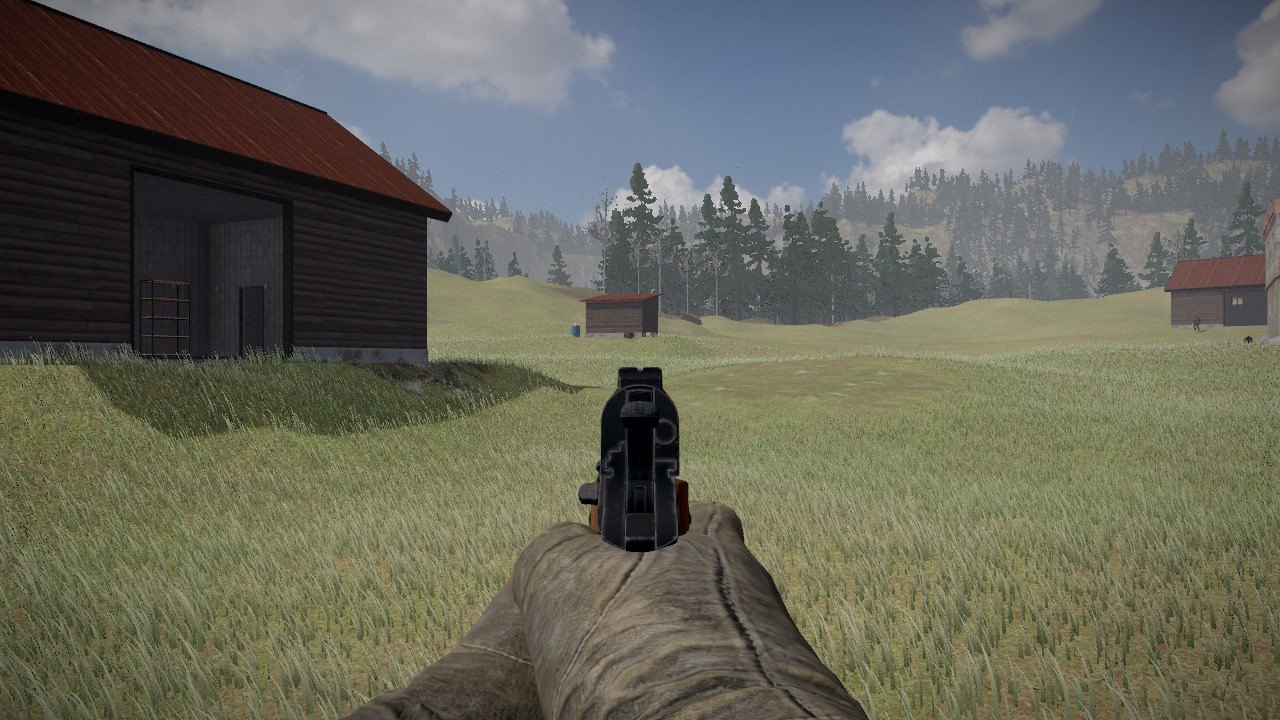
Sights line up: each gun was aimed and fired at a mark, and its rounds land where its sights are. The AKS-74U's, the MP7's and the Colt's irons were off and are fixed. The scoped rifles no longer rise above the eye as they come up.
Fixed: the left gun of a pair now stops showing its muzzle flash after a shot.
The map (M) redrawn: relief you can read, forests, cream roads, the regions named, an icon by every place, a compass and a legend, and the grid square under your pointer. It opens fully zoomed out. The corner map has the same colours.
Smoother fights: being shot and bleeding no longer slows the game. The blood on your screen cost several milliseconds every frame and a hitch of up to a fifth of a second when it first landed; now it costs nothing you can measure. (The first version of this fix cost some players frames all the time, hurt or not: that is fixed too.)
The map, three times bigger
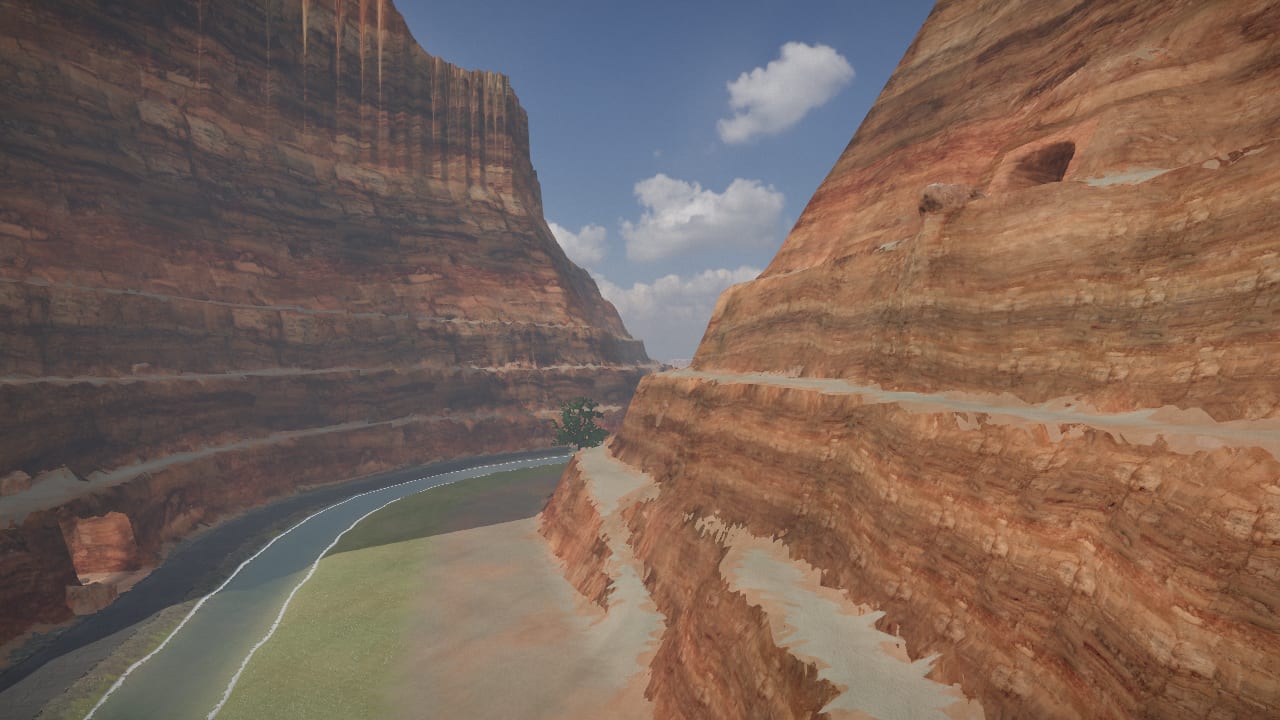
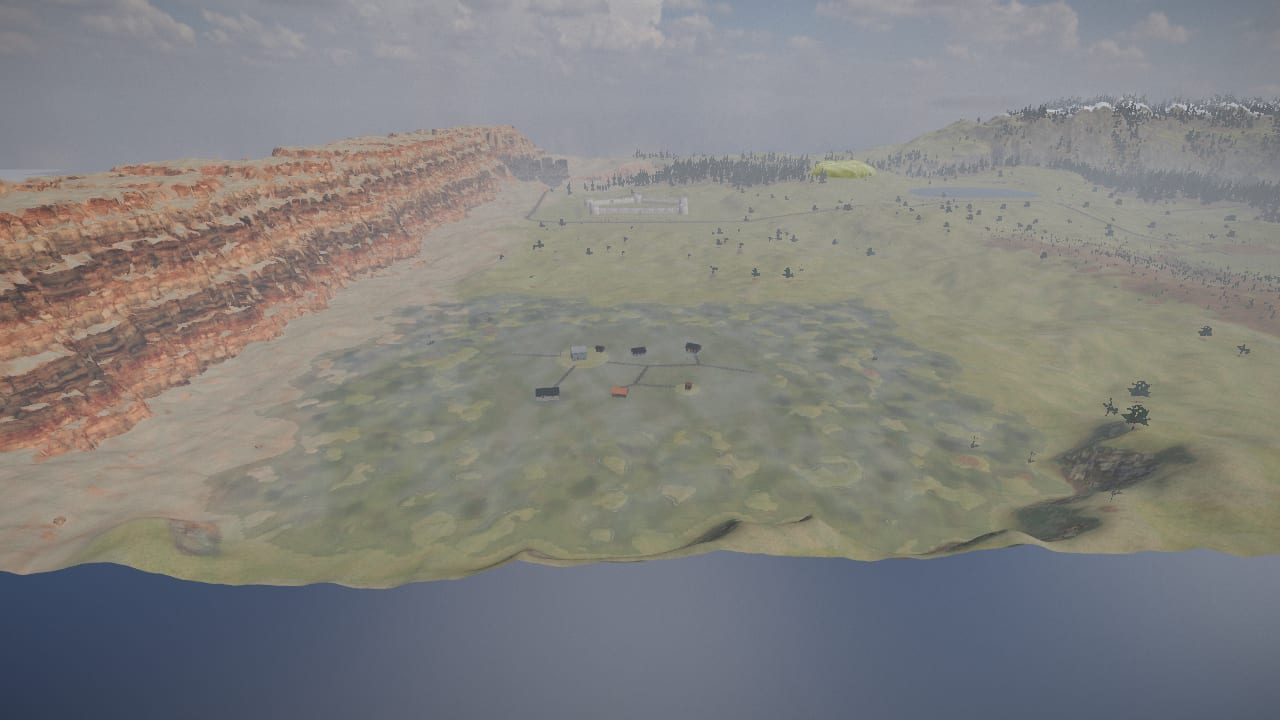
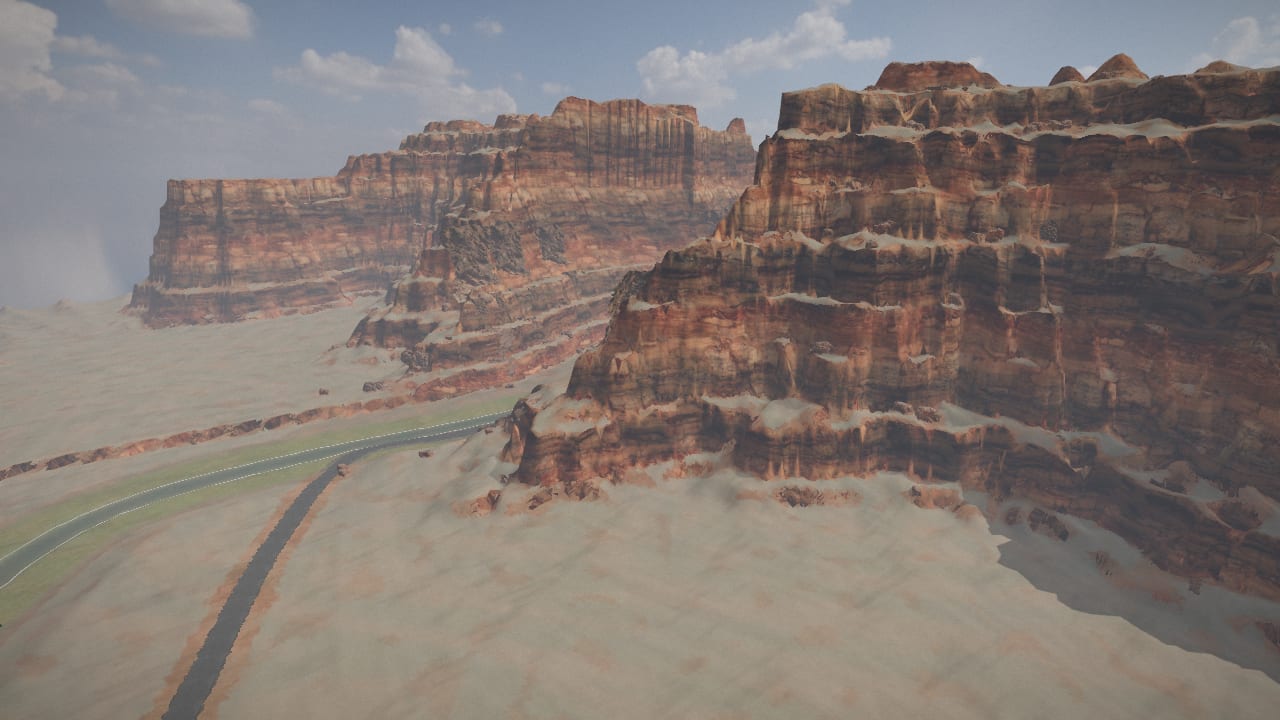
The Zone now runs 4.6 km west to east, three times the old 1.5 km square. Past the old valley lies a green west of rivers, a lake and a swamp, with five new towns. Beyond it a red canyon ridge closes the whole map, crossed by one pass. Past that is a desert with the ruins of Kalat, a beach and the sea. Everybody starts again at the map's edge with what they carried.
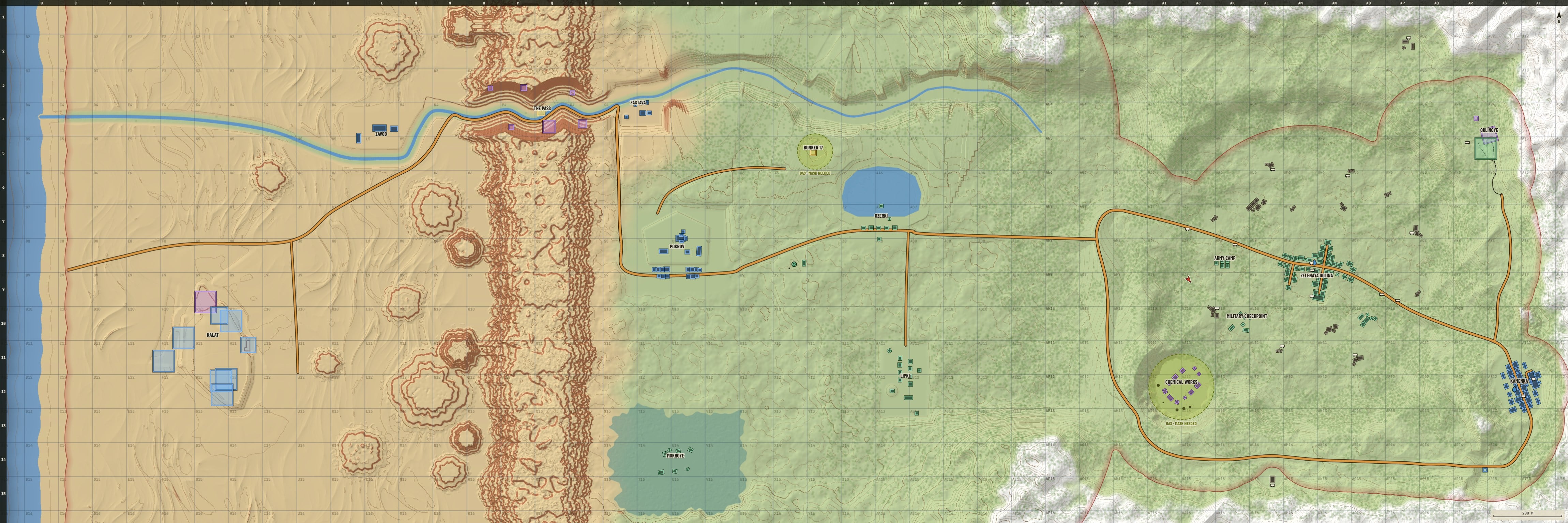
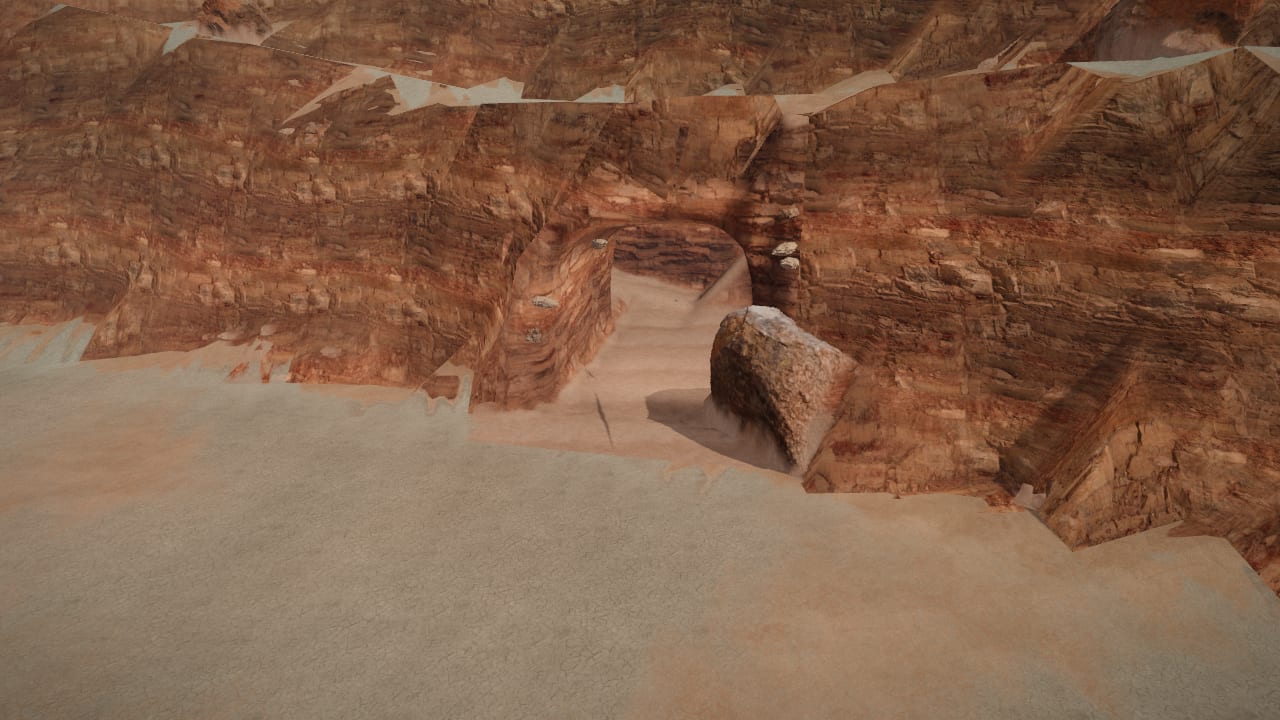
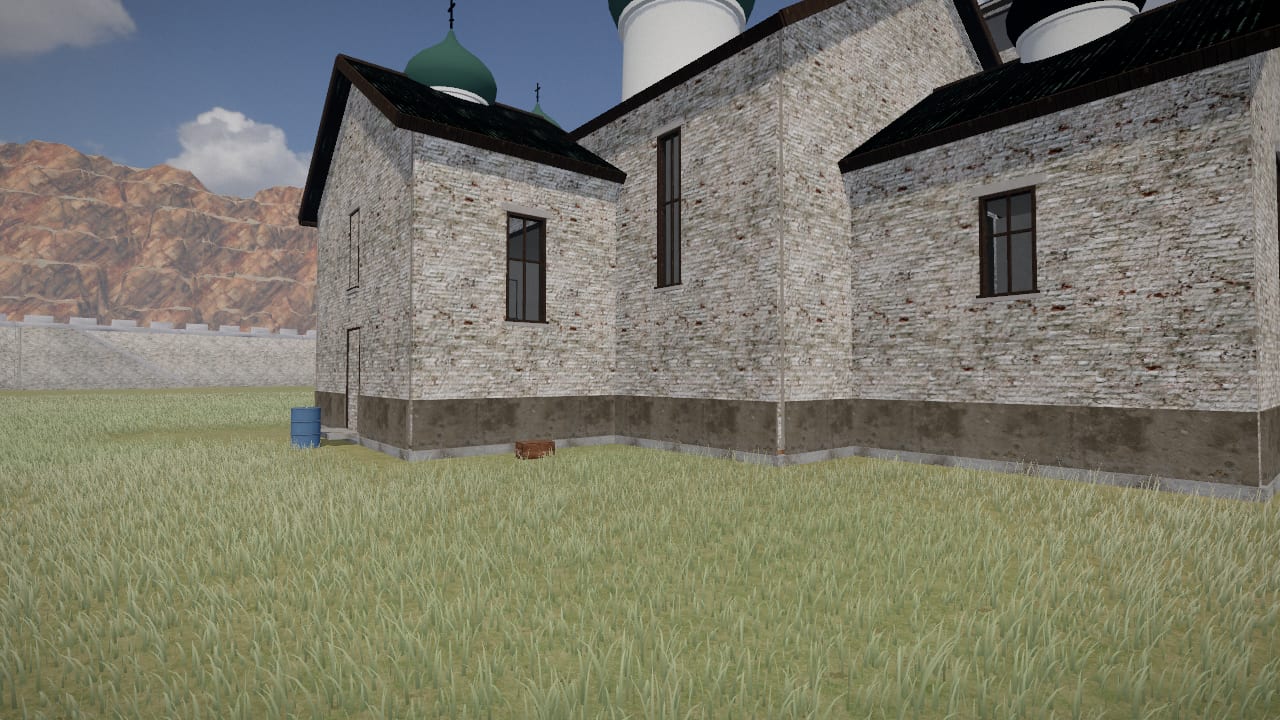
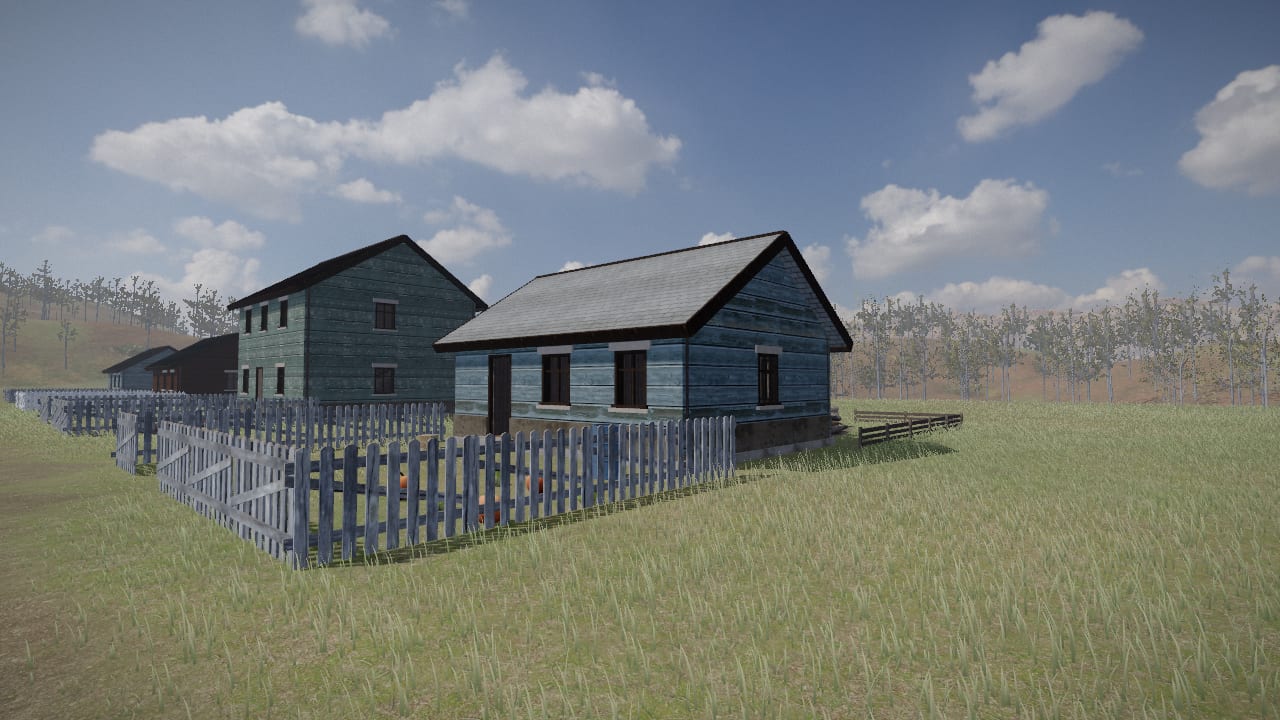
The whole map, as the game's map (M) draws it. Drag it, and zoom with the wheel, two fingers or the keys. Every building is outlined in the colour of its loot tier.The pass, the one way through the ridge, from a shelf on its wall.A cave mouth in the pass's wall. The caves are dark inside: bring a light.Pokrov, the monastery town, its cathedral inside white walls.Lipki, a log village on a knoll.Mokroye, a hamlet the swamp has drowned. Some houses have water over their floors.The swamp from 150 m up.Kalat, a ruined walled town on its own hill in the desert.Zavod, the brick works by the desert river.The canyon country from 80 m up.The beach at the map's west edge. The sea is not swum.
The green west: farmland, woods and a river valley between the old valley and the ridge. Ozerki's lake and the swamp are in it, and you can wade in the water.
Five new towns: Pokrov (22 buildings), Lipki (13), Ozerki (8), Mokroye (7), and Zavod, the brick works (3). Zastava, the post at the pass's east mouth, adds 5 more. Loot runs up to tier 3 in Pokrov, Zavod and Zastava, and tier 2 in Lipki, Ozerki and Mokroye.
The pass: the ridge cannot be crossed anywhere else. The pass is 517 m long, with shelves up both walls at about 8, 18 and 30 m. Six caves run through those walls, and the best of the pass is cached on its floor at the middle. The caves hold tier-4 loot, the cache tier 5.
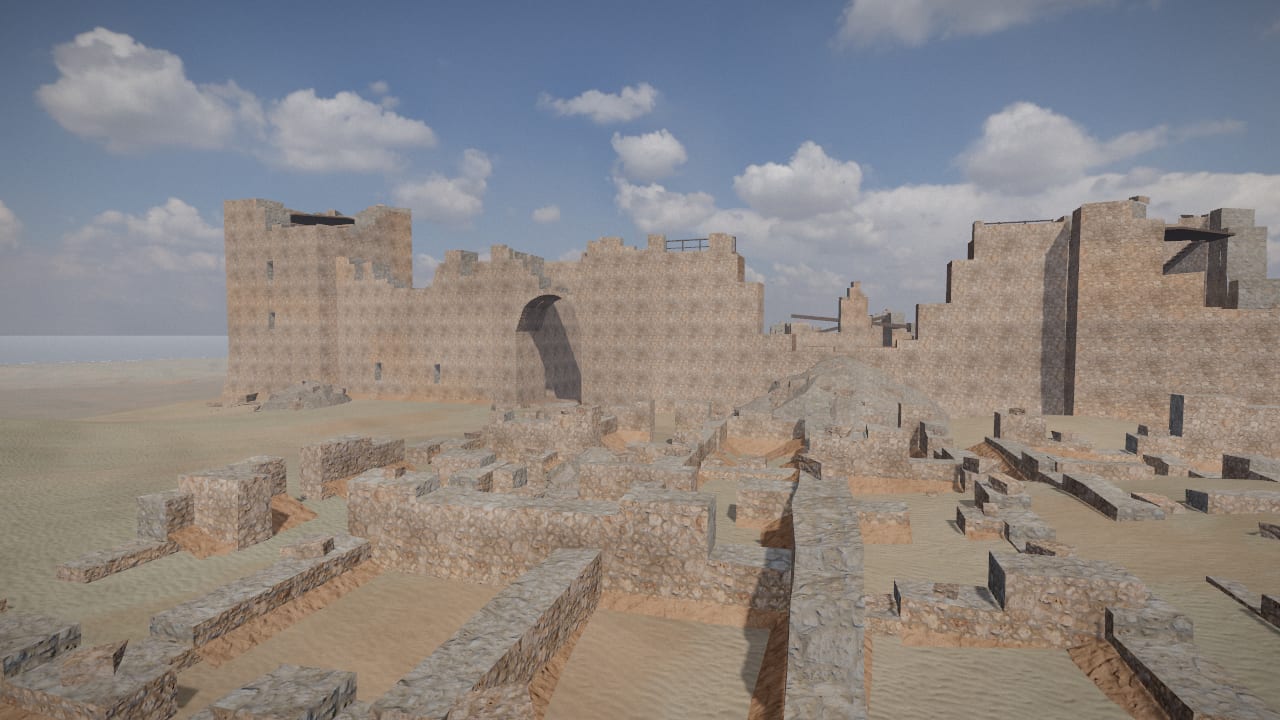
The desert: dunes and buttes, the river running through it to the sea, and the ruins of Kalat: tier-3 loot in its streets and walls, tier 4 in its citadel.
Moved: Bunker 17 and its gas now sit on the river valley's south rim, well away from the fort. The trader has moved to the main road.
The map (M): the land is in colour now: green country, desert sand, red cliffs, snow, blue water. Every hundred-metre square has its name in its corner, A to AT across and 1 to 15 down, so you can say "I'm in C12". The grid lines are stronger.
Draw distance: a new setting from 300 to 1,500 m (800 by default) for how far buildings are drawn. Loot is drawn within 55 m whatever it is set to.
Smoother walking: pictures of things you walk past now go onto the graphics card a little each frame, not all at once in one frame.
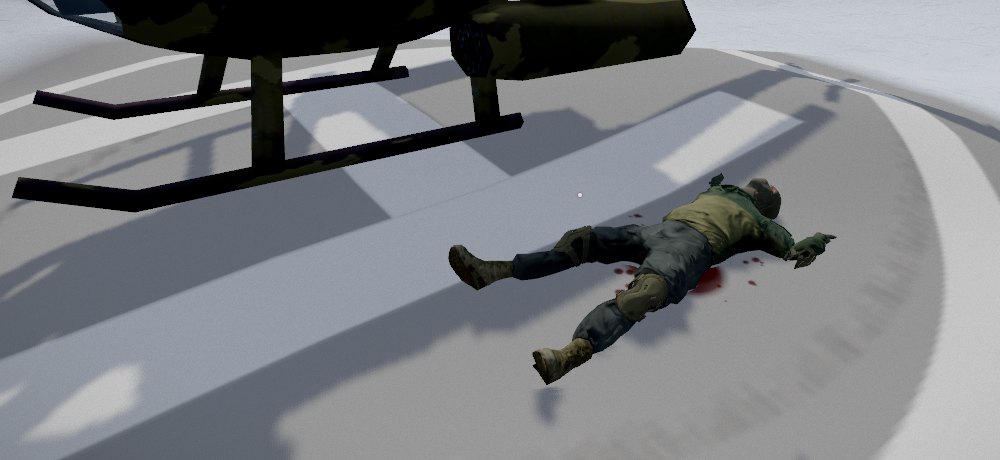
Fixed: a player shot out of a helicopter no longer hangs in the sky. The body rides in its seat until the helicopter lands or crashes, then lies beside it to be searched. The airdrop's helicopter now flies in over the map's real edge.
The helicopter's searchlight reaches the ground
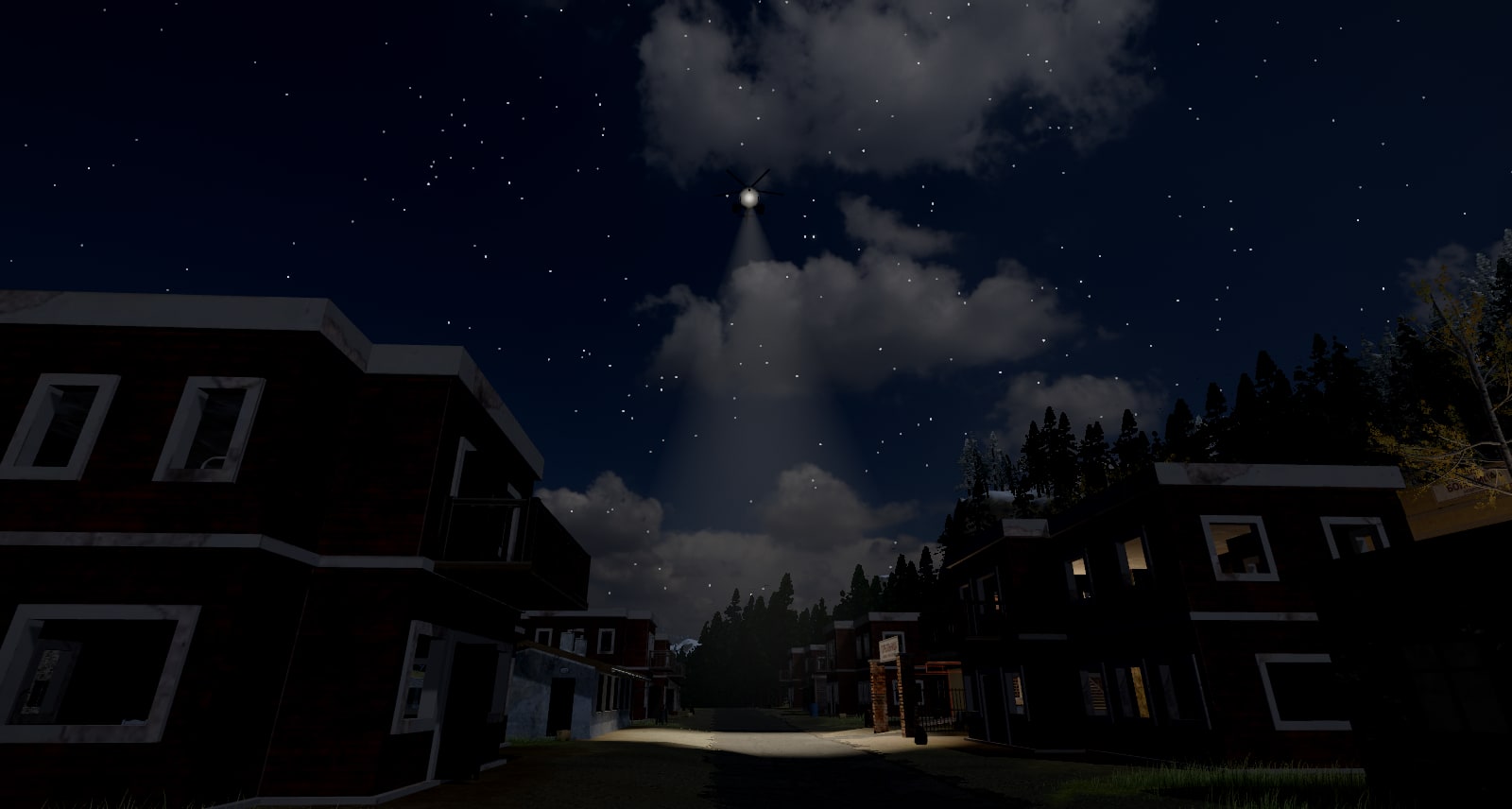
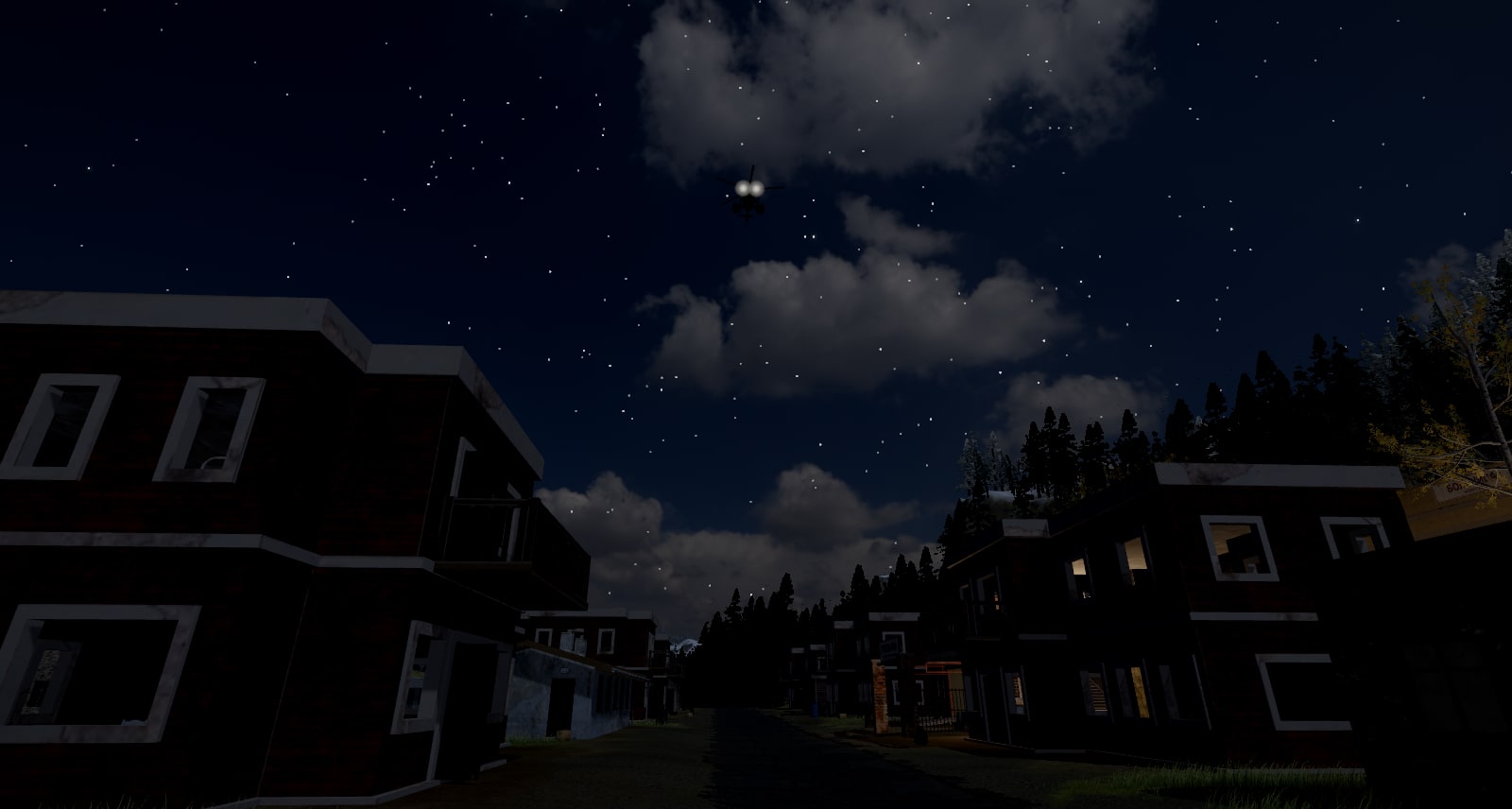
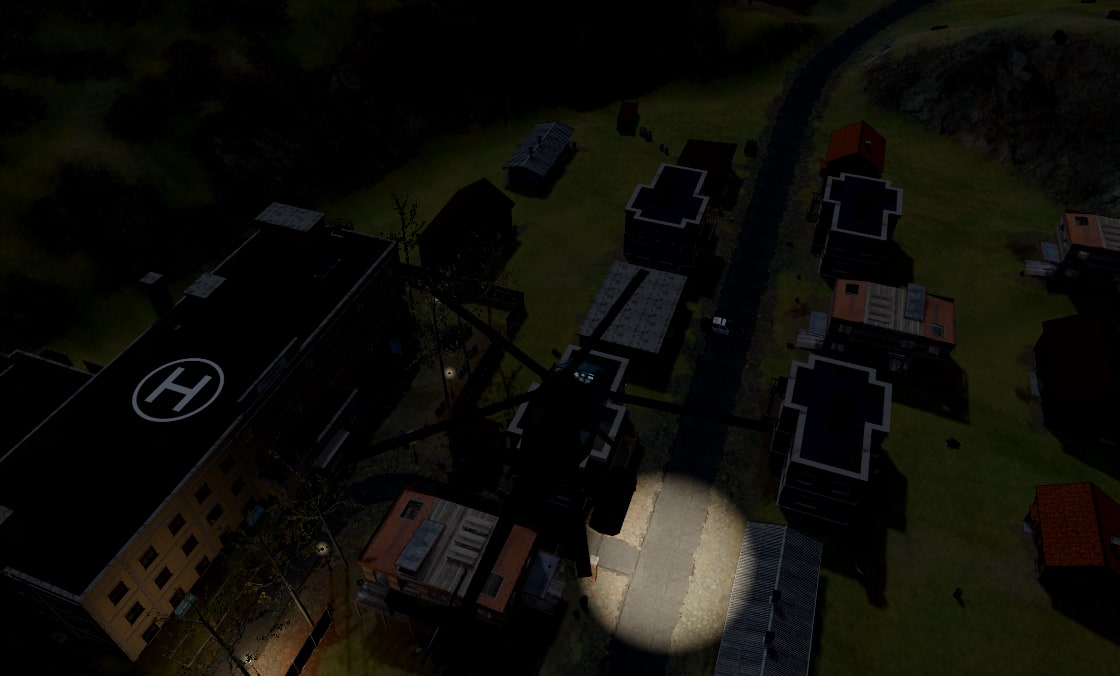
The helicopter's light was a car's headlight pointed straight ahead: from the air it lit nothing below. It is a police helicopter's searchlight now, a narrow beam from under the nose that throws a pool of light on the ground from 50 m up all the way to the 100 m ceiling, and the beam itself shows in the night air.
From the street in Kamenka, the helicopter 50 m up.Before, from the same place: two lamps pointed at the horizon, and the road dark.From the pilot's seat, 50 m over Kamenka.
Like a police helicopter's: they carry searchlights such as the Nightsun, whose beam is focused between 4 and 20 degrees wide. Ours is 17 degrees: a pool about 13 m across from 50 m up and about 23 m from 90 m.
As bright high as low: the spot is as bright at the ceiling as at 50 m, only wider.
Steady: it points down and a little ahead of where the helicopter is going, and stays there when the nose dips to fly or it leans into a turn.
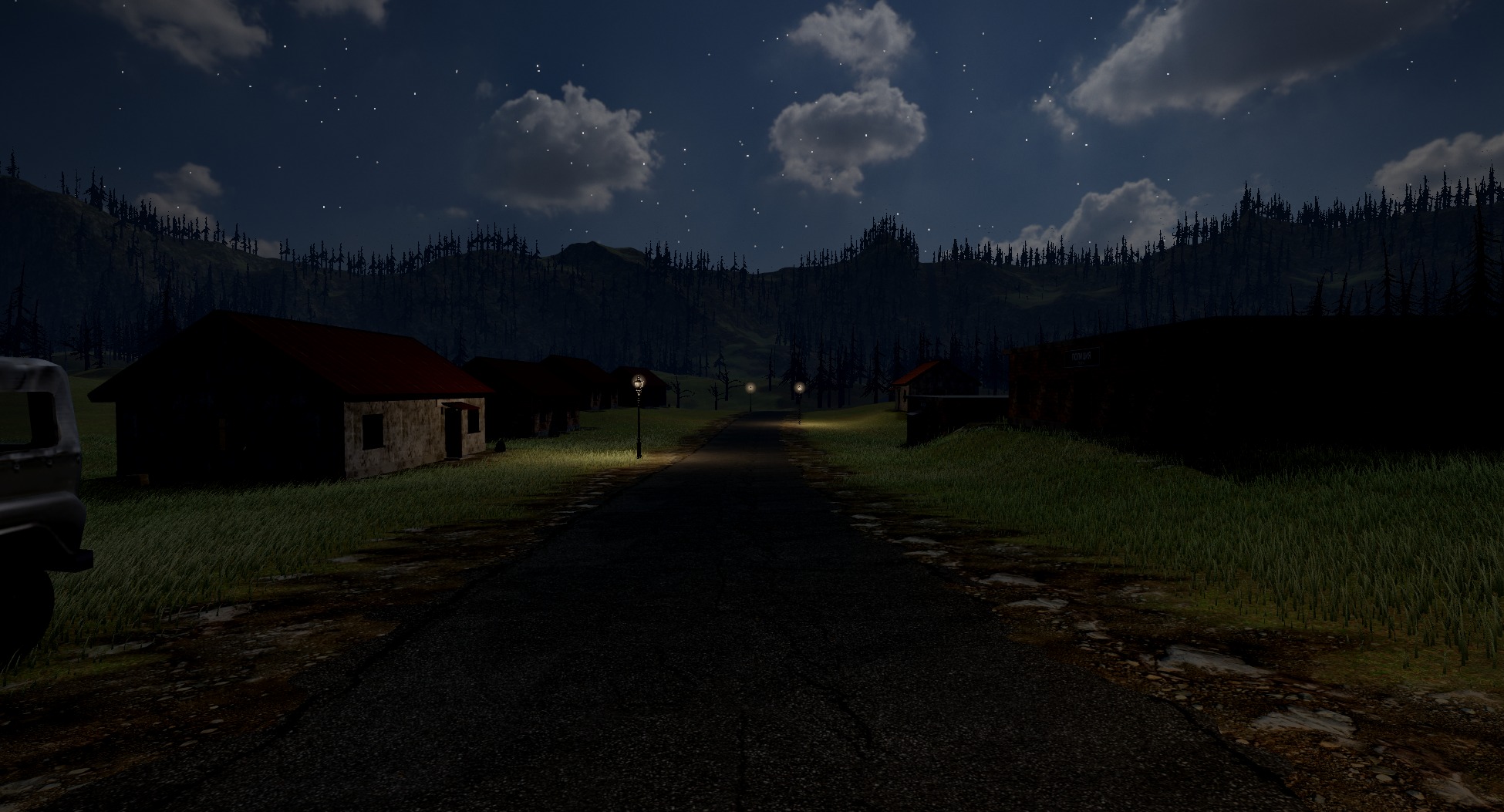
Seen from the ground: the lens is a bright star to whoever it is turned toward, and the beam is a pale shaft in the night air. A helicopter out looking for you is seen across the valley, as any lit lamp is.
When: after dark, while somebody is at the controls, as a car's headlights are.
Bot farms turned away at the door, and a dropped connection takes you straight back in
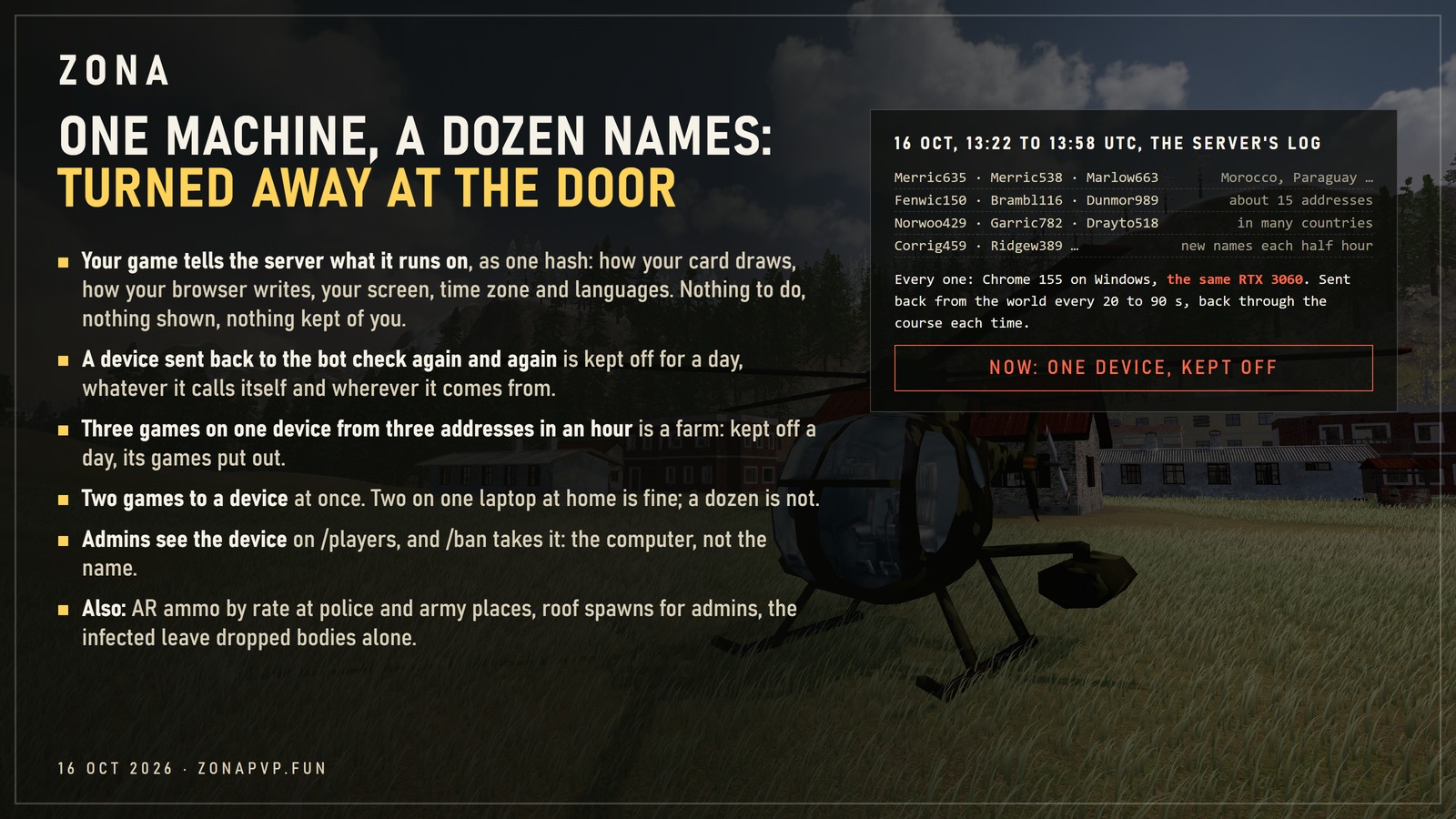
On 16 October a dozen made-up names (Merric635, Brambl116, Drayto518 and the rest) came through about fifteen rented addresses in many countries, every one of them the same Chrome on the same graphics card, passed the bot check, were sent back out of the world within seconds and came round again every half minute, with new names and keys each half hour. Your game now tells the server what it runs on, as one hash, and the server knows one machine under a dozen names for what it is. Nothing to do and nothing shown: it takes a few tens of milliseconds the first time you press Play. And a connection that drops takes you straight back to your body.
The device check, and the swarm of 16 October as the server's log had it.The week's fixes, most of them on the site already since 15 and 16 October.
What your game tells the server: a single hash of how your graphics card draws a small test picture, how your browser draws a line of text, your screen, time zone, languages, cores, memory and system. Not your name, not where you are, and nothing that changes while you play (not the window's size, not the page's zoom). Two of the same machine set up the same way look the same, so no rule turns anybody away for the device alone.
Kept off by device: a device whose games are sent back to the bot check four times in half an hour is kept off for a day, whatever those games call themselves and wherever they come from. Before this it was the name and the address that were kept off, and the swarm changed both every half hour.
A farm: three games on one device from three different addresses inside an hour, and the device is kept off for a day and its games put out. One player whose phone changes its address as they play is one game, however many addresses; two friends on the same kind of laptop are two games. Neither is a farm.
Two games to a device at once. Two on one computer at home is fine. A third is told so, and is in when one of the two leaves.
Before the bot check: all of this is asked the moment the game says hello, so a farm spends nothing of the course, and no body of theirs ever stands in the world.
For admins: the device is on /players, /recent and the panel (dev: and eight characters); /same dev:xxxxxxxx lists everybody playing or lately gone on it; /ban dev:xxxxxxxx bans the computer, not the name, and it holds for every name on it. A wrong call is on /bans and /unban lifts it.
Sent back four times in half an hour, by name and by address, is kept off for a day as well: a swarm that passes the course and is thrown out of the world again and again no longer gets a fresh go each time.
A card named without its number fails the bot check: every real Chrome on Windows names its graphics card with its id, as in "RTX 3060 (0x00002504)"; over two and a half days of the server's log every player's did, and every one of the swarm's said "RTX 3060" with none. A typed string, not a card.
Too many shots: a go at the bot check ends at 90 shots (the people who passed on 16 October fired 9 to 45; the swarm's programs 63 to 160), and a dozen or more shots that land by the geometry but were not aimed by a hand fail the go.
Pardon: the admin panel's Bans page lists everybody turned away at the door lately (banned, kept off, a full device, the bot check not passed) with a Pardon button that lifts everything on that person at once, their game, address and device, so a wrong call is undone in one press. /turned and /pardon in the chat do the same.
Bans written reliably: a ban always held the moment it was given, but the site's copy of the list (which outlasts restarts) was refused for about a hundred seconds after any write, and the admin was told it would hold only until a restart. The server now hands the site the mark of what it last wrote, and keeps trying for ten minutes if the site cannot take it. Somebody banned also leaves the panel's "Left lately" list.
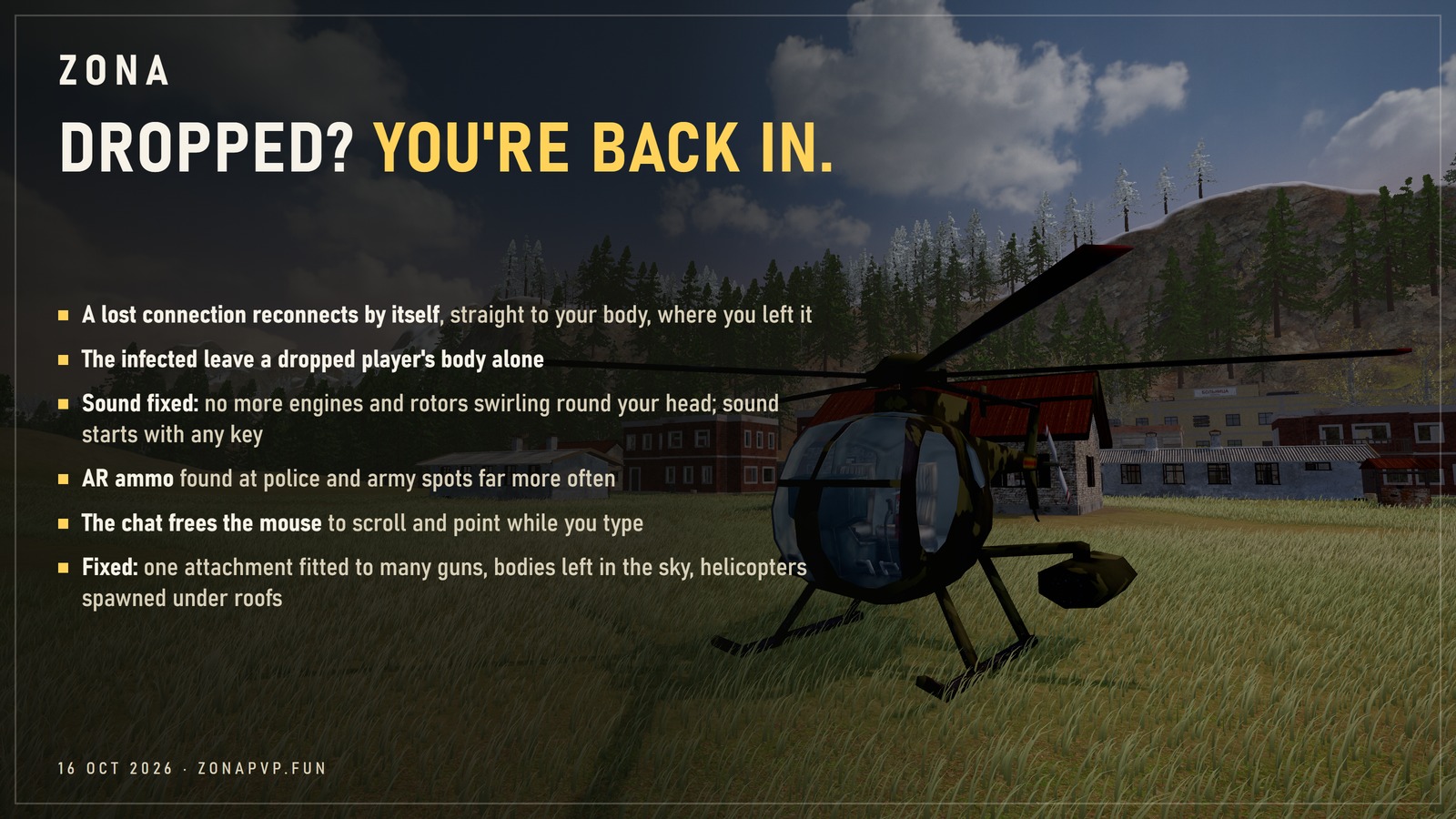
Dropped? You're back in: a connection that drops in the middle of play reconnects by itself, straight to your body where you left it, with everything you carried; no reload. How each connection ended is written down in the server's log, so a drop can be traced.
The infected leave a dropped player's body alone while its connection is gone.
Sound: a car's or a helicopter's own sound is heard from where your ears are, not swung round your head; the sound starts with any key you press, not only a click.
AR ammo: 5.56 rounds are found by rate wherever the police and the army were, not at a handful of set spots.
The chat frees the mouse while you type, to point at what was said and scroll back, and takes it again when the chat shuts.
Fixed: one scope or light fitted to many guns from one item; bodies left standing in the sky over a house; an admin's spare things dropped in the sky; a helicopter stood under a roof; an admin's /spawn lands at their own height, on a roof as on the ground.
Smoother frames, bags that open where they lie, and the Elite crown
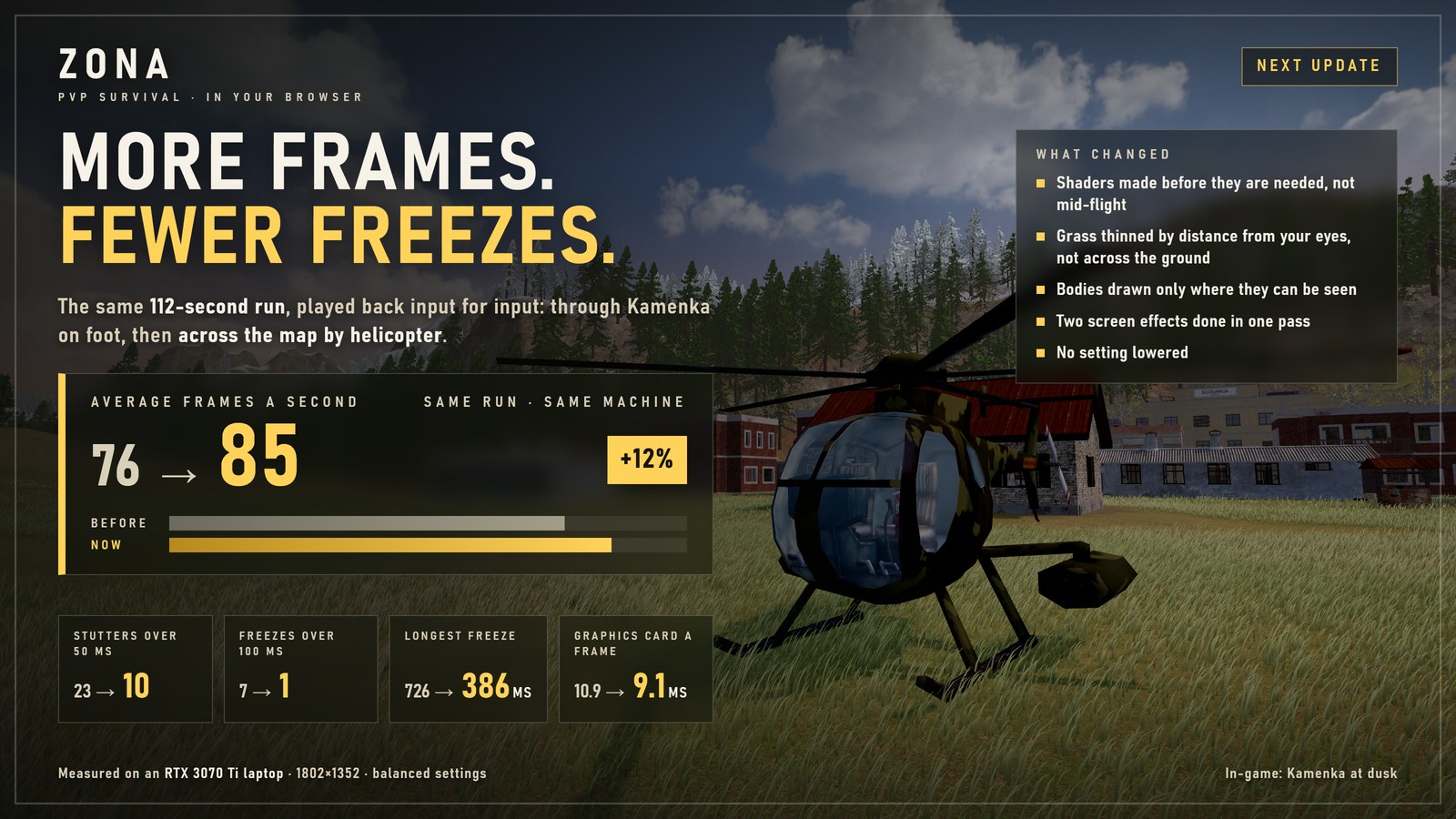
On the same recorded run, through Kamenka on foot and across the map by helicopter, 76 frames a second became 85 and freezes over a tenth of a second went from seven to one, with no setting lowered. A pack, a vest or a jacket lying on the ground now opens where it lies. And whoever is paid at the top rate has a crown by their name in chat.
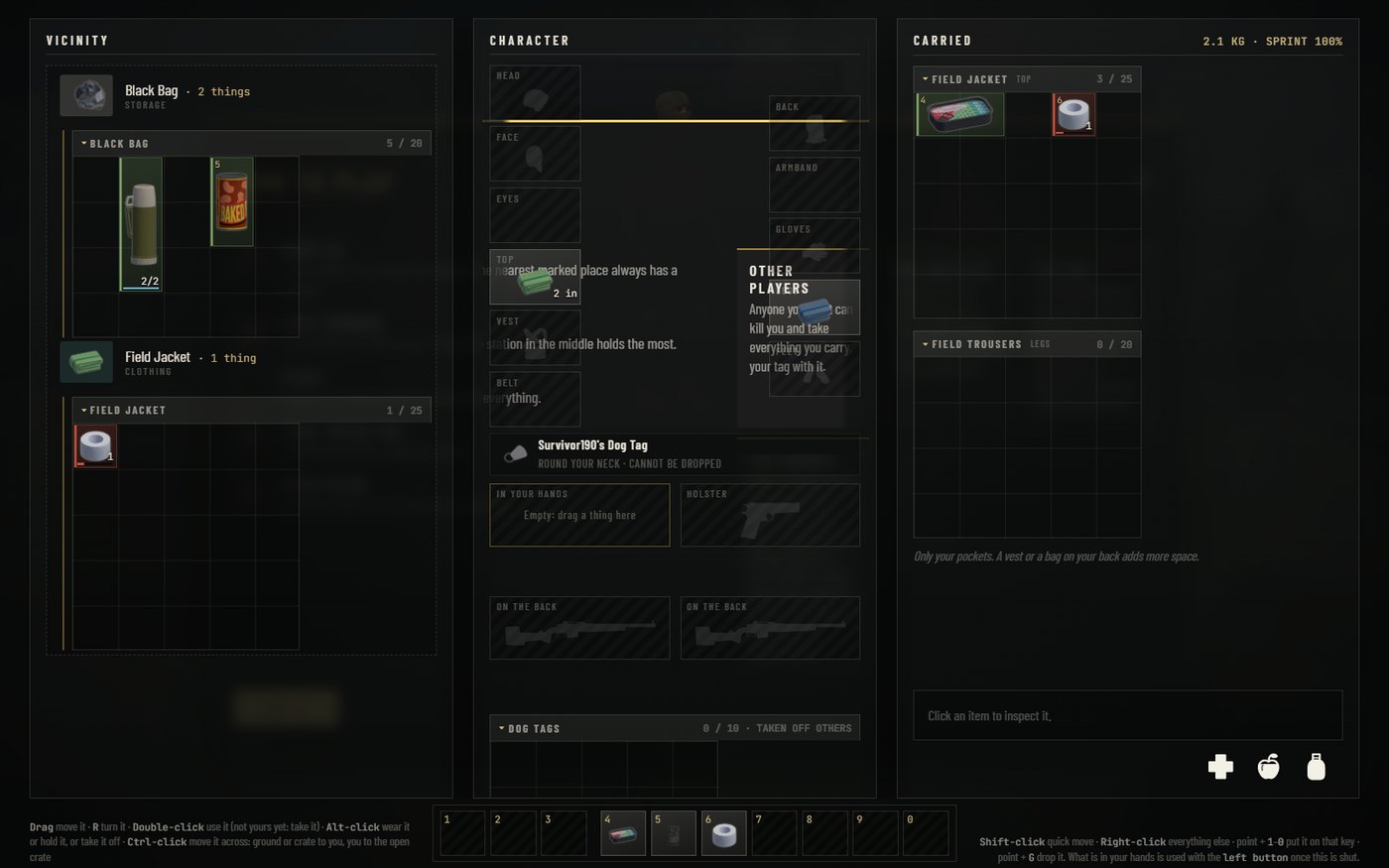
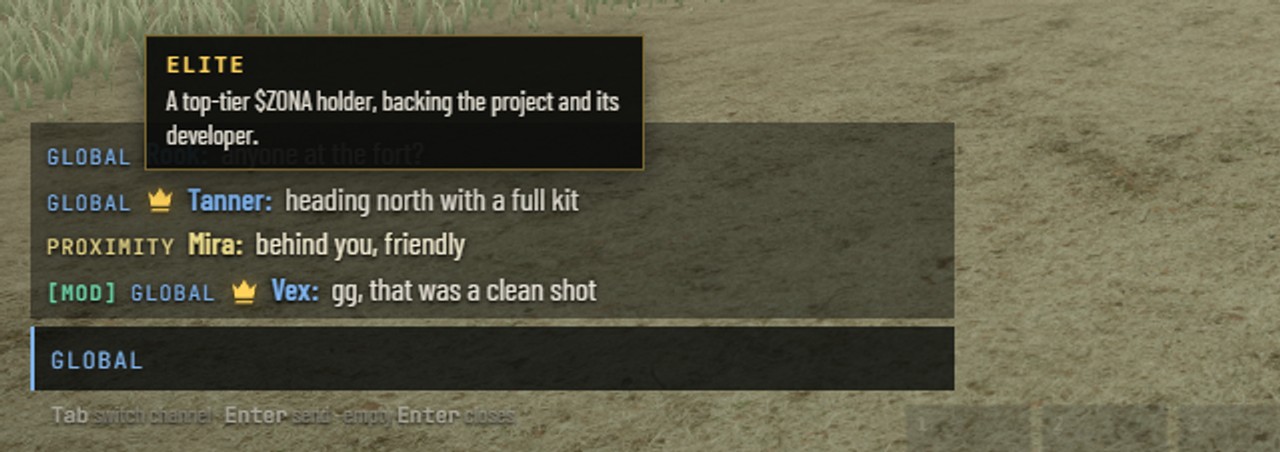
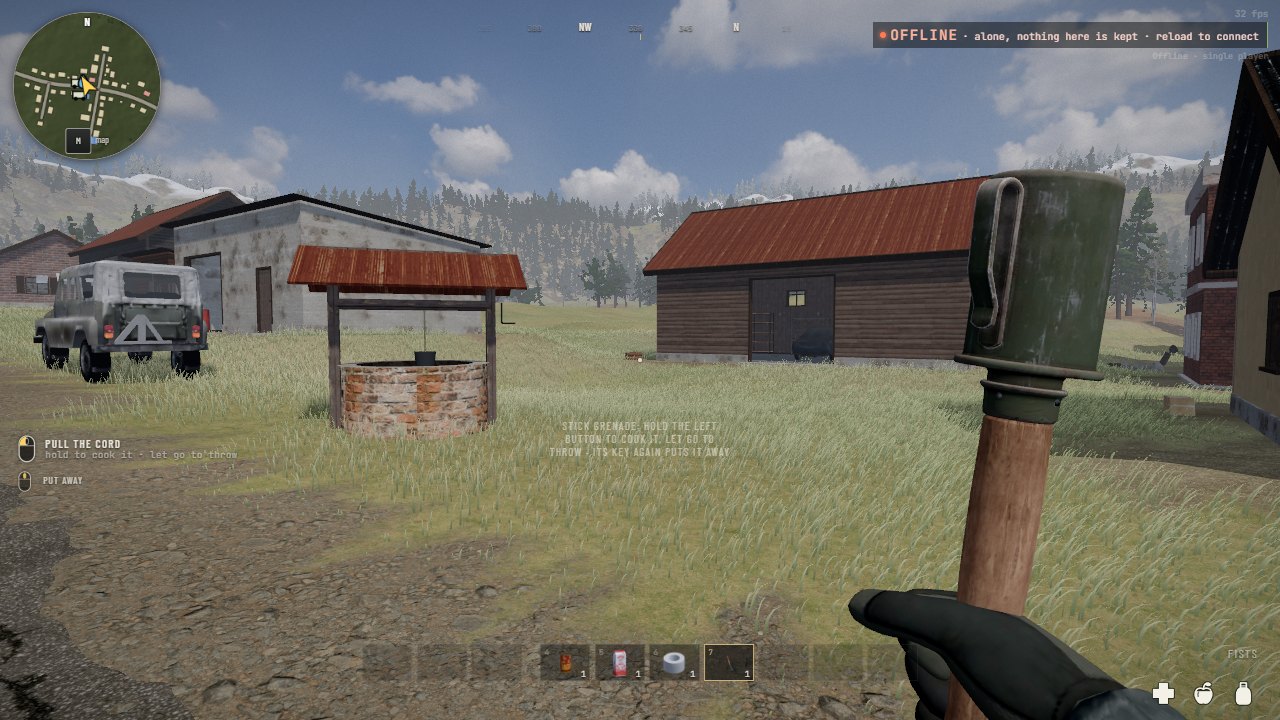
The same 112-second run, played back input for input before and after: measured on an RTX 3070 Ti laptop, 1802×1352, balanced settings.Vicinity: a bag and a jacket on the ground, each open as a grid, gone through where they lie.The Elite crown in chat, and what it says with the pointer on it.The stick grenade held by its handle until the cord is pulled.
Fewer freezes: the crashed helicopter on the crest, the airdrop's wreck and the fort's fires had their shaders made the moment they were first seen, and the game stopped for half a second to a second. They are made before they are needed now.
More frames: grass is thinned by its distance from your eyes, not across the ground (from a helicopter the grass under you was drawn as thick as at your feet); bodies are drawn only where they can be seen; two of the screen's effects are done in one pass. Nothing you see was given up and no setting was lowered.
Bags, vests and clothes on the ground: anything lying within reach that holds things is shown open under it in Vicinity, as what you wear is: drag things in and out and move them about in it. One player at a time: anyone else is told somebody is going through it, and cannot pick it up from under them until they close their inventory.
The Elite crown: paid at the top rate (15M $ZONA and over), you have a gold crown by your name in chat; hover it to read why. It goes with the payout: paid less later, it comes off.
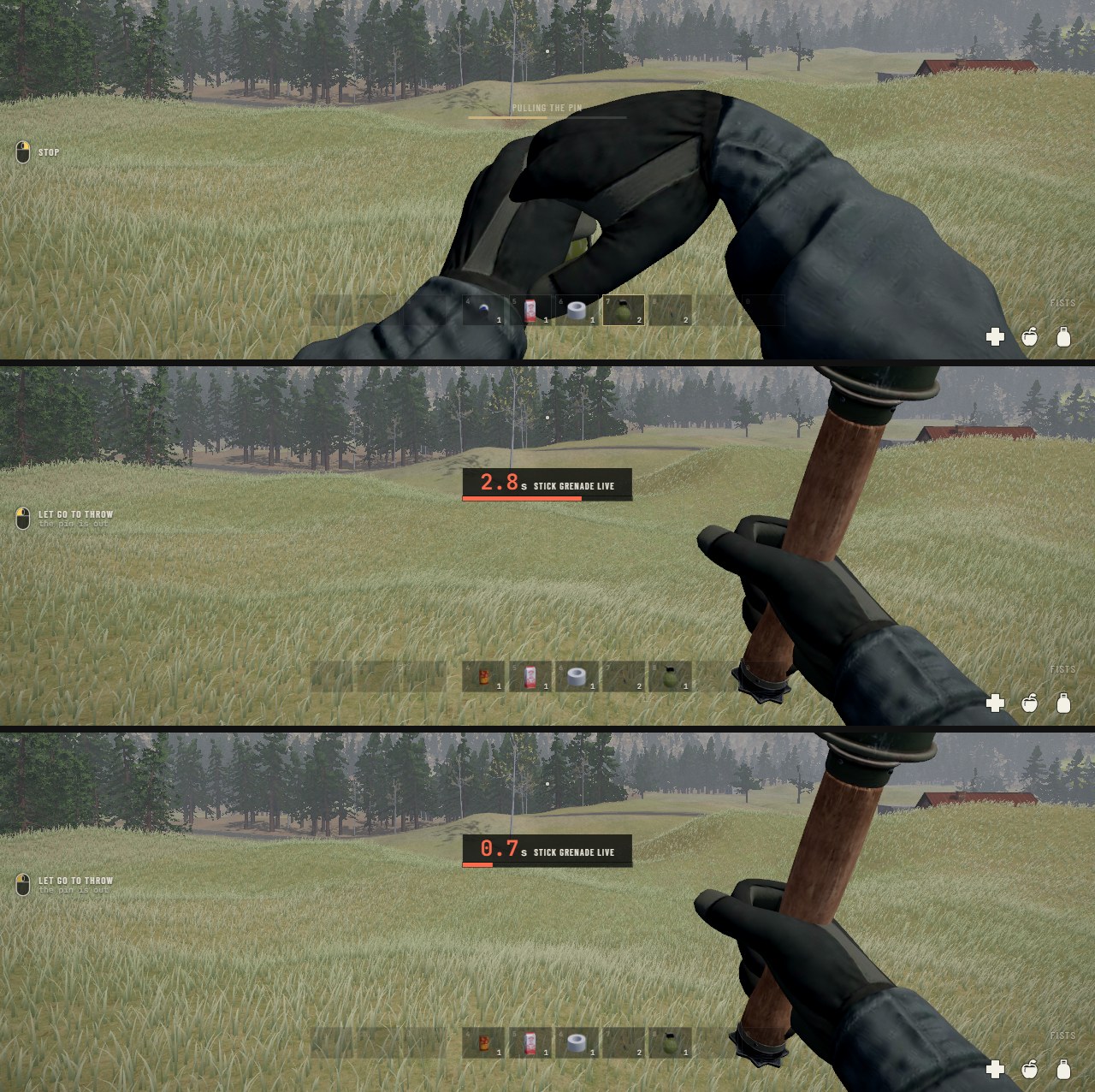
Stick grenade: held like a club, by the end of its handle, until its cord is pulled; pulling it draws it back over the shoulder to throw.
The door: on a computer it says when the game was last updated; on a phone the Live sign no longer sits over other words.
Phones in the bot check, a one-row hotbar, and stairs
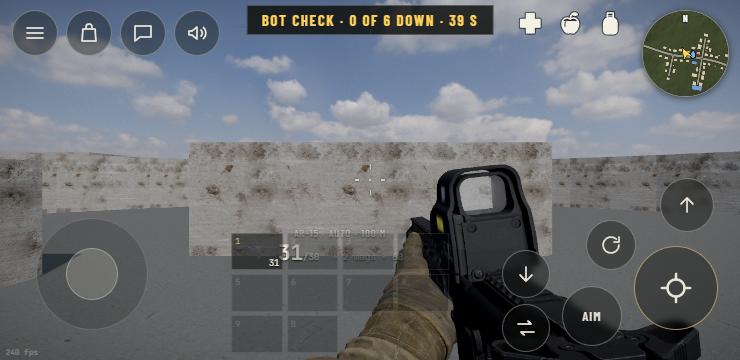
On a phone the bot check could not be played: the controls never came up. They do now, the check's sign is small, and the hotbar is one row along the bottom.
The bot check on a phone: the stick and the buttons are there from the first moment, and the sign is one line once you are under way.The hotbar on a phone: one row of five along the bottom, more on a bigger screen.
Bot check on a phone: it waited for a mouse click that a phone cannot make, so it stood paused with no controls. On a touch screen it starts at once.
The check's sign is small and high on a phone, and says how to pass for the first six seconds of each go; then just the count and the clock.
Hotbar: five slots in one row on a phone, six to ten as the screen gets wider. What is in the others is on the swap button and in your pack.
Stairs: going up a house's stairs, which turn back on themselves at each landing, could be taken for a program pacing to and fro, and the player sent back to the bot check. Going up or down a storey now counts as going somewhere, and by a building the gentler rules hold from the start. And side to side behind cover, watching and not firing, is given three minutes where it had a minute and a half.
Hold $ZONA, and every tag pays more
Play free and earn SOL for every tag; hold $ZONA in the wallet you are paid to and every tag pays more, up to 0.025 SOL. And a wallet can now be paid for five tags every twelve hours, not every twenty-four.
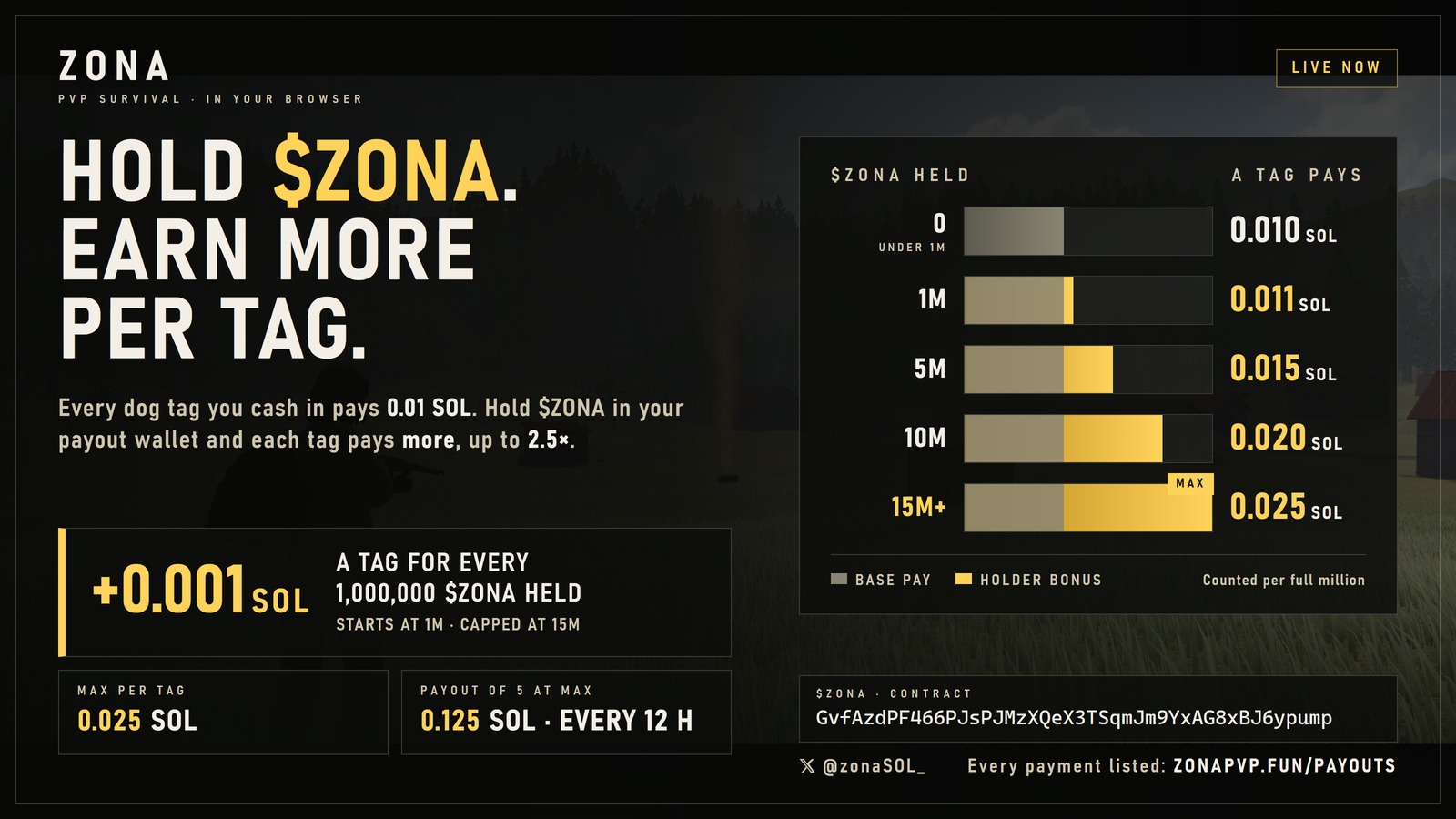
+0.001 SOL a tag for every full million $ZONA held, from one million to fifteen.
The tiers: Recruit (under 1M), Soldier (1M), Veteran (5M), Commander (10M) and Elite (15M and over): 0.010 to 0.025 SOL a tag.
What counts is the lower of what your wallet held when the tag was cashed in and when it is paid, read from the chain.
Five every twelve hours: a wallet is paid for five tags at once when the fifth is due, and the next five can come twelve hours after the first of those.
The payouts page shows the tiers, checks what your own wallet's tags pay, and lists the Elite: everyone paid at the top rate, with all they have made. In the game, the rewards window says what your own tags pay.
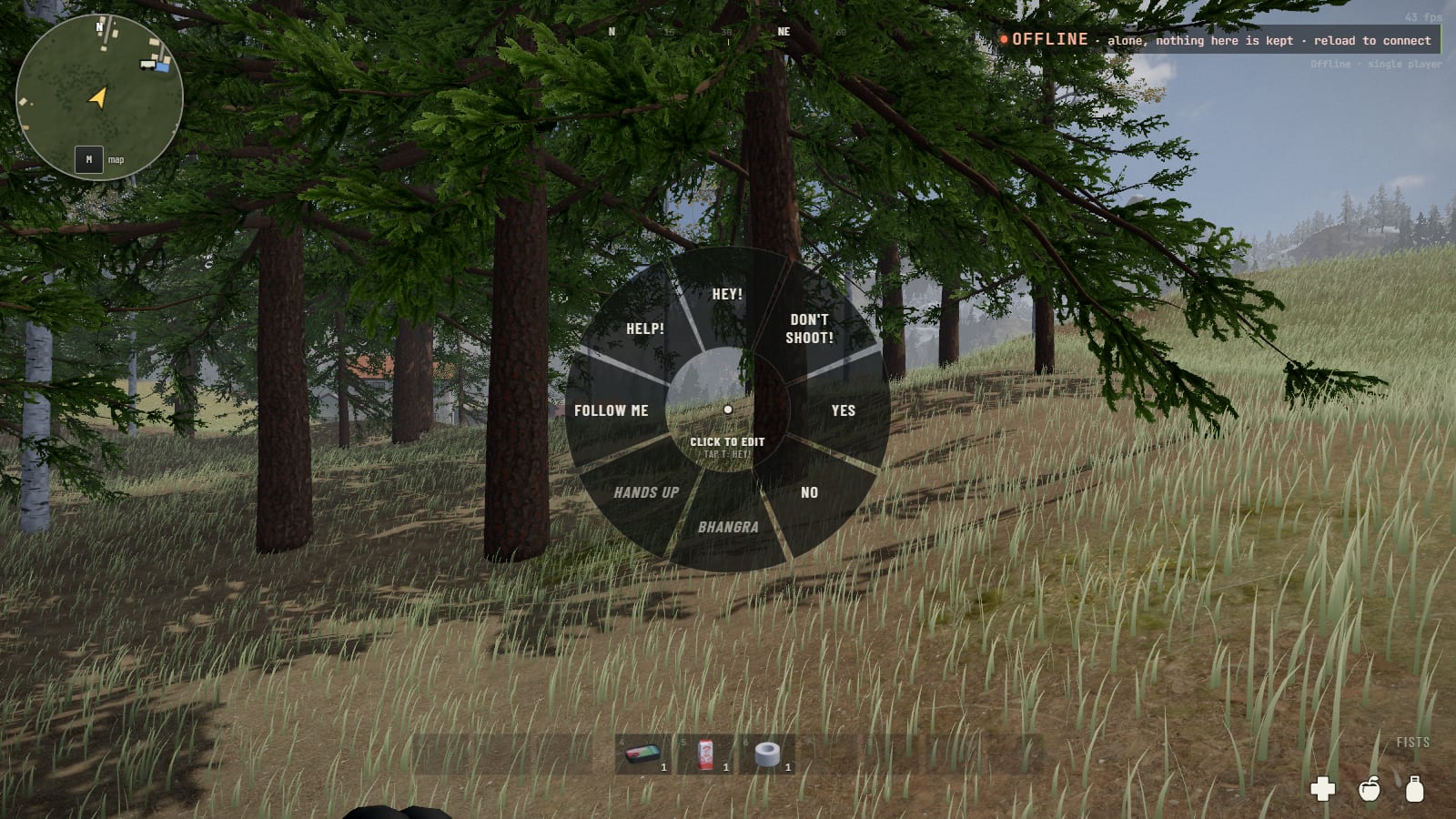
Sixteen slots on the emote wheel
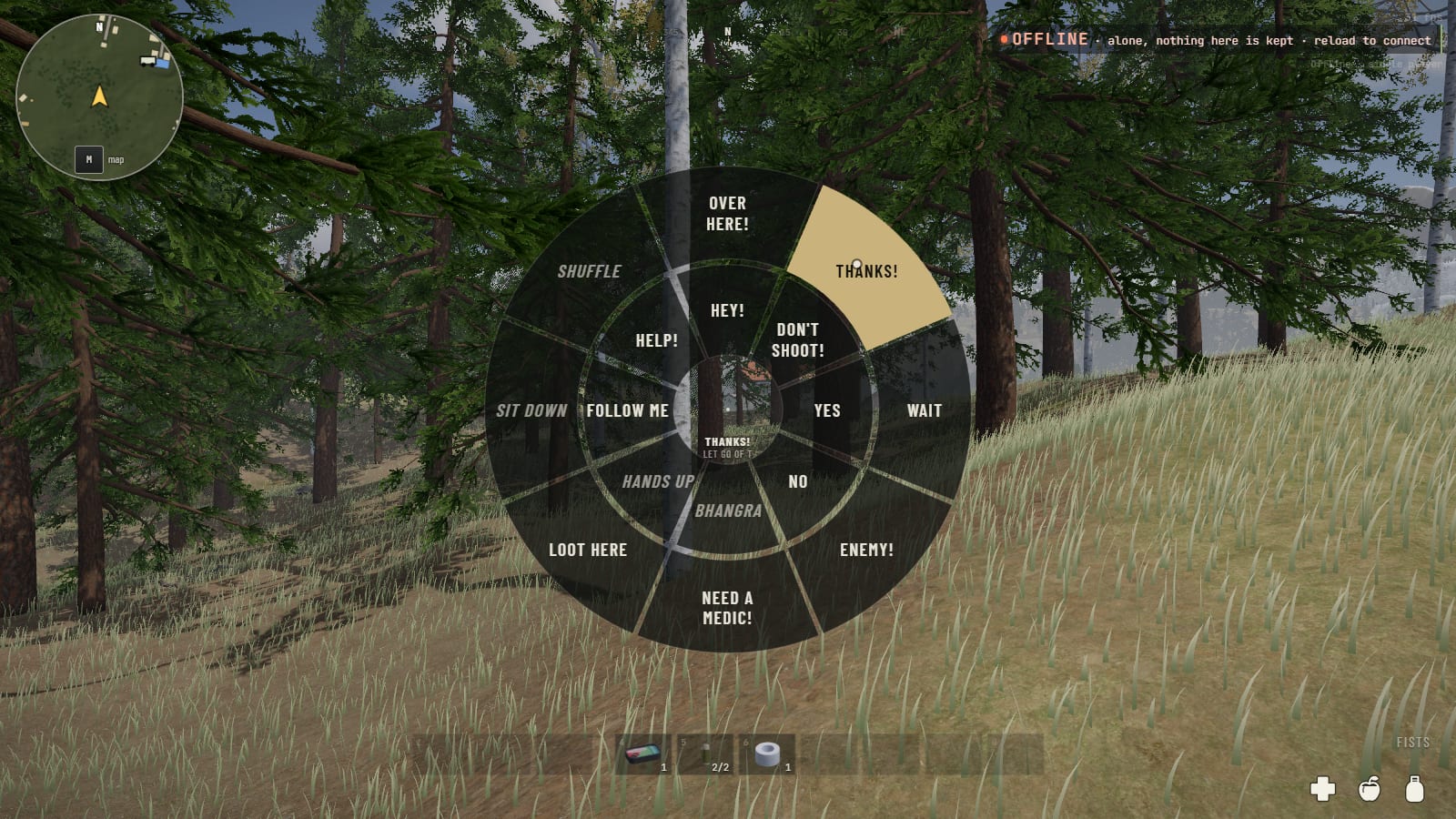
The wheel is two rings of eight now: the eight you had, as you set them, and eight more round them.
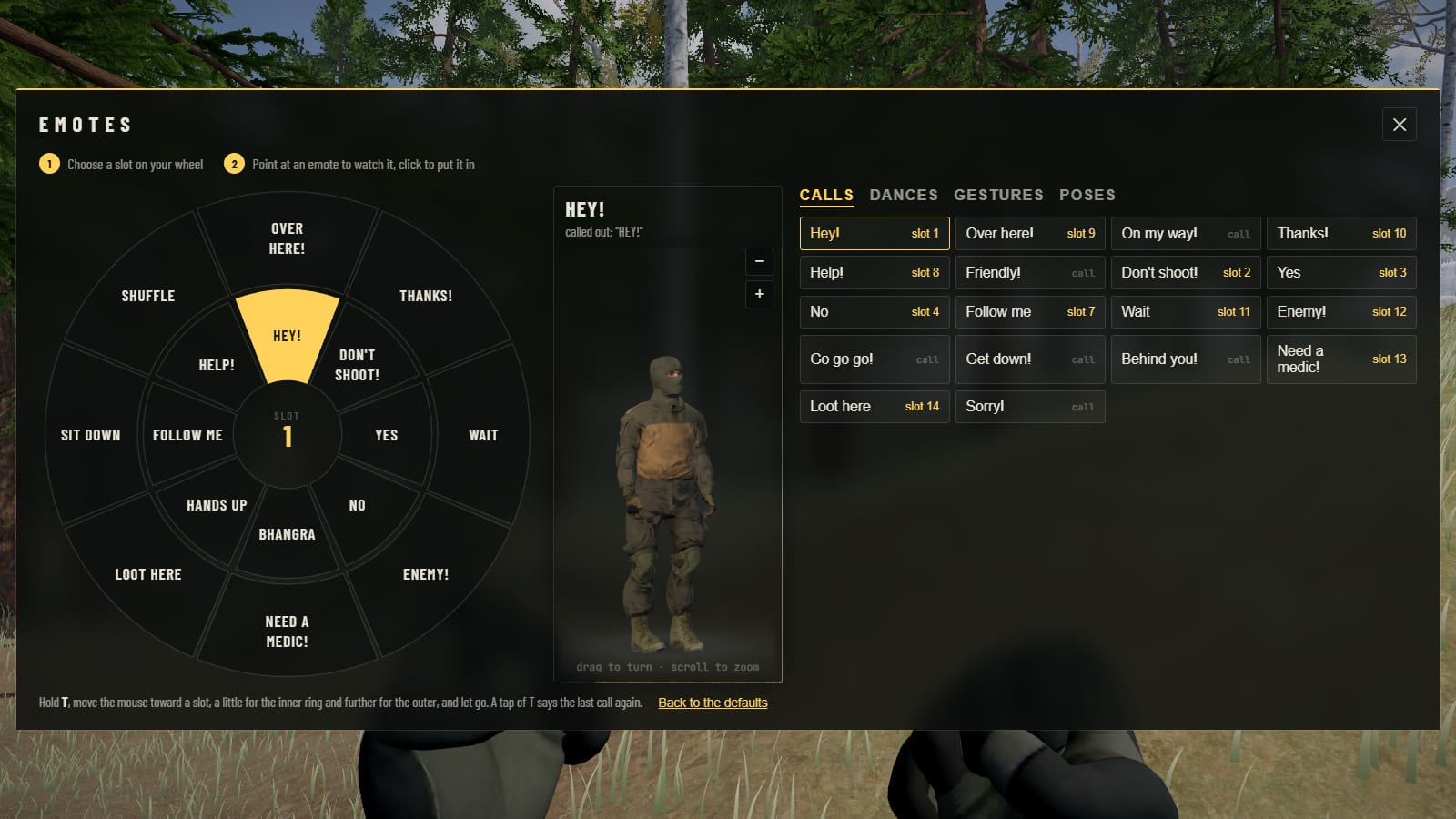
Hold T and move the mouse a little for the inner ring, further for the outer one.Emotes sets all sixteen.
The outer ring starts with Over here, Thanks, Wait, Enemy, Need a medic, Loot here, Sit down and Shuffle. Change any of them in Emotes (hold T and click).
On a phone the emote buttons are four across.
Shadows far off no longer need drawing again every time you turn: turning fast, the furthest of them is drawn half as often. A small gain, and they look the same.
A quicker load, and more so the second time
The map is now made beside the page rather than on it, and kept in your browser for your next visit. The physics engine is a file of its own, which the browser keeps ready.
On a phone held upright, the changelog and the payouts are a tap away, with no need to turn it.
Ready to play, a first visit: 39.4 s where it was 42.2.
Coming back: 18.6 s where it was 22.9.
The longest the page stood still while loading: about 0.96 s where it was 1.0 to 1.2.
Measured on one laptop (an RTX 3070 Ti) over a line slowed to 50 Mbit/s with 40 ms of delay, two loads each, the first with nothing kept from before. Yours will differ.
Phones: the screen that asks you to turn your phone now links the changelog and the payouts, which read fine held upright.
A harder bot check
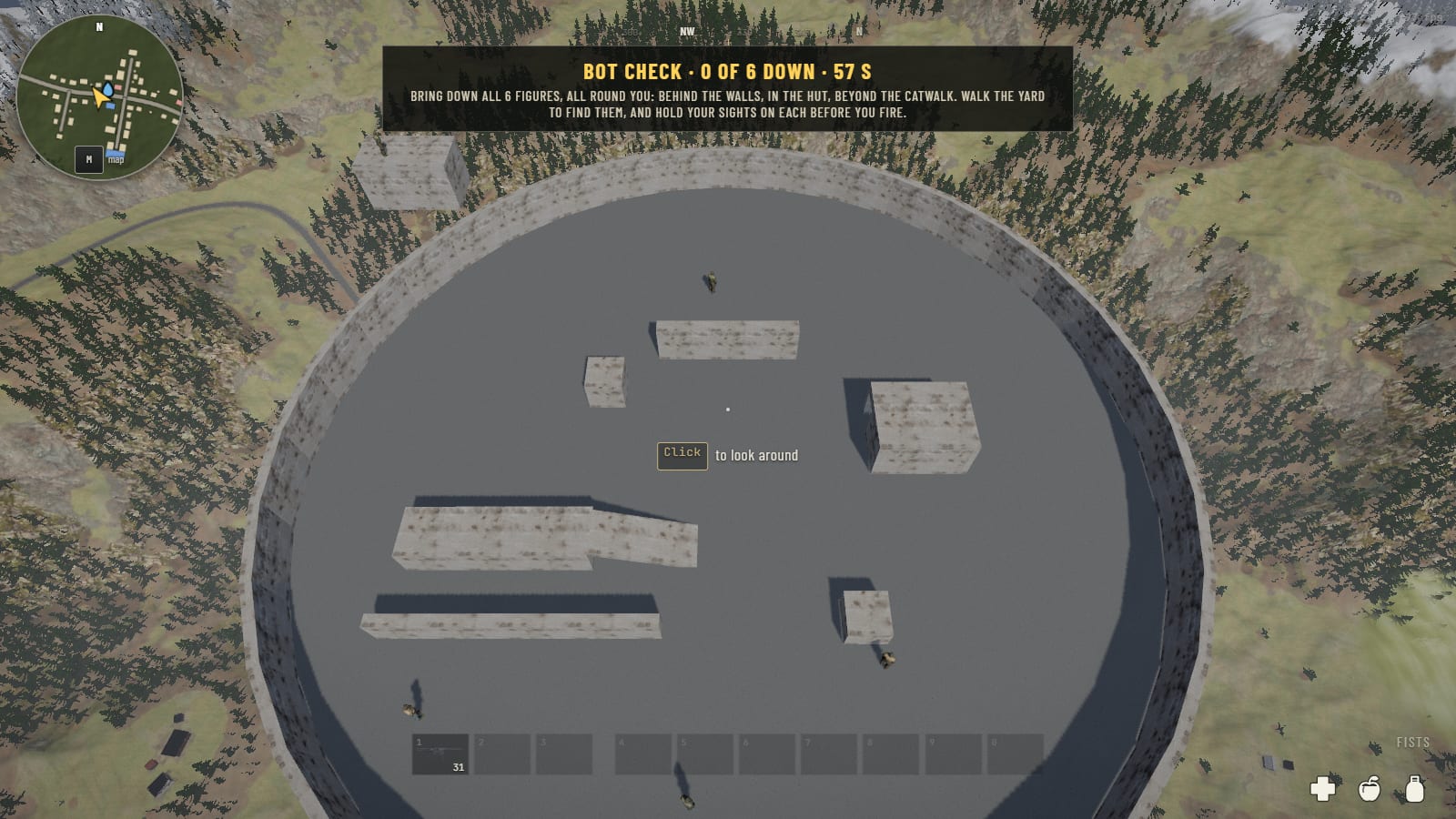
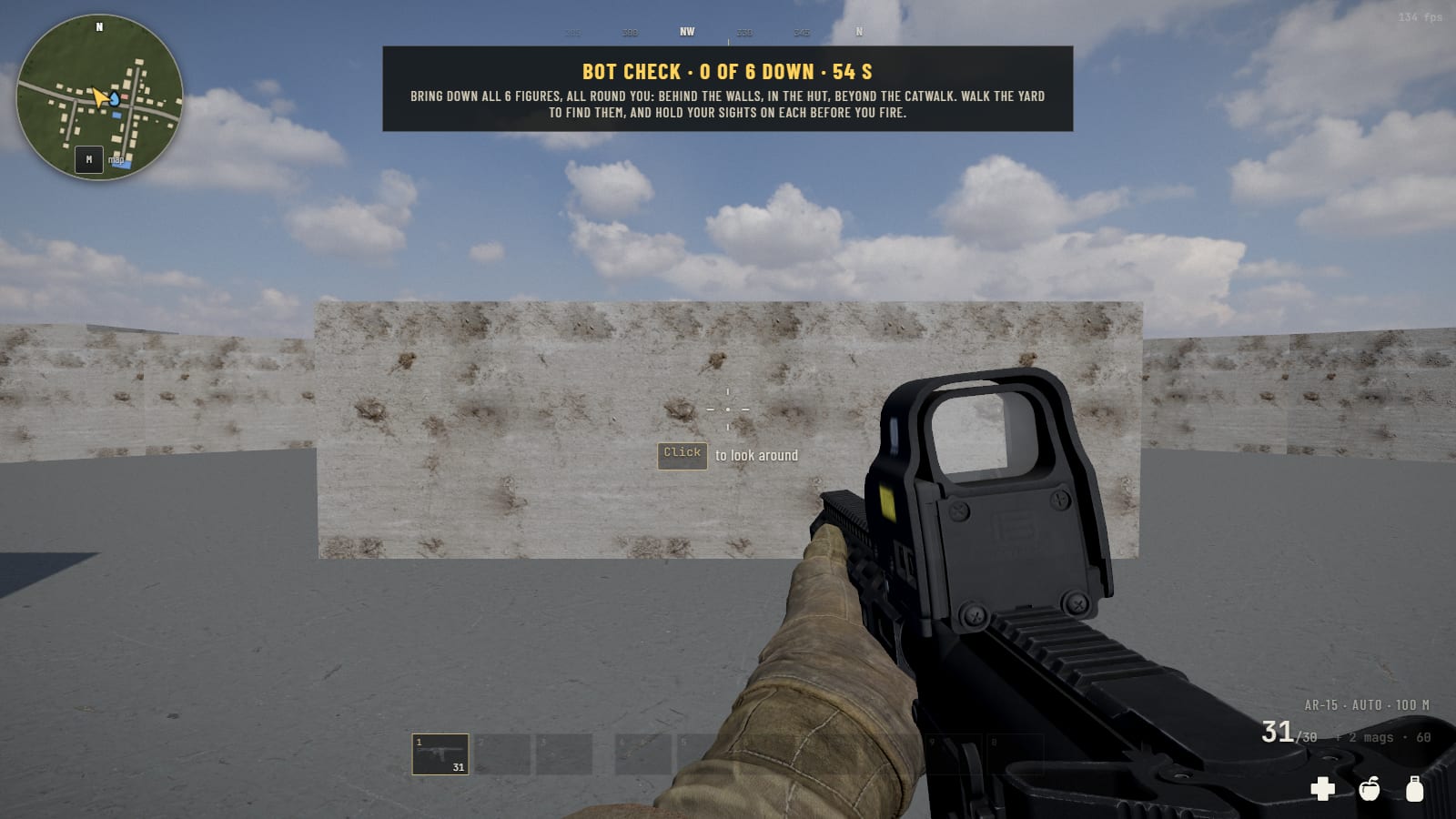
Scripts were getting through the firing range at the door. It is a course now: six figures all round you, behind walls, in a hut and beyond a catwalk, to be walked to and brought down in a minute. Everything about it is decided by the server.
The course, from above: walk the yard to find each figure.At the start, nothing is in sight: every figure is behind something.
The course: six figures where the range had four, all round you, each seen only from where it can really be seen. Bring them all down within a minute, sights on each before you fire.
Your first minute in the world is watched more closely: a body that moves as no person can is sent back to the course, kept where it stood with everything it had. Falls, jumps, stairs, roofs and dancing are fine.
A browser far out of date is asked to be updated before it comes in.
Play with a controller
A PlayStation or Xbox controller, on a PC or an iPad. Switch it on in Settings, under Controls: its buttons are where Call of Duty has them.
Menus and the inventory keep their mouse: the left stick moves a cursor, the yellow ring. ✕ clicks, holding ✕ drags, ○ goes back, the right stick scrolls.
The buttons: R2 fires, L2 aims. ✕ jumps; ○ crouches, held lies down. □ reloads, or takes, opens a door or searches when there is something in front of you. △ is the next weapon, held empties your hands. L3 sprints, and aiming holds your breath. R3 is the light; L1 and R1 lean. On the D-pad: up the map, down the call-out wheel (held, the right stick picks), left single shots or automatic (held, drops what you hold), right looks the gun over (held, talks). The touchpad, or View on Xbox, is the inventory; Options is the menu.
In a vehicle: the left stick drives, L3 sounds the horn and R3 the siren. In the helicopter ✕ climbs and ○ drops.
Settings: how fast the right stick looks round, and the look turned up and down round, under Controller.
On an iPad or a phone the touch buttons go away while the controller is used, and come back at a touch.
The emote wheel says Click to edit in its middle. Opening Emotes from it no longer brings up the menu as well.
Emotes, a wheel of your own, and magazines filled by hand
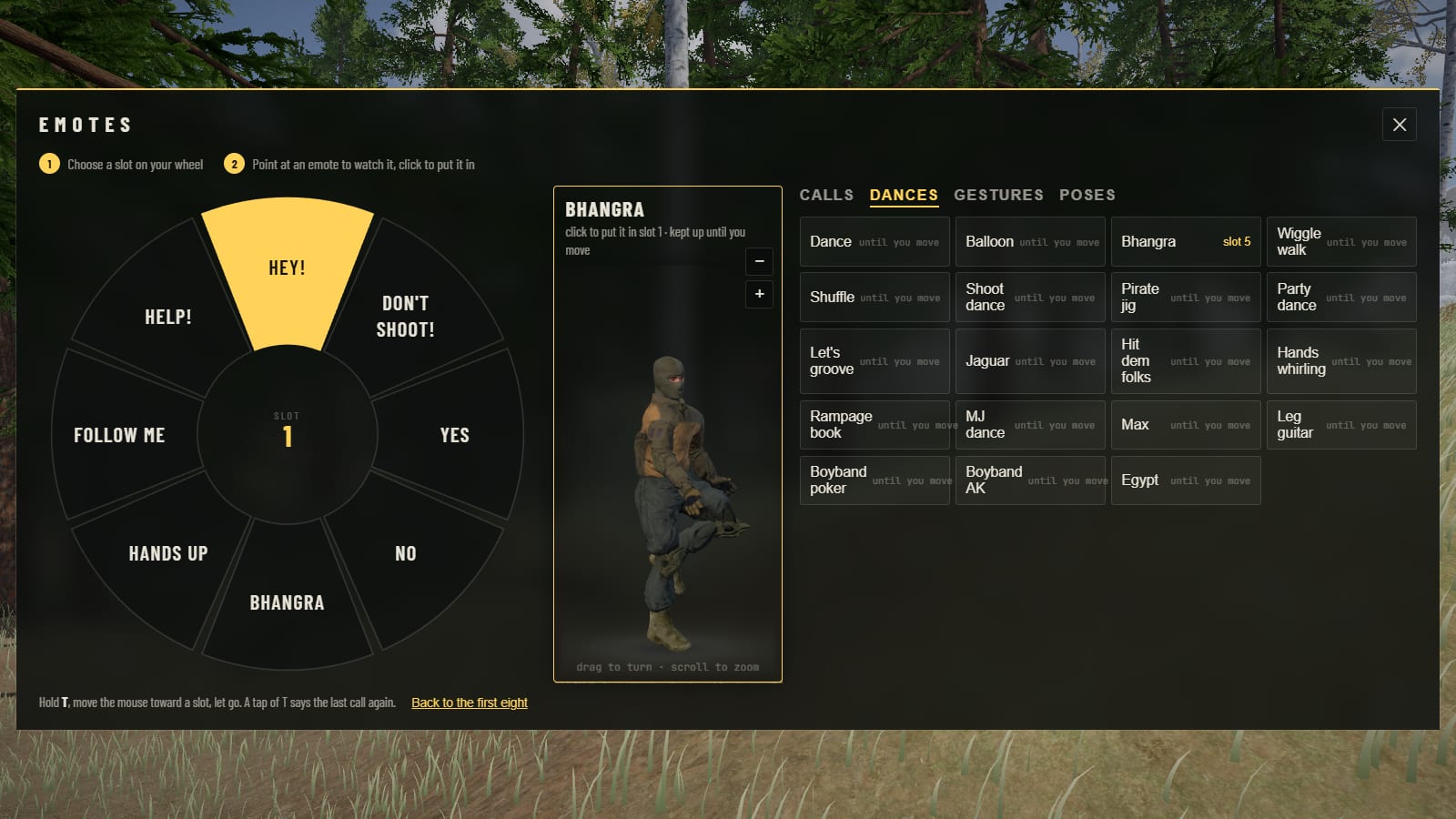
Twenty-eight dances and gestures, on your own survivor, and everybody near sees them. Choose which are on your wheel in the game, and watch each one before you put it there.
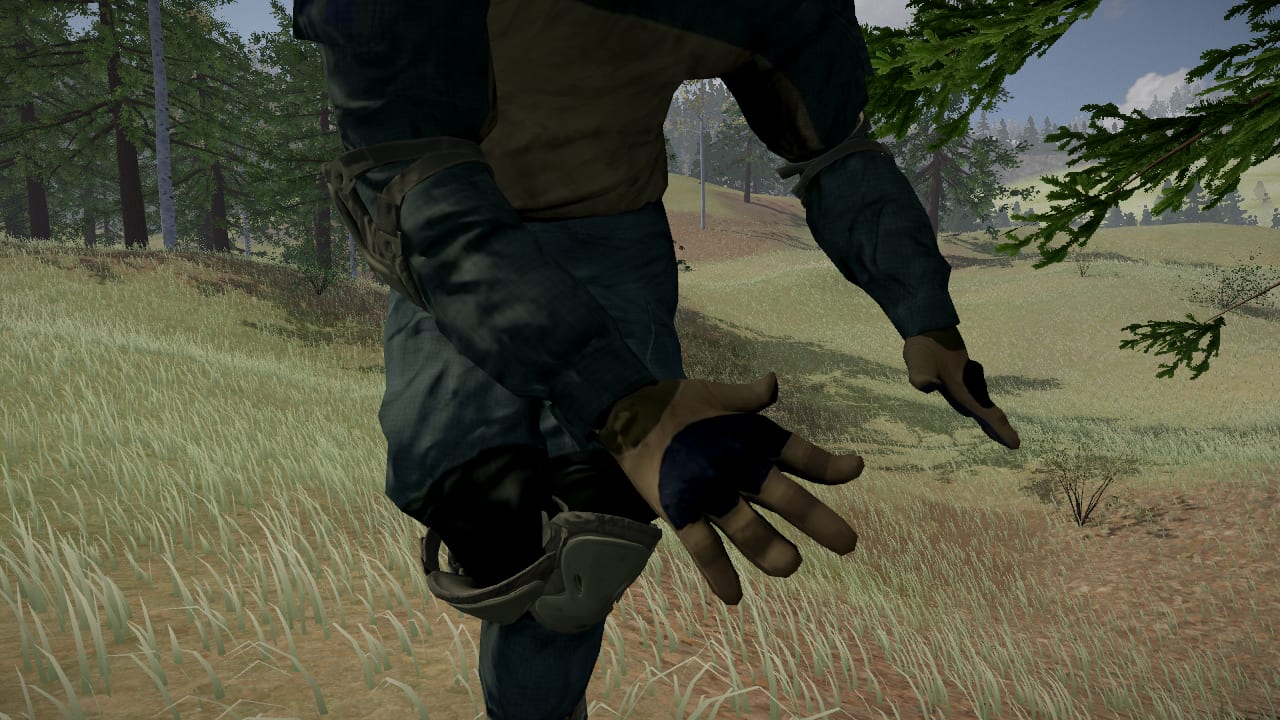
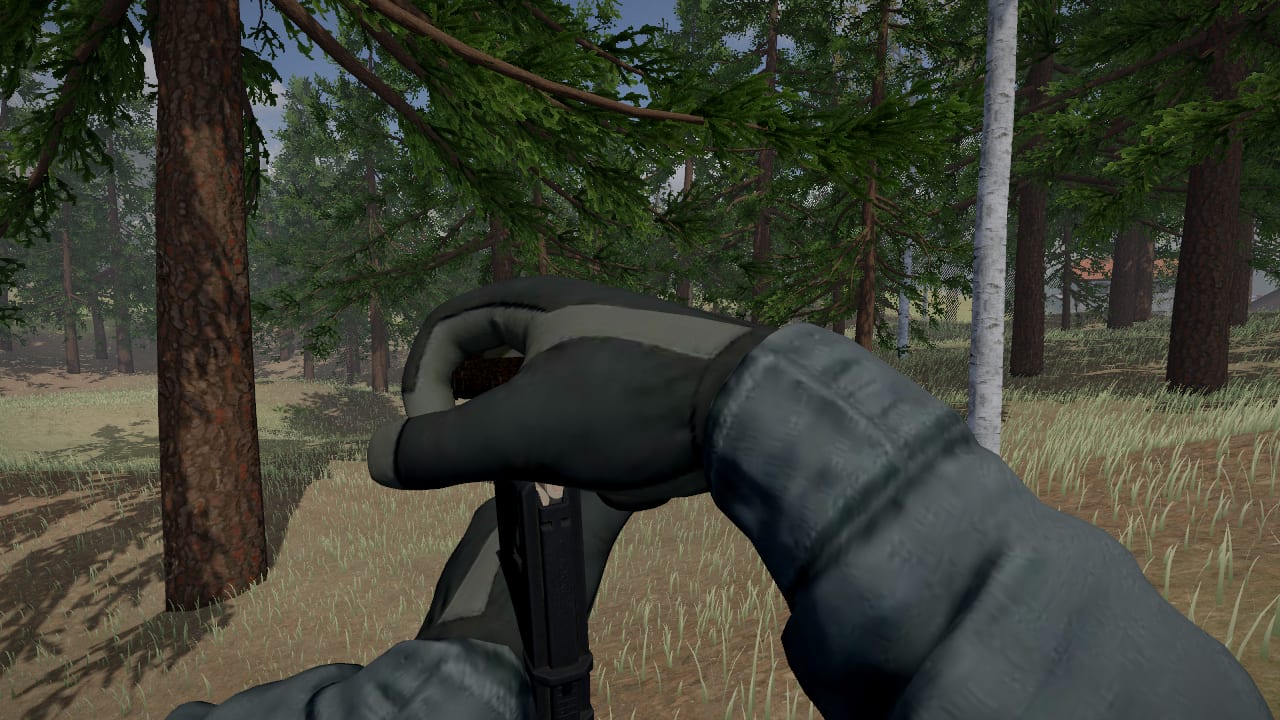
Emotes, over the game: choose a slot on the wheel, point at anything in the list and the survivor does it, click to put it in. Drag the survivor to turn it, scroll on it to come nearer.Hold T for the wheel as always. A click while it is up opens Emotes.Hands that dance: the fingers move as the dance's own do.Filling a magazine: held round in the left hand, each round pressed in on top with the right.
Emotes: 28 dances and gestures, from the Free Fire emote pack by endlessinfinitydream (CC BY 4.0), danced on your own survivor and seen by everybody near you. A dance goes on until you move; a gesture plays once.
Your wheel: eight slots, set in Emotes and kept in this browser. Hold T, move the mouse toward a slot and let go; a tap of T says your last call again. With T held, a click opens Emotes; Escape or its cross closes it. On a phone, Edit is among the emote buttons.
Calls: 18 things to call out, each said aloud and with a gesture of its own, for whoever plays without a microphone. Yes nods, No shakes the head, Wait holds up a hand.
Filling magazines: the magazine is held upright and turned to run away from you, round in the left hand, and the right hand pinches each round and presses it in on top. Every magazine was looked at.
Reloading an empty gun: with no magazine in it, R goes straight to putting the new one in. It used to show a magazine coming out first.
Automatic fire: two hits from a fast gun that reach the server together are both counted. The second could be thrown away before.
The payouts page: a wallet paid for several tags at once is one line with its one transaction, the tags folded under it with their receipts. See it on the payouts page.
The bot check at the door is stricter.
A faster start, a new menu, horns and a crawl
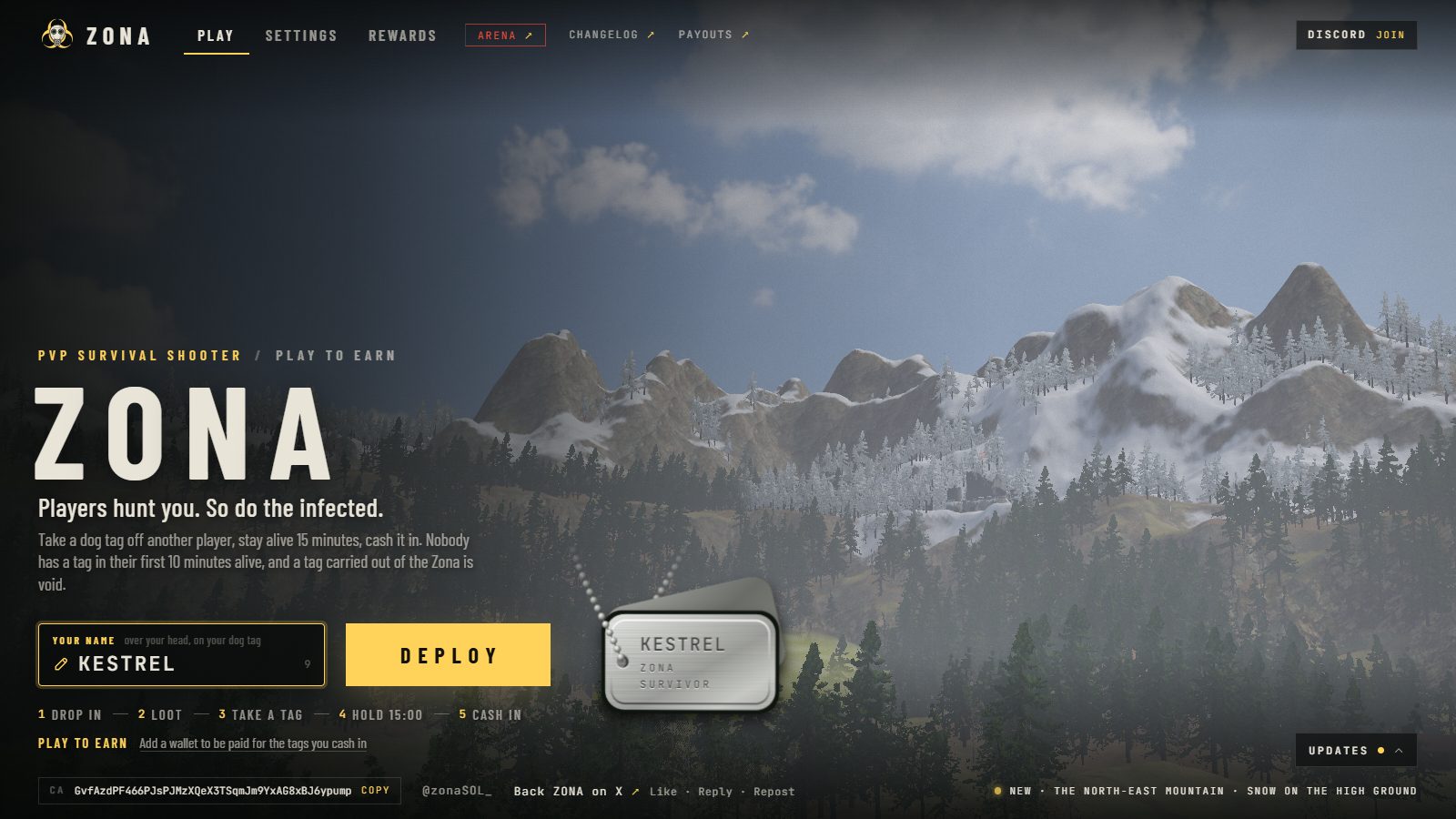
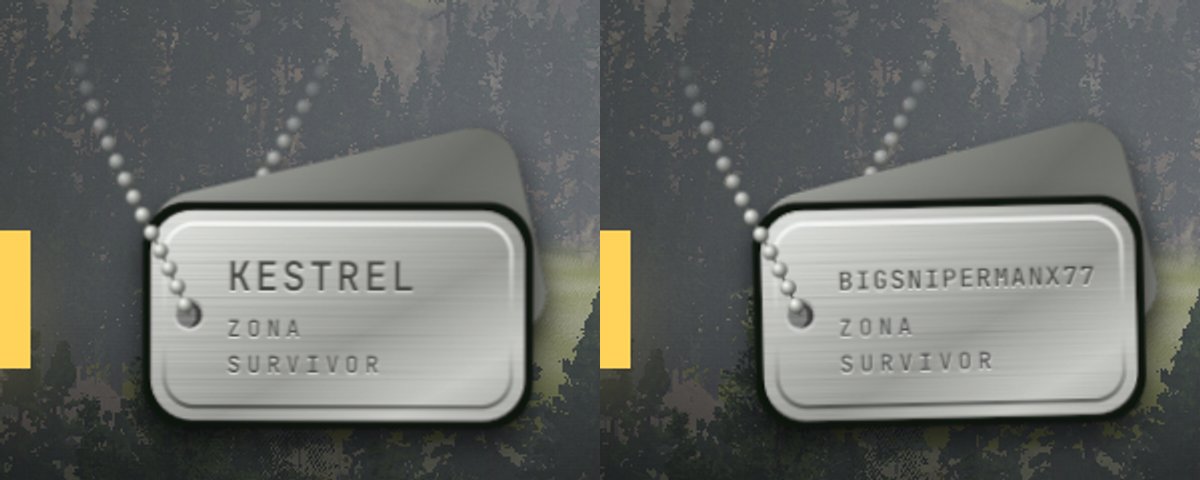
The game no longer stands still while it loads, so the browser stops calling the page unresponsive, and the menu comes up sooner. Your name has a proper field, and your dog tag looks like one.
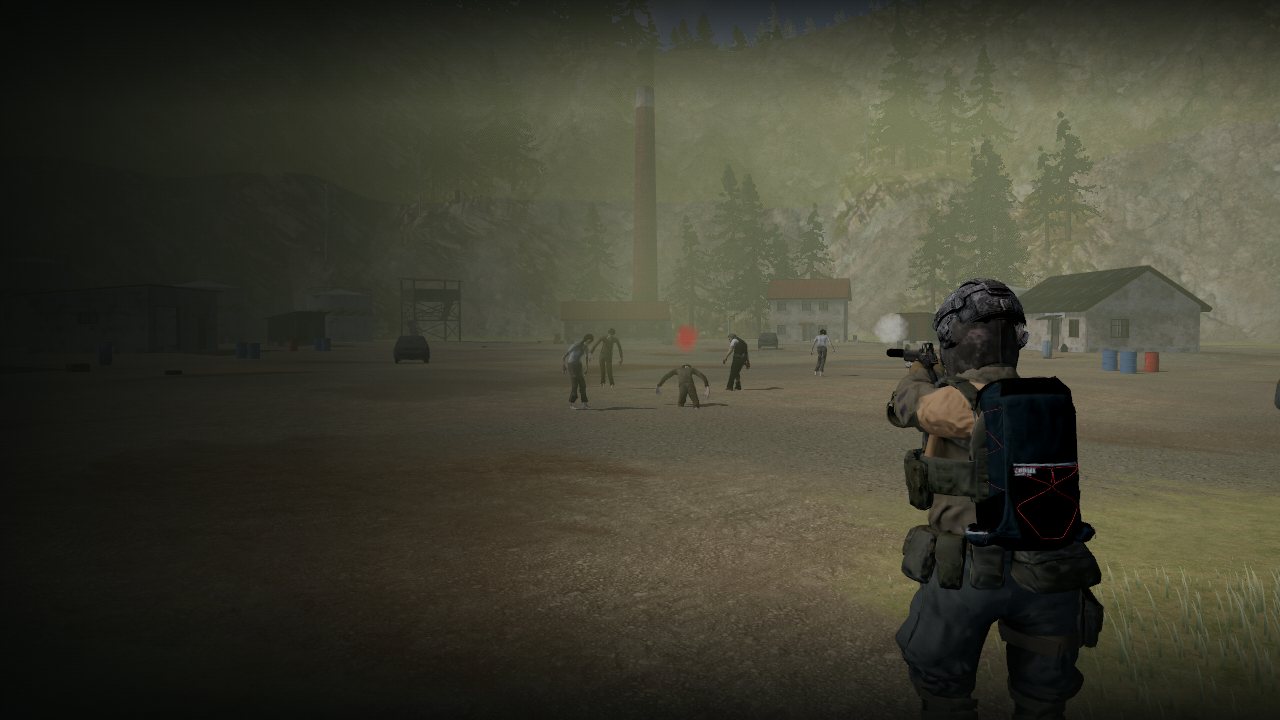
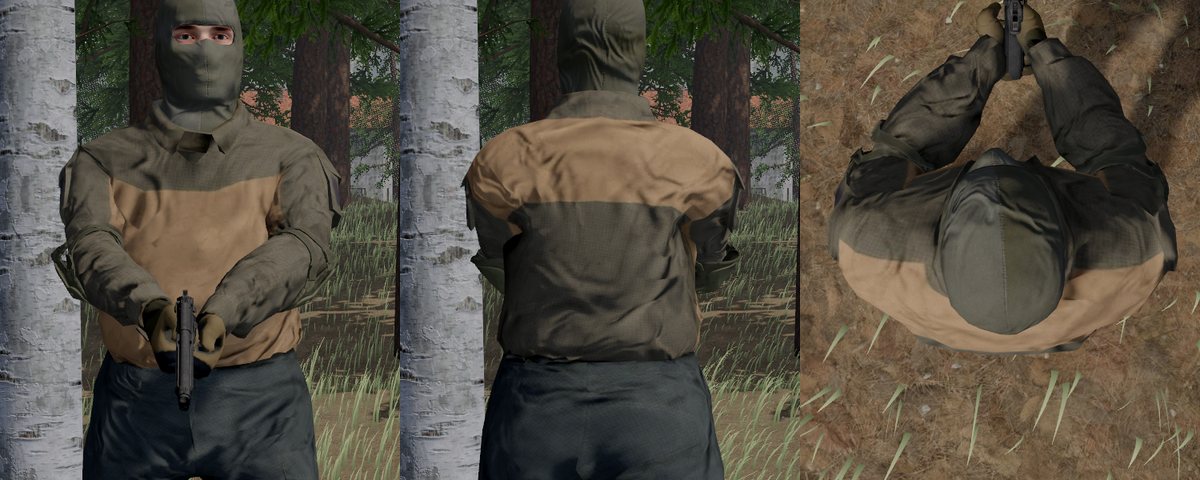
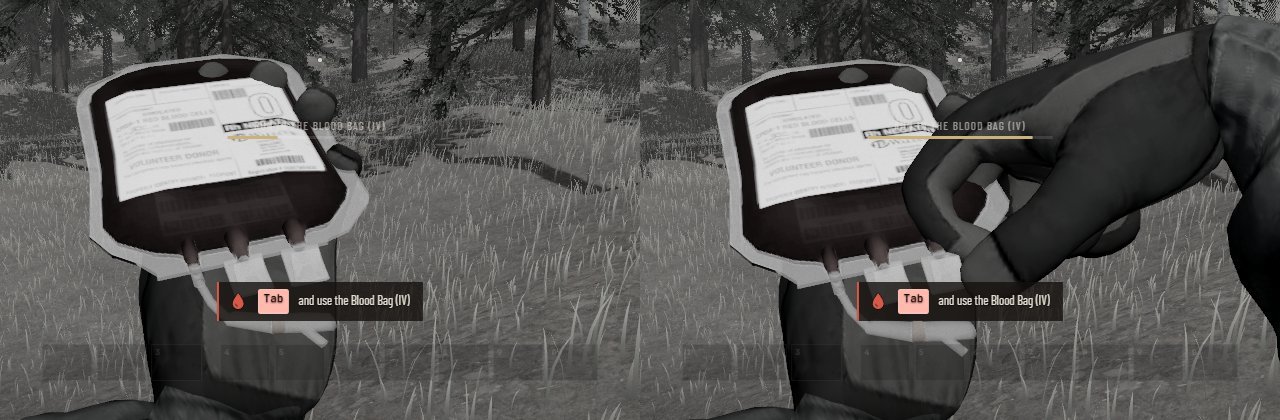
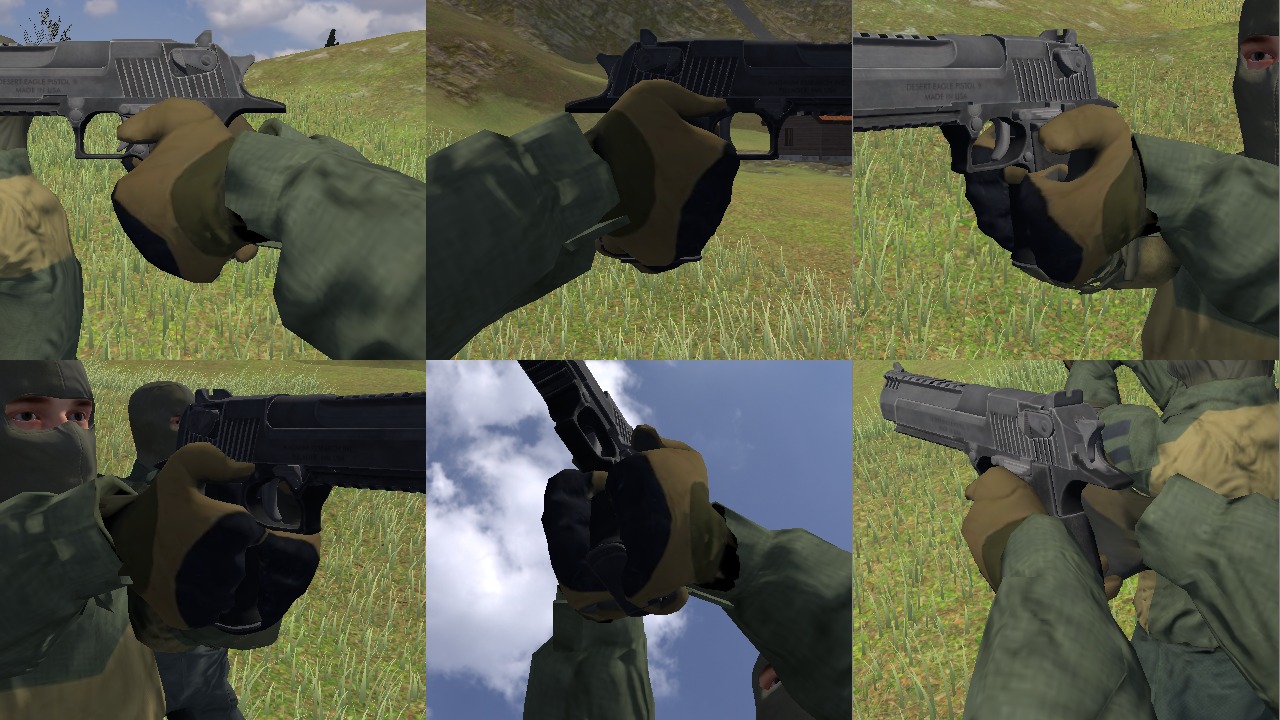
Your name, plainly, and stamped into your tag letter by letter as you type it.The tag: brushed steel, a rubber rim, the chain through the hole, a second tag behind. A long name is struck smaller to fit.The gas scene in the menu, shot looking into the gas now: it looked out, at trees.A pistol in other people's hands, from the front, behind and above: low at the belt, the elbows down and out from the ribs.A blood bag lies on the left hand as a roll of dressing does.
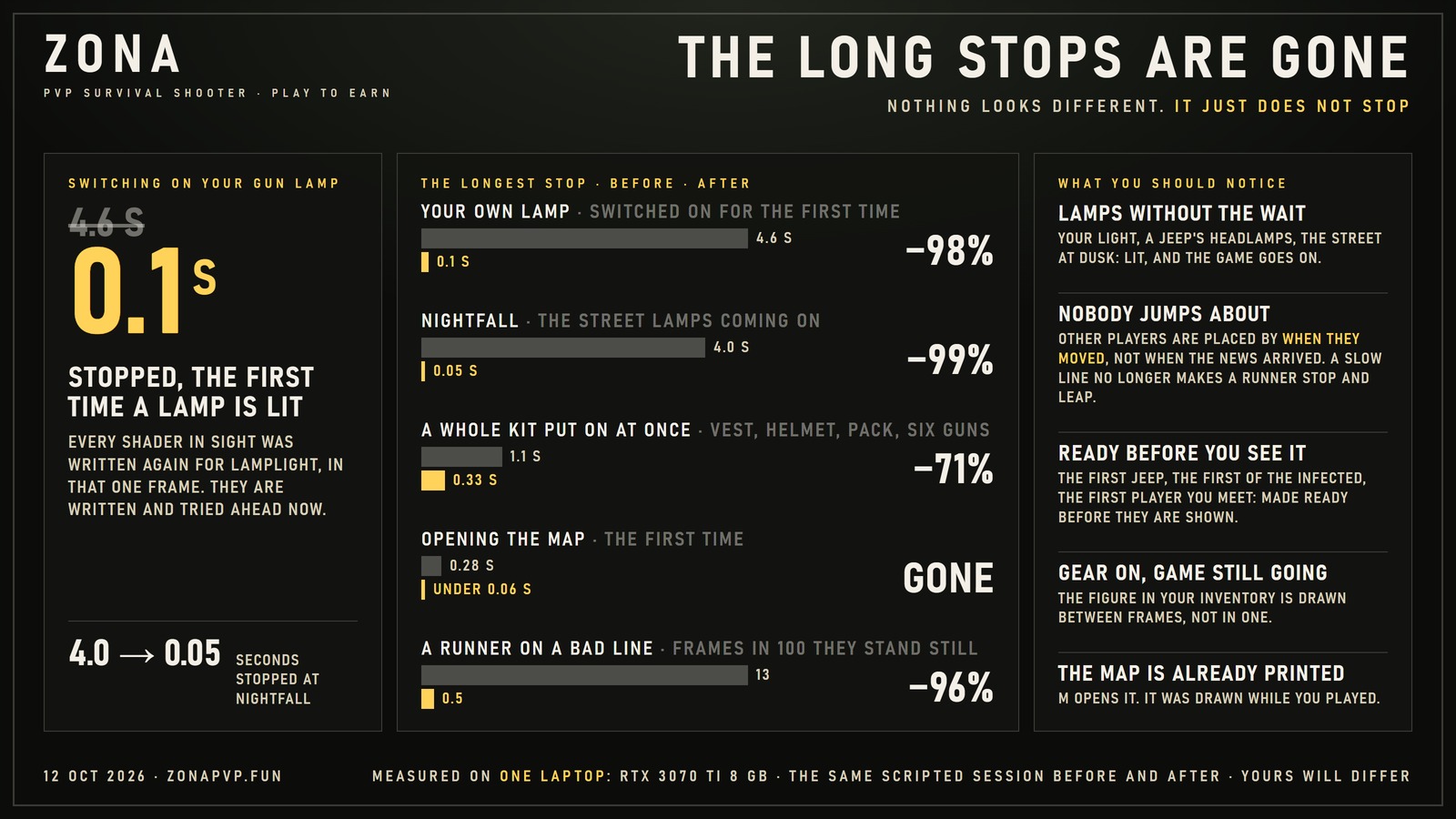
The start: the game used to get every one of its shaders ready in one go and then draw the whole world with them, and for 25 seconds or more the page answered nothing. Now it is done a piece at a time while the page goes on answering, with a count on the loading screen. On a first visit the menu came up in about 29 seconds where it took 47, and nothing on the loading screen held the page for more than about a second (measured on one laptop, an RTX 3070 Ti, with nothing kept from before; yours will differ). The lamps' half of it is now done behind the menu: pressing Deploy at once can show Loading for a few seconds while it finishes.
Your name: a field that says what it is, with the letters you have left. Your dog tag beside Deploy, stamped as you type (not on phones, where there is no room).
Horns: H sounds a car's horn, and J the siren on the police car. Everybody near hears them.
Lying down and crawling: going prone now plays a real drop from a crouch to the ground, from standing too, and crawling is a real crawl. Lying down, your head turns to look where you look, where it looked straight up.
Crawling is heard: a crawl makes a sound of its own, from where the crawler is, quieter than a crouched walk.
Phones at the firing range: a phone that took its time building the range could be failed before it had finished. It is given the time.
Headshots on the infected: the part of them that counts as the head is now the middle of each one's own head. It was 7 to 8 cm off on three of the four kinds, and 4 on the one in the suit.
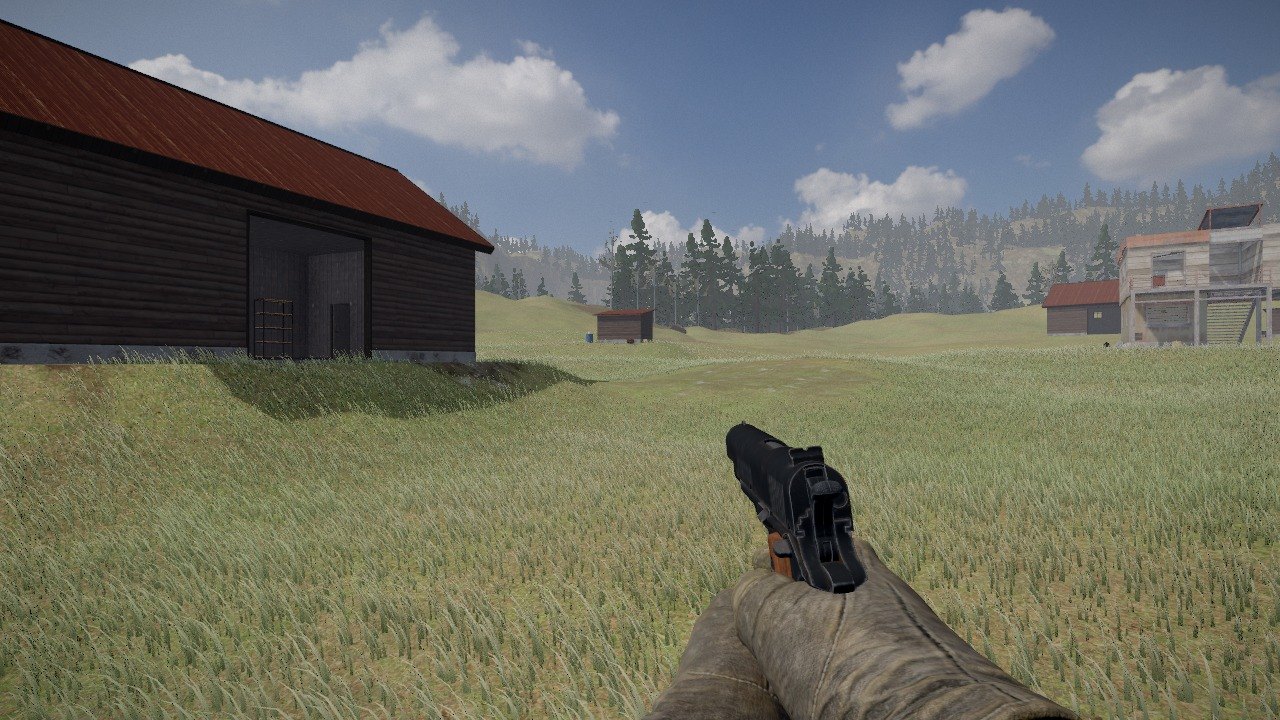
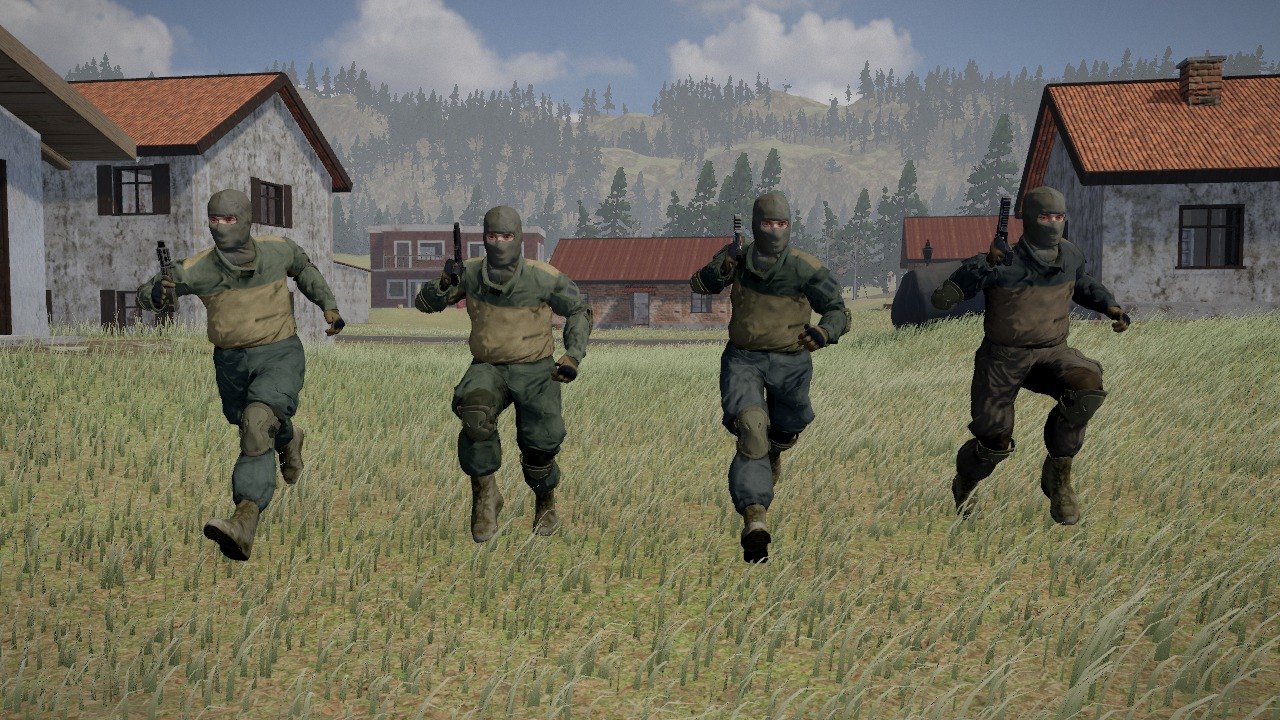
Hands: a pistol is held low at the belt by everybody you see, elbows down and out from the body, and aimed with the head down to the sights. A blood bag or saline is held on the left hand, the right hand working it. The roll of dressing is drawn bigger in the hand.
The menu's gas scene: over the shoulder, into the gas: in with the pistol low, two quiet shots, two of the infected down.
Shot down with it
Somebody killed in a helicopter no longer dies in the sky. Their body stays in its seat, and comes down with the helicopter.
Still in the seat while the helicopter flies on or falls.On the ground beside it once it is down, everything they carried on them.
Until it is down (landed, crashed or wrecked) the body is in its seat, and nobody can search it from under it.
Then it is laid on the ground beside the door of the seat they sat in, with everything they carried, to be searched as any body is.
Performance boost, and no more lamp freezes
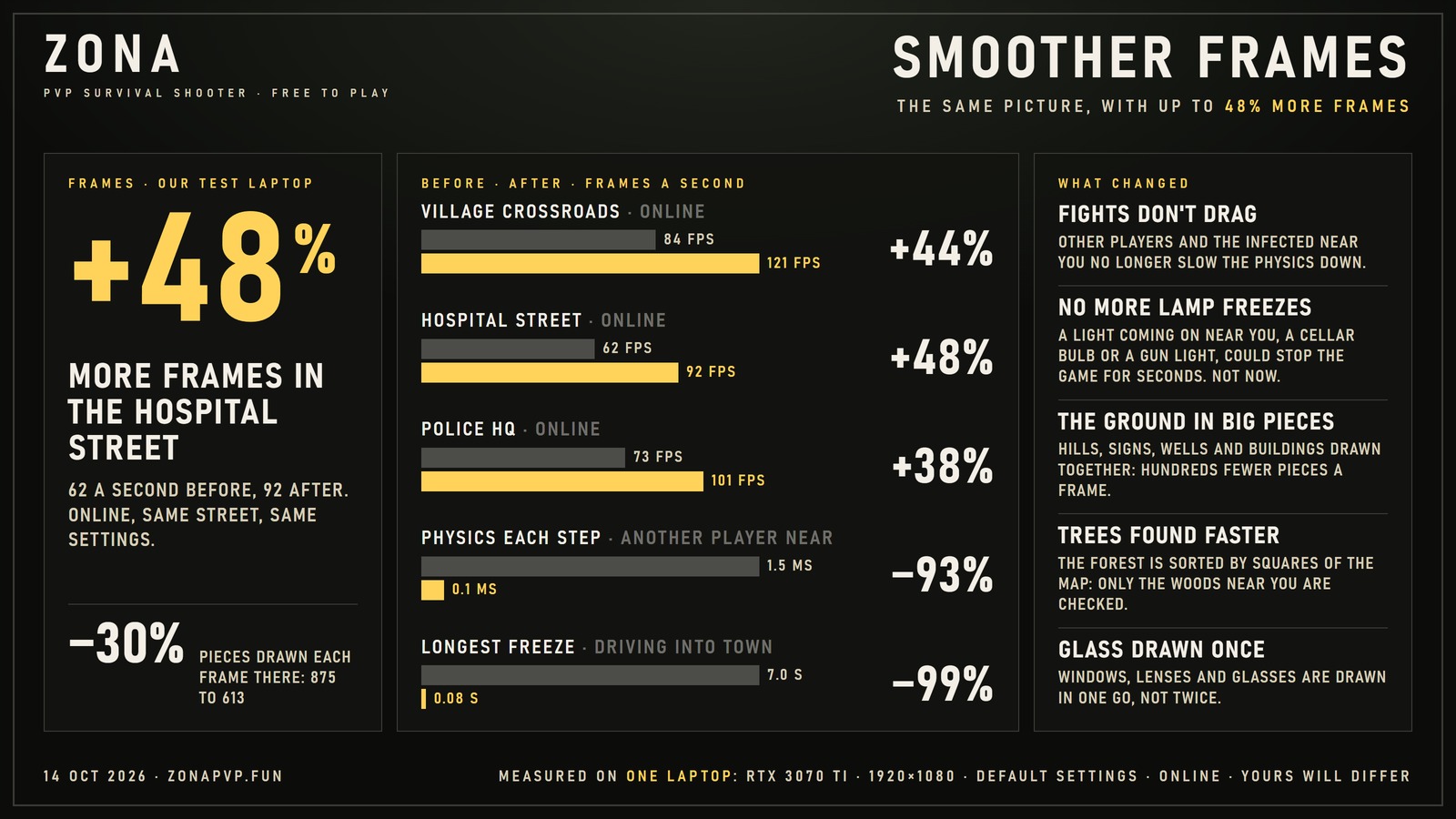
The second half of the day's work on frames: glass and buildings drawn in fewer goes, and an end to the freeze when a light first came on. Together with the update before it, up to 48% more frames than this morning, the same picture. And the helicopter comes down fast.
This morning's game and this one, both updates together, measured online on one laptop (an RTX 3070 Ti, 1920×1080, default settings). Yours will differ.
No more lamp freezes: the first time a light came on near you (a cellar bulb, the lamps at dusk, a gun light) the game could stop for five to seven seconds while it got ready to draw it. Now it gets ready first and the light comes on a moment later. The worst frame driving from the village into town went from 7.0 seconds to 0.08.
Glass drawn once: windows, lenses and glasses seen from both sides were drawn twice, back and front, choosing how to draw them again each time. They are drawn in one go.
Buildings: every copy of a building's model is drawn at one go, a piece at a time.
The crosshair: the first time it showed, the game could stall for a quarter to four tenths of a second. Not now.
The helicopter: hold C and it all but falls, still going the way it was, and slows itself in time for the ground (it came down at 6 m/s at most). Space climbs at 12 m/s, where it was 7. And it takes a quarter less to wreck than a car: 4,050 where a car takes 5,400.
Smoother frames, the same picture
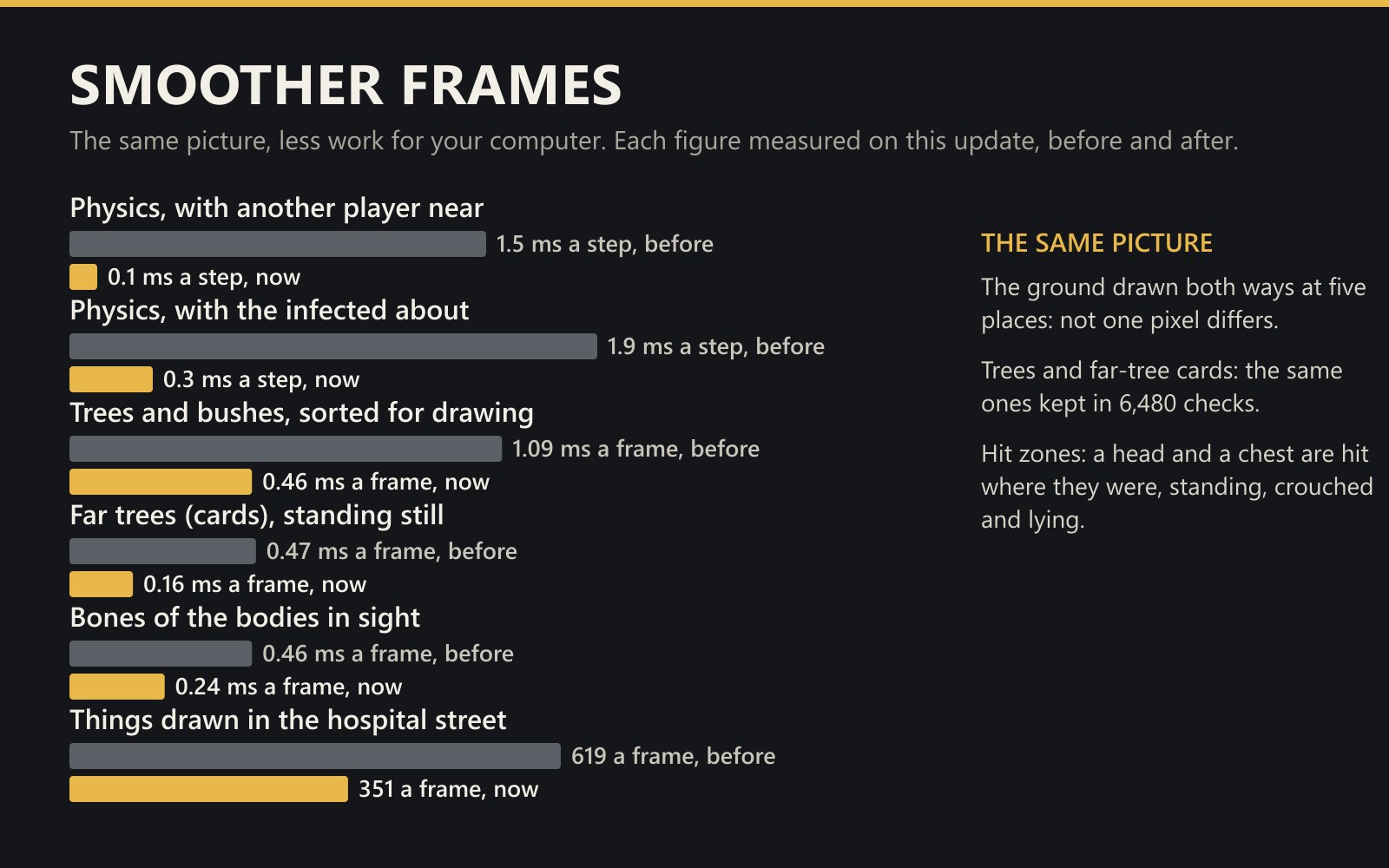
The world is drawn in fewer pieces and worked out with less waste: the same picture, with less for your computer to do in every frame. And the basements are stocked as they were meant to be.
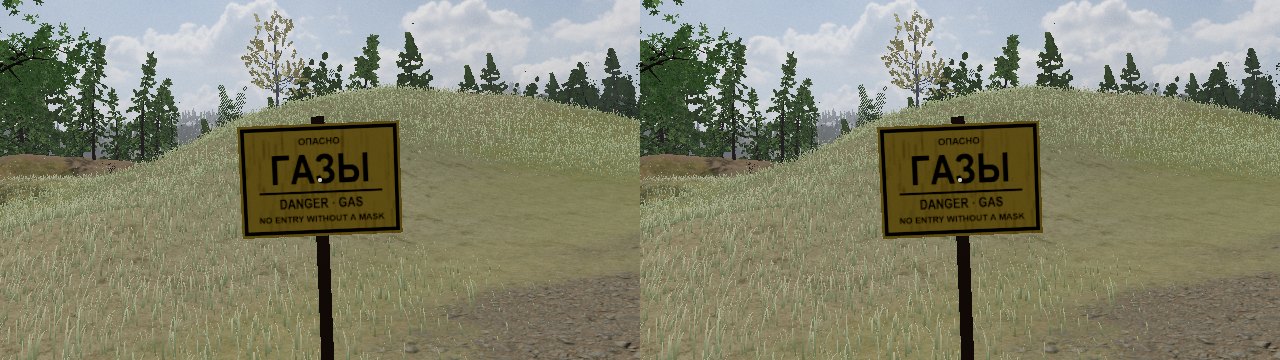
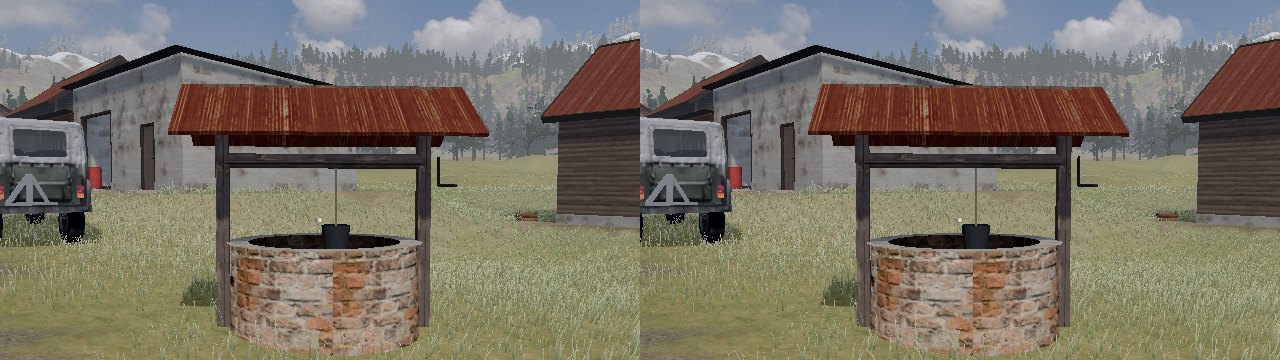
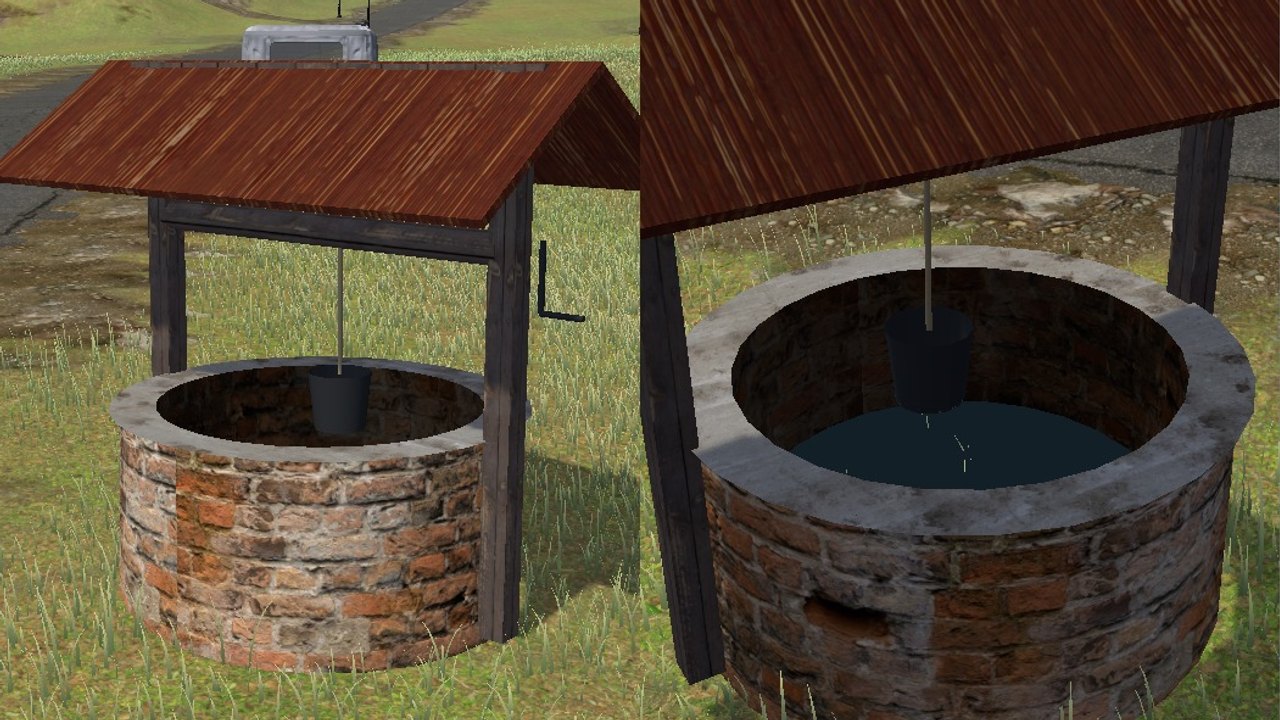
What changed, each measured before and after on this update.A gas sign, before and after: the 22 signs were 154 things to draw, and are 3.A well, before and after: fifteen things to draw, now eight for both wells.
Physics near other people: another player's head and chest, and an infected's, were moved in a way that made every physics step cost about one and a half milliseconds. They are hit exactly where they were, standing, crouched and lying, for a tenth of the cost.
The ground is drawn in large pieces where all of a piece is in sight, not tile by tile: 36 to 60 fewer things to draw in a frame, and not one pixel different.
Trees and bushes are sorted for drawing by squares of the map: the same ones drawn, at less than half the cost.
Bodies: fingers are curled four times faster, and each body's bones are worked out once a frame where three.js did it twice.
Doors, signs and wells: 423 still door hinges no longer weigh on every frame; the gas signs, the wells and the bunker's roofs are drawn in fewer pieces.
Loose loot more than about 8 metres away is drawn with its lighter copy, and casts no shadow.
Basements are stocked as a place of their own, three times their share: they had been counted in with the houses above them and stood empty.
Basements
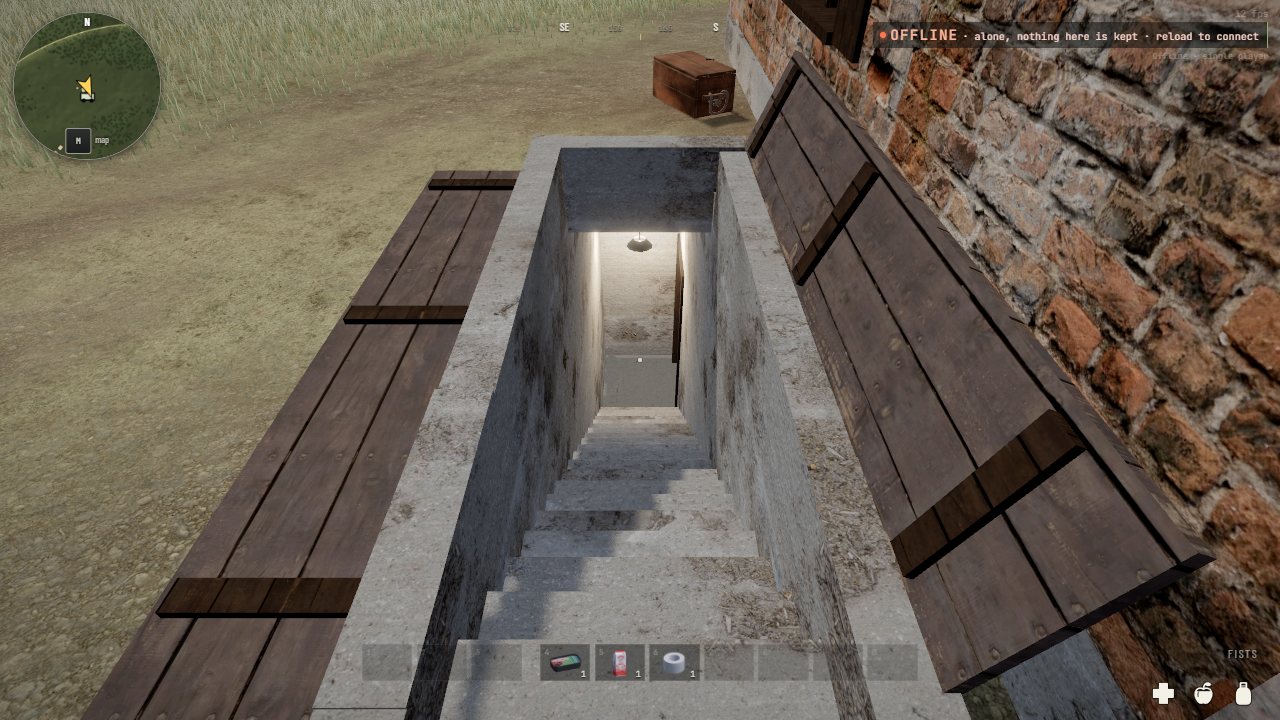
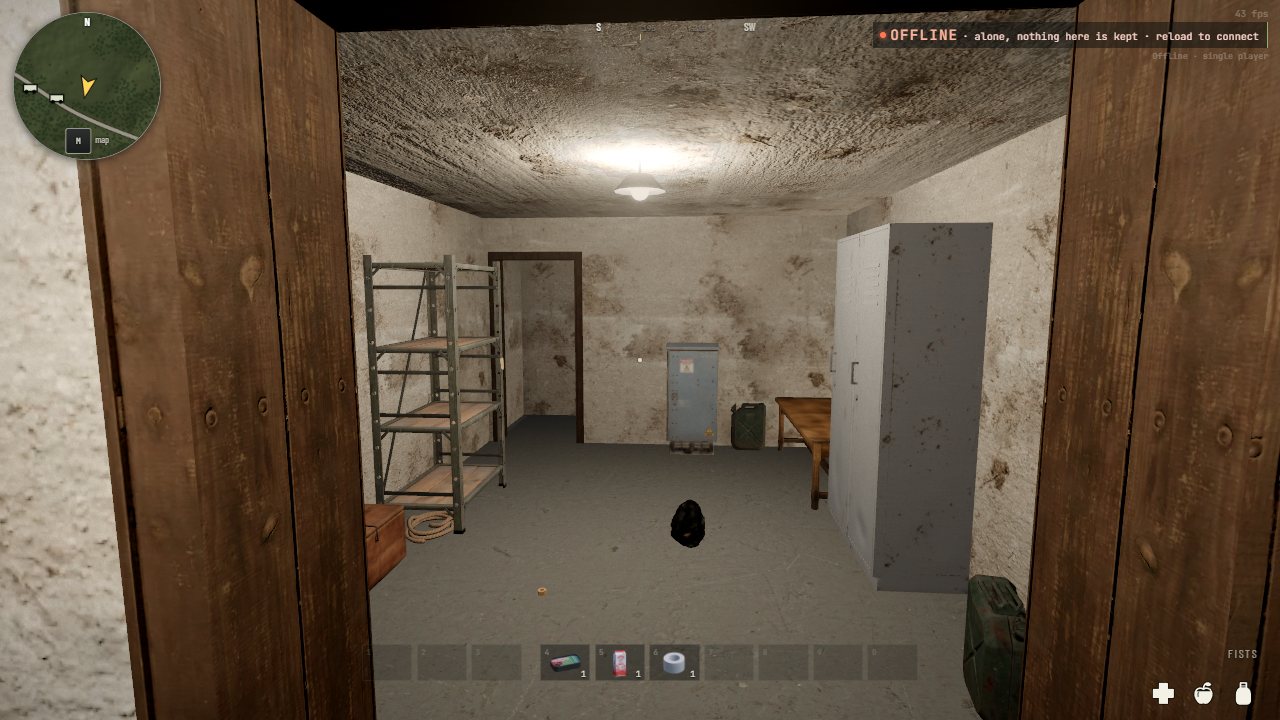
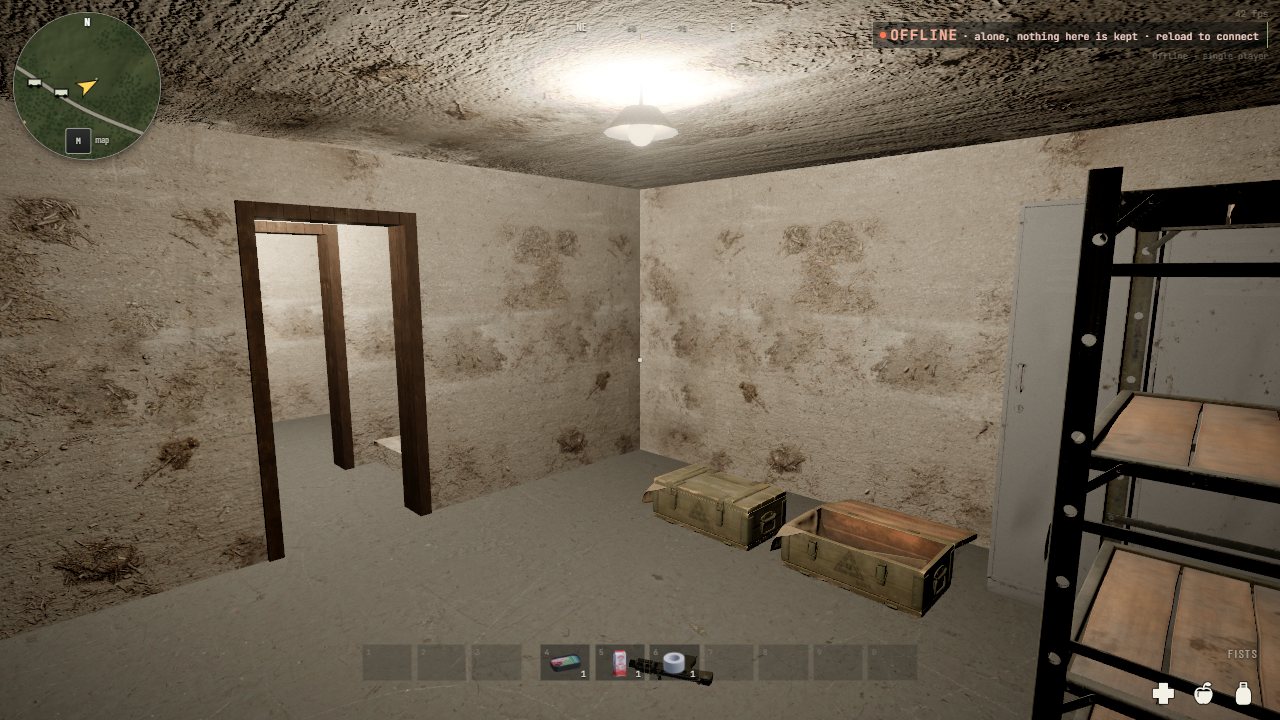
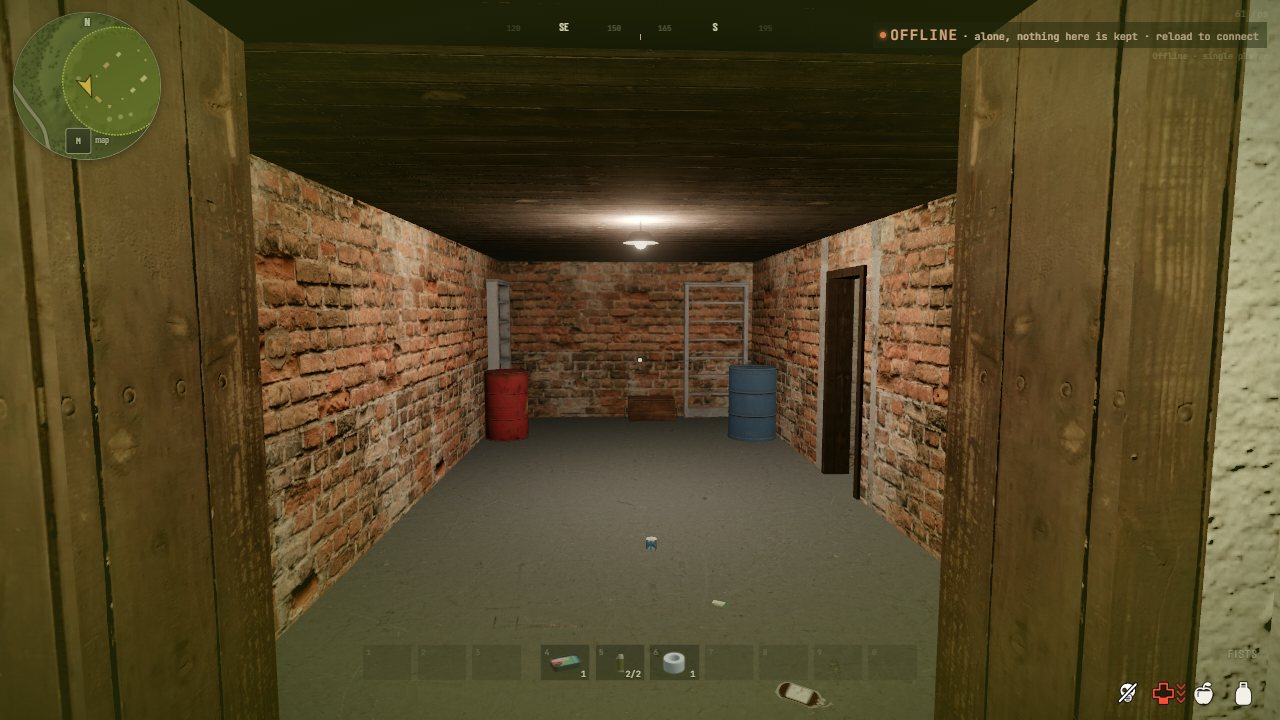
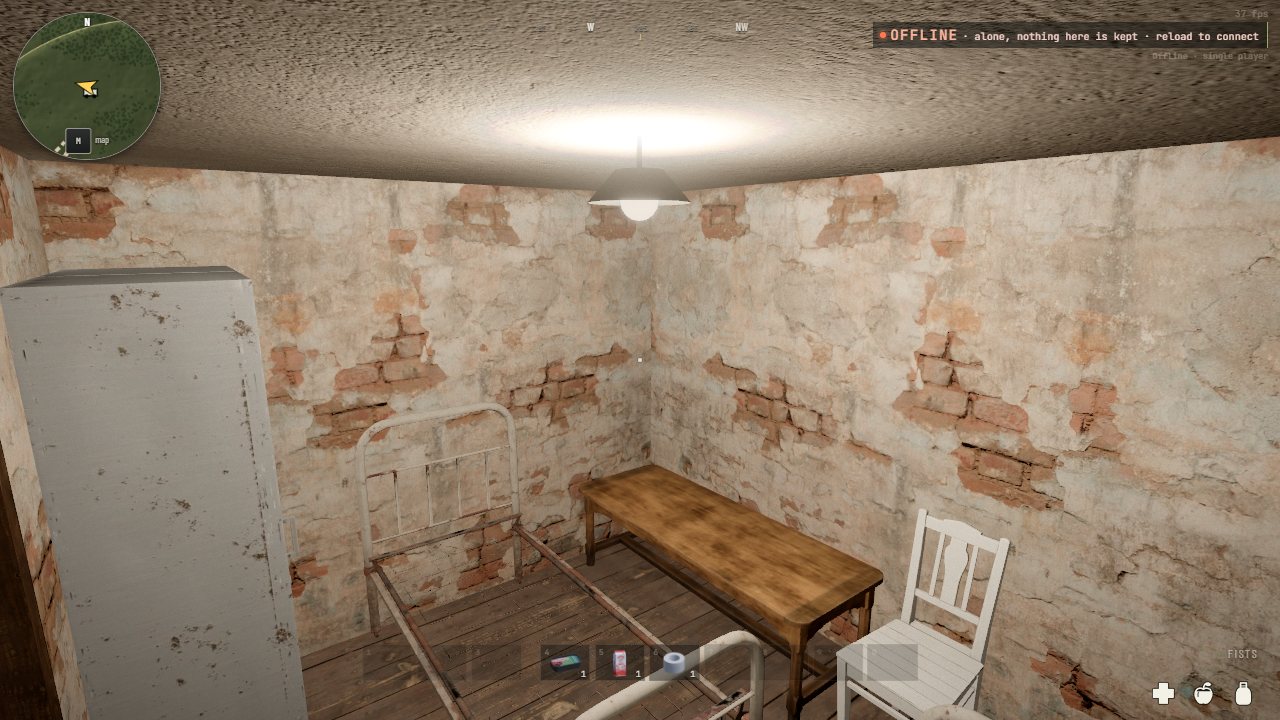
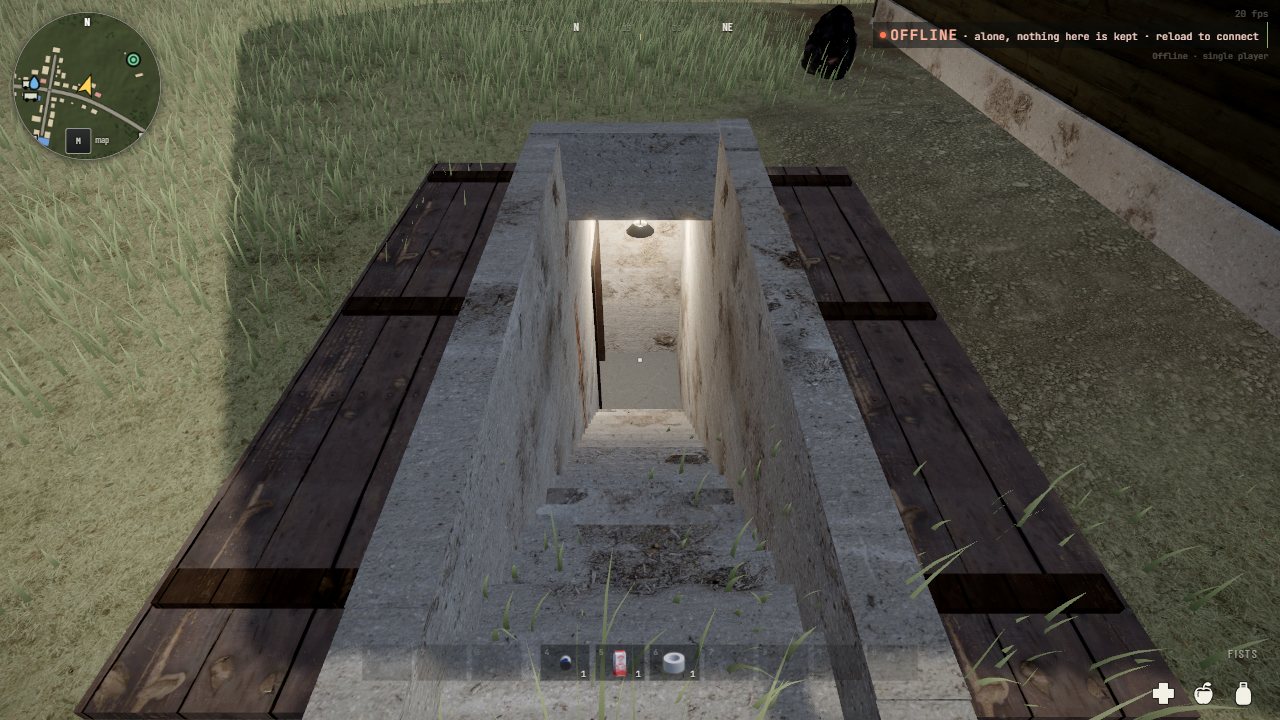
Some houses have a cellar door in the yard, and some barns a storm cellar beside them. The steps go down four metres to rooms under the earth, lit by a bulb or two, with loot in them: the further in and the deeper, the better it is.
The way down: a cellar door in the yard. One way in, one way out.A workshop from the foot of the steps.Two levels down: the vault at the foot of a second flight.A double cellar: a passage leads out under the yard to a second room.A hideaway: bunks, a locker, a store and a closet off a hall.A storm cellar in a barn's yard.
Six kinds of basement: a root cellar; a workshop with a closet and a store room; a hideaway; a double cellar with a passage out to a vault; one of two levels, with a shaft down to a vault and a closet; and the storm cellars by the barns. The rooms run out under the yards as well as under the houses.
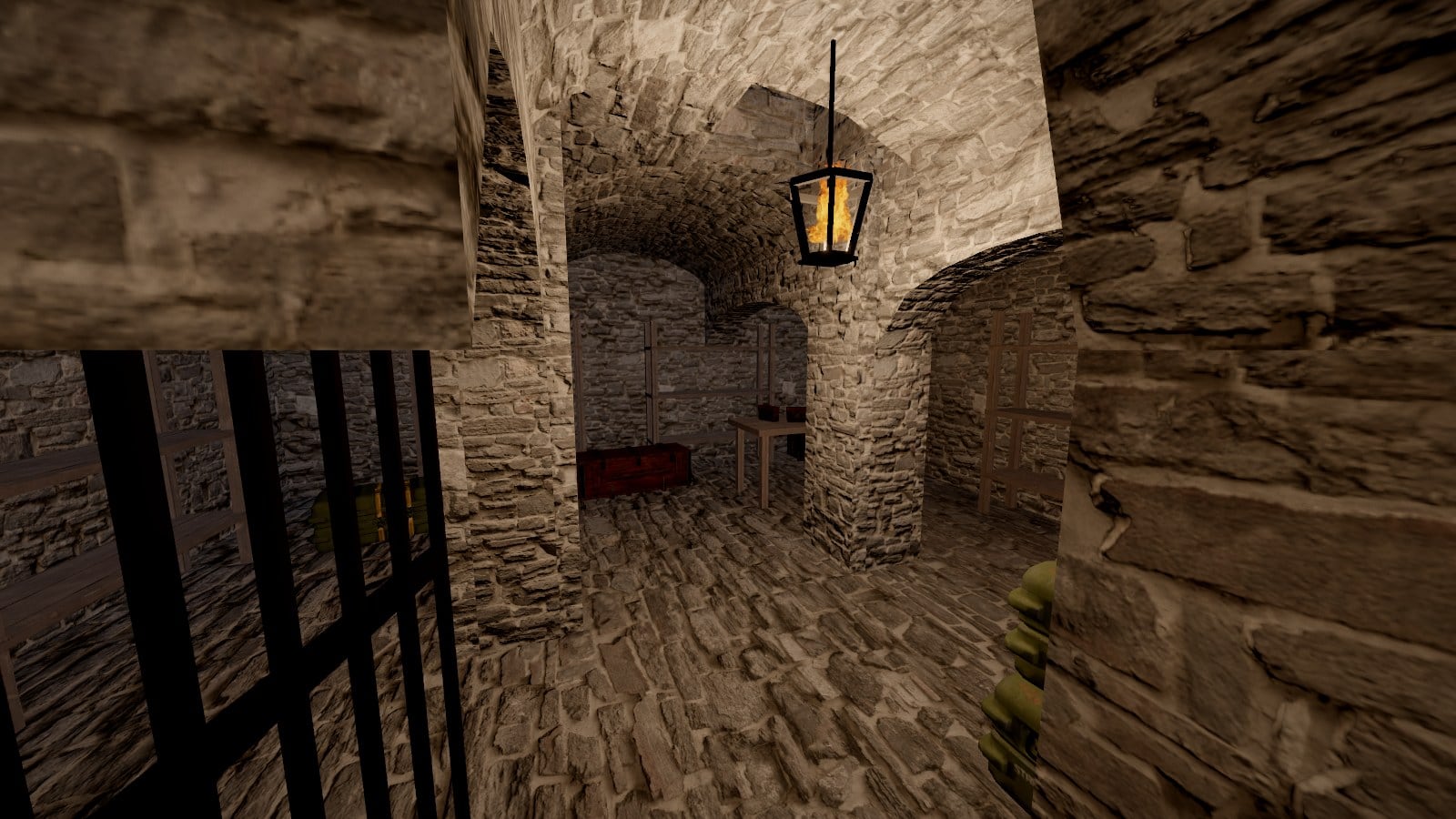
Loot in them lies on the floors and in their crates and lockers. A hideaway's or a vault's is a step better than the house's own, and on a second level two steps better, its crates the best kept anywhere under a house.
Dark down there: the bulbs light the rooms; the day comes no further than the steps.
A smoother picture: every computer is set once to full resolution with anti-aliasing and ambient occlusion off, shadows low and foliage medium. What you change in Settings after that is kept.
The white shelves no longer stand half inside the walls of sheds, huts, shops, clinics and barracks.
Admins keep their powers when they leave and come back, and across restarts, and get their role back as soon as the server knows it.
Two games, one door: the Arena gets its own menu
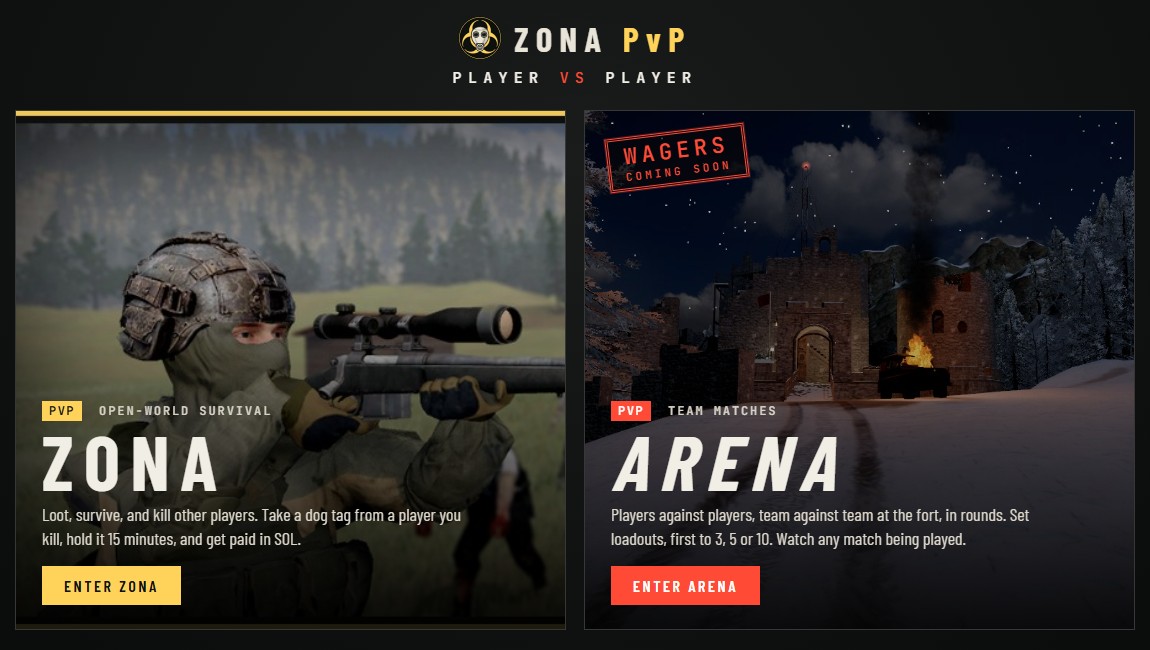
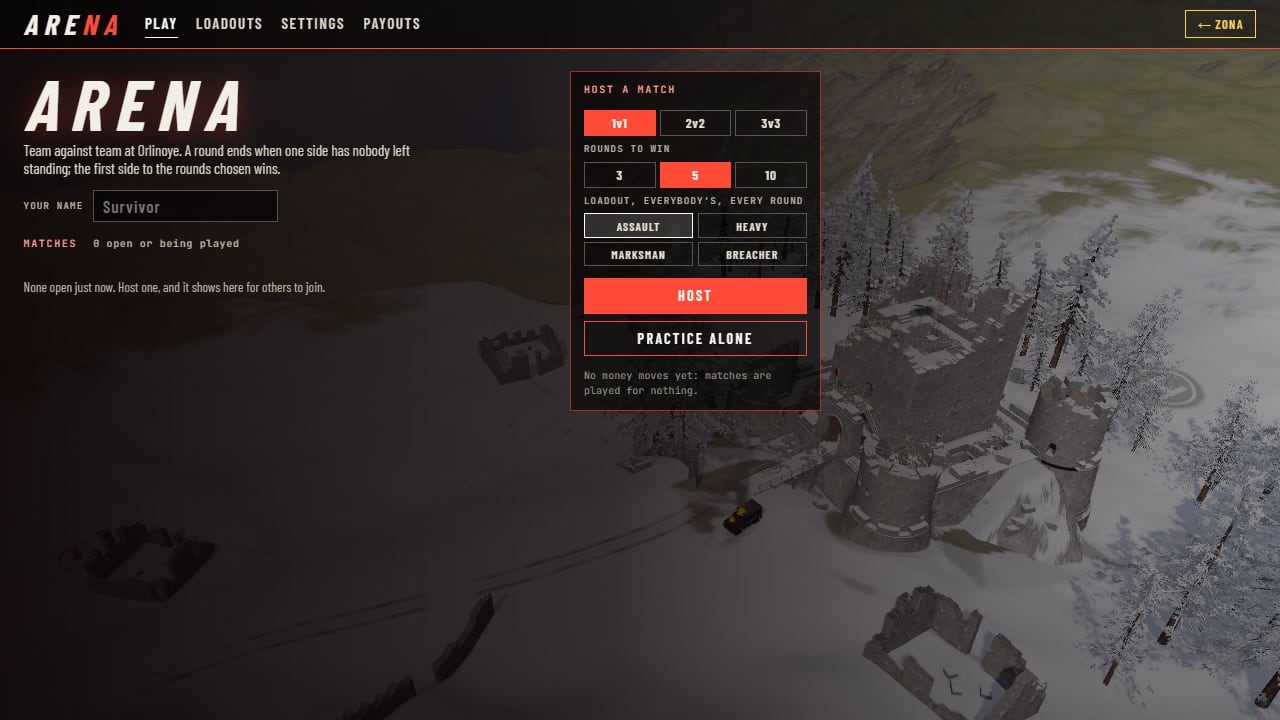
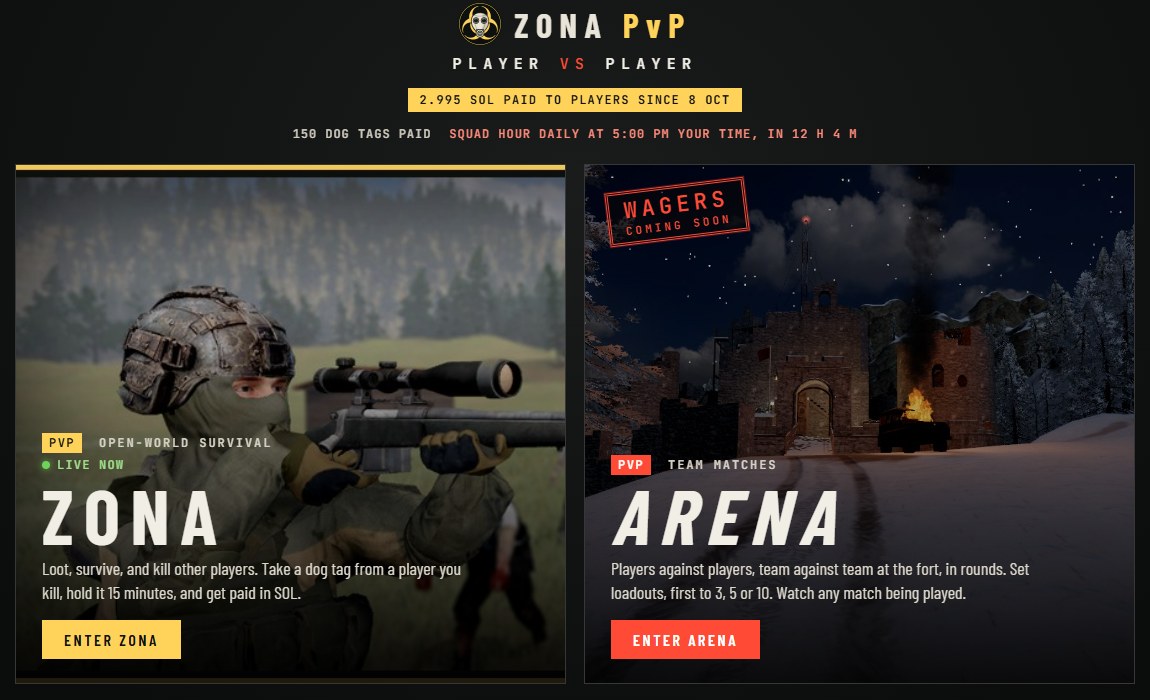
zonapvp.fun now asks what you came for: ZONA, the open world, or the Arena, team matches at the fort. Each has its own menu, and both are ZONA PvP. zonapvp.fun/zona and zonapvp.fun/arena go straight in.
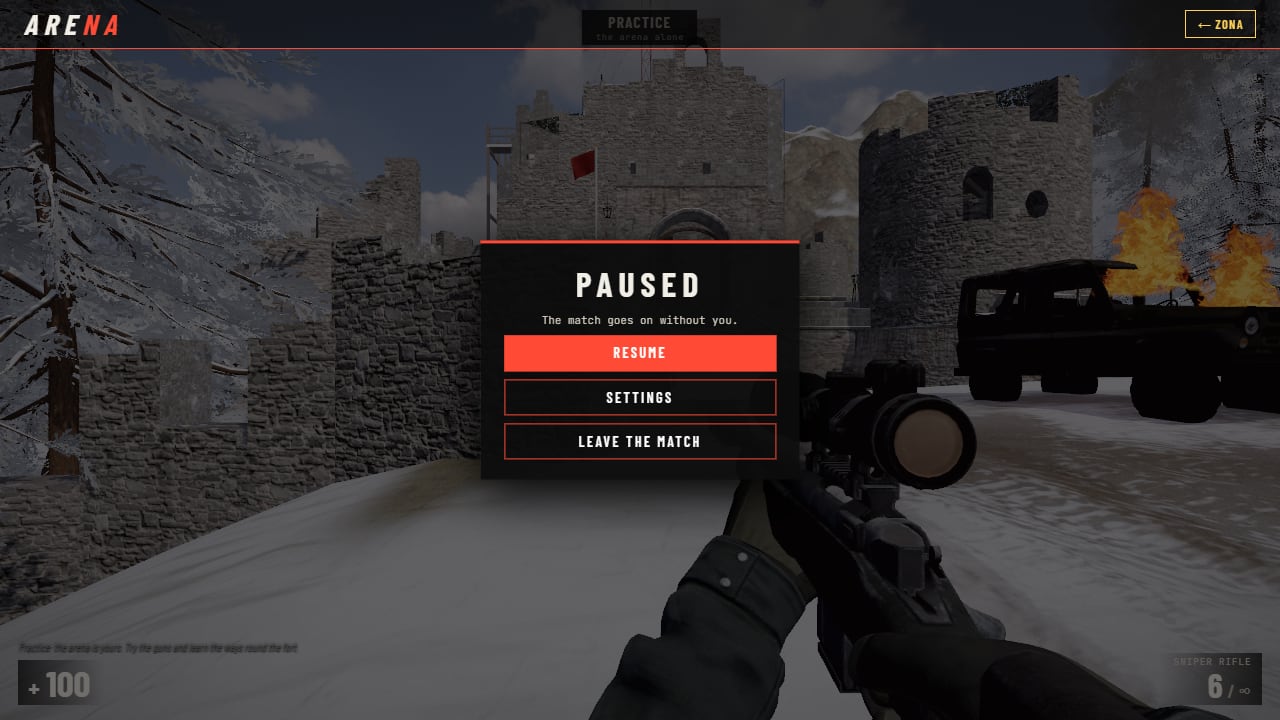
The door. Pick a game; the one you played last is lit. Both are player against player.The Arena's own menu, the fort turning behind it.Esc in a match: resume, settings, or leave.
The Arena's menu: the matches to join or watch, with their score; hosting; practice; the four loadouts; the settings; and the Arena's payouts. The arena sleeps when nobody has played for a while: the list says when it is waking it, which takes up to a minute.
Guns empty and are reloaded, as in CS:GO: R, or the trigger on an empty gun. The rounds never run out, and there is nothing to carry or fill.
The Zone's menu is shorter: Play, Settings and Rewards, and the way across to the Arena. How to play opens by itself on your first visit, and is on the menu (Esc) during a game.
Every money screen says what all of ZONA PvP has paid: the door, the Zone's rewards, the payouts page and the Arena's payouts.
No loading again in the Arena: leave the wait for a match, leave a match, or go on from a match's result, and you are back at the Arena's menu at once.
A match's result can be clicked: the pause used to come up over it and take the mouse.
The stake is shown in Host a match, marked coming soon.
The door says how many are online in each game, as its own server counts them.
The menu comes up sooner: the guns are built behind it, and Deploy waits for them if it is pressed first.
The Arena's loadouts have no suppressors, and each gun has its own magazine in place of a drum or a long one.
The door says it plainly: Player vs Player. Both games are tagged PvP, and the Arena's card carries a stamp: wagers are coming.
A computer starts on Medium graphics (it started on Ultra), smoother on more machines. Settings has the rest, and whatever you have set yourself is kept.
The door's numbers: how many dog tags have been paid, how many played Zona in the last day (each player once, and only once they have moved in the world), and the Arena's matches being played. Under five in a game, its card says Live now.
Squad hour, every day at 01:00 UTC, shown on the door in your own time with how long until it: one hour when everybody is asked to come at once.
The loading screen no longer asks you to reload when a start is slow: it carries on by itself.
The door's numbers and squad hour, in the visitor's own time.
The Arena opens: team matches at the fort
A second way to play. Team against team at Orlinoye, in rounds as in CS:GO: a round ends when one side has nobody left standing, and the first side to the rounds chosen wins the match. Open the Wagers tab on the menu to host a match, join one, watch one, or practise alone.
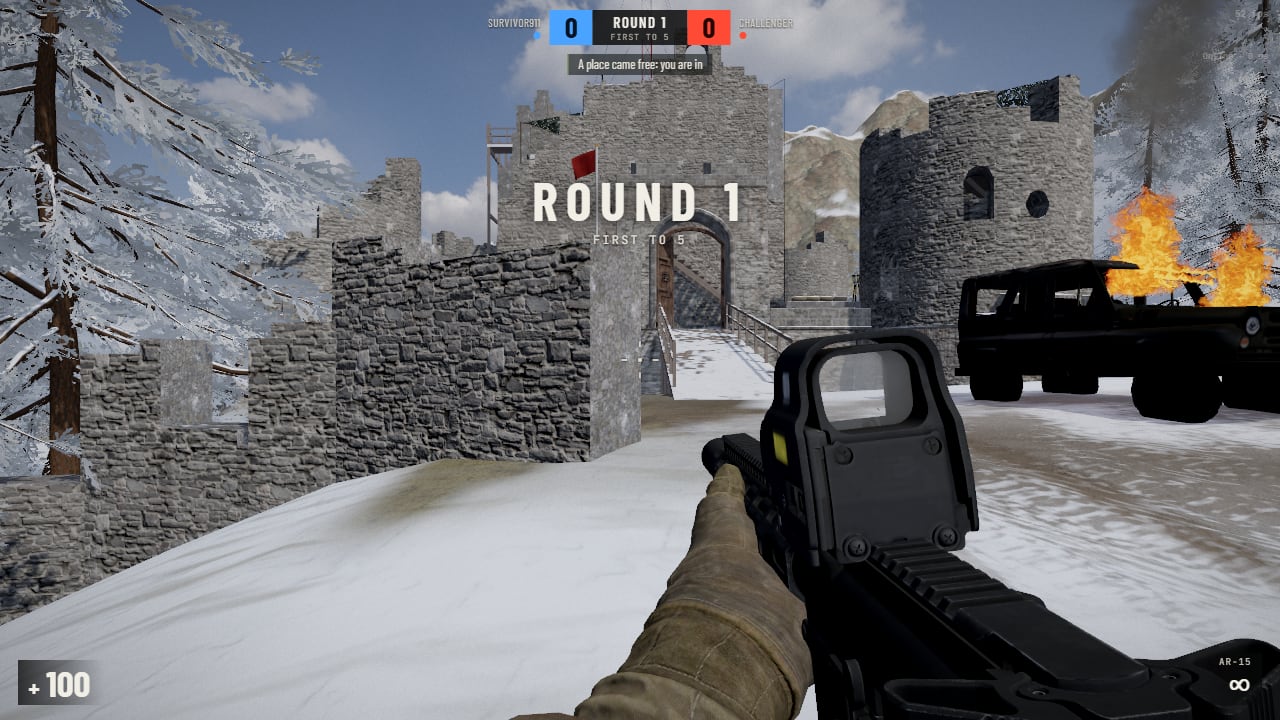
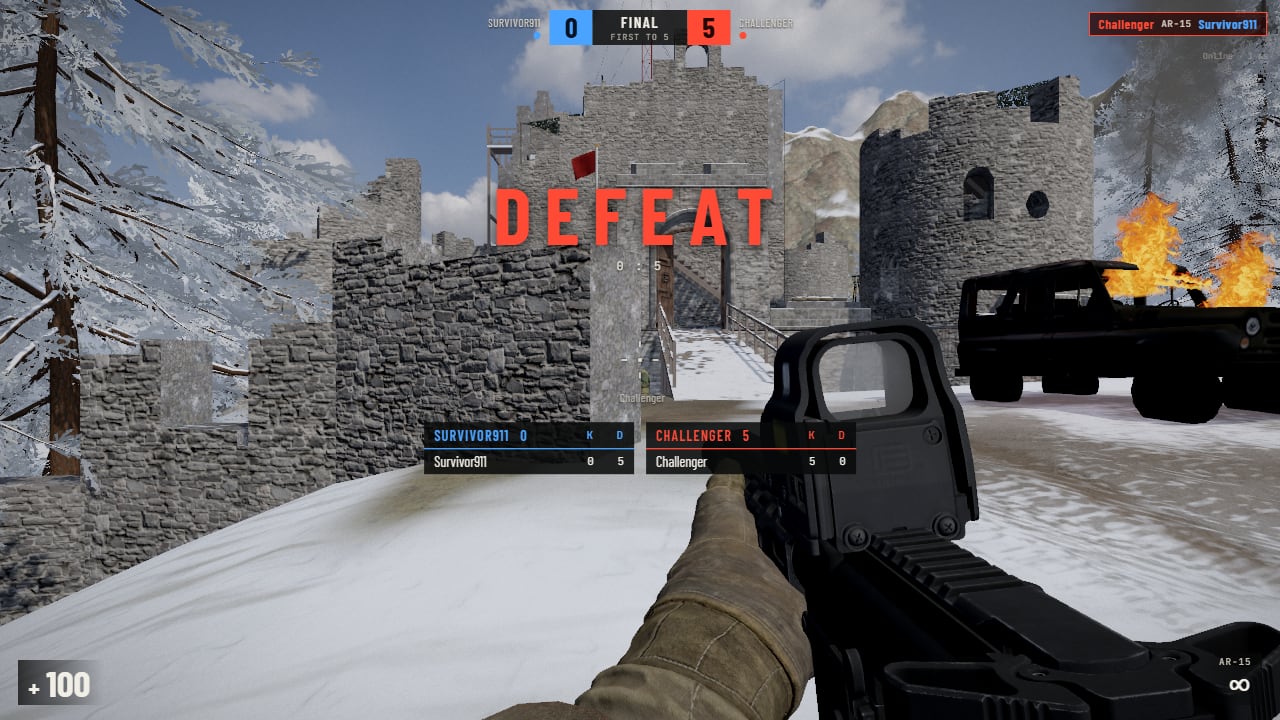
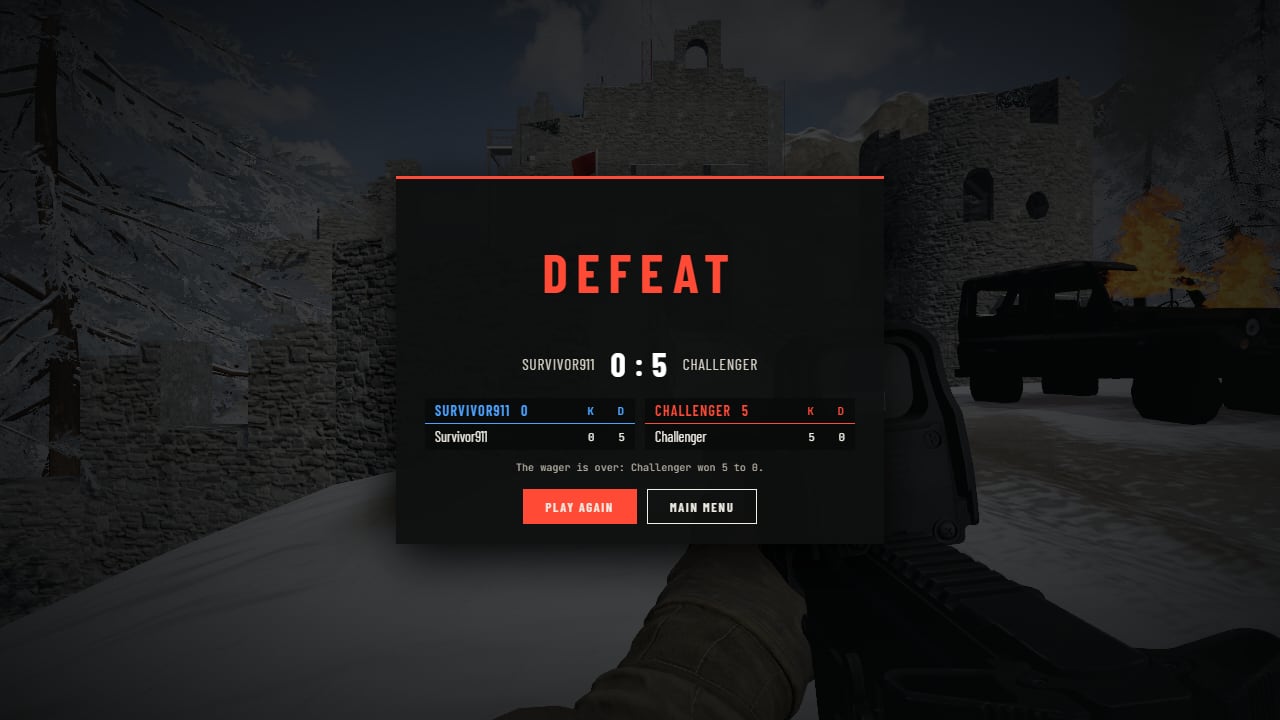
Round 1. Every round starts at your own end, facing the other, gun in hand.The match won and lost. Everybody stands for a while, and nobody can be hurt.Then the result, and on to the next.
Host a match: 1v1, 2v2 or 3v3; first to 3, 5 or 10 rounds; and one loadout for everybody in it, every round: Assault, Heavy, Marksman or Breacher.
Guns only, and they never run dry. No magazines, rounds, armour or food to see to.
The map is the level ground the fort stands on, from the foot of the mountain to the edge of the cliff. One side starts before the gate, the other behind the back wall; the fort is between them, and every way through it.
The arena's own server decides every hit and every point of health. No game's word on either is taken.
A screen of its own: the score and who is left standing at the top, kills at the top right, health and the gun at the foot, and Tab for the scoreboard.
Watch any match being played from the Wagers tab, flying and unseen, with the score and the kills as they happen, and the result at the end.
Drop out of a match and you have 30 seconds to come back. After that your side plays on without you; if nobody of your side is left, the match is the other side's.
No money moves yet. A stake is shown with each match, and nothing is paid.
In the Zone: tabbed out for a minute, you are taken off the server, saved where you stood with everything you carried. A hit in that minute starts it again.
Helicopters: an Apache brings the drops, and two to fly
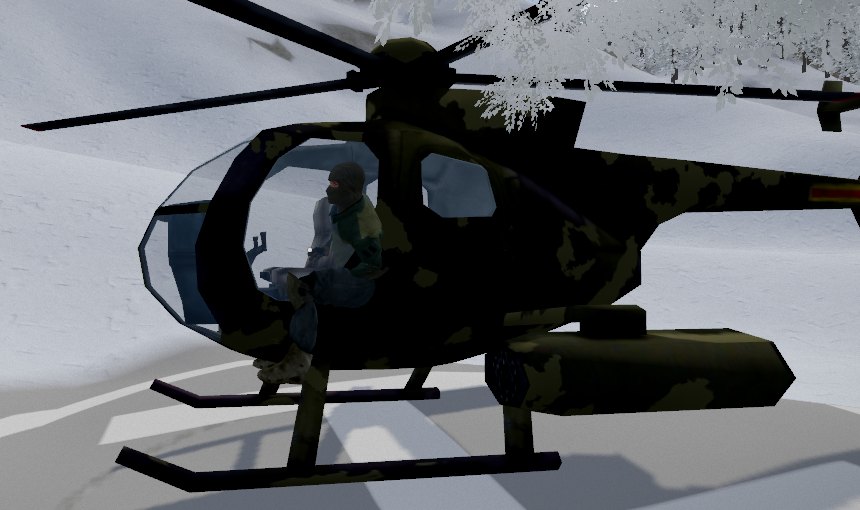
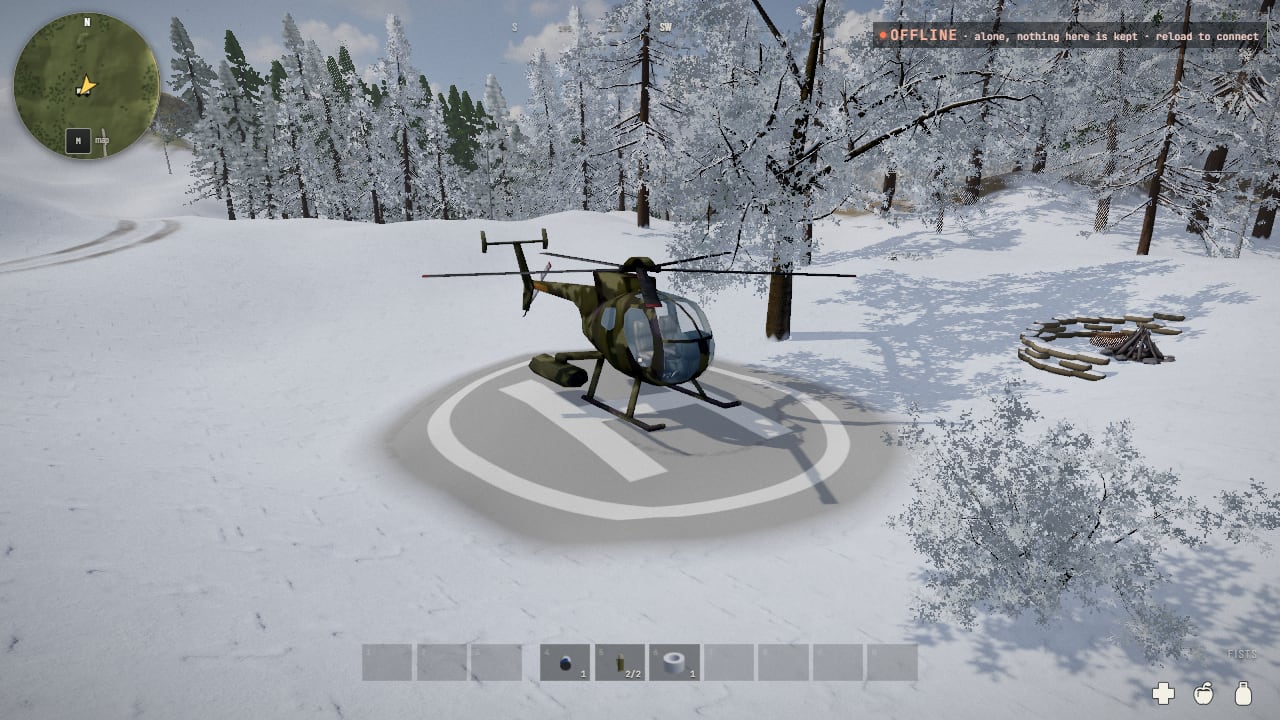
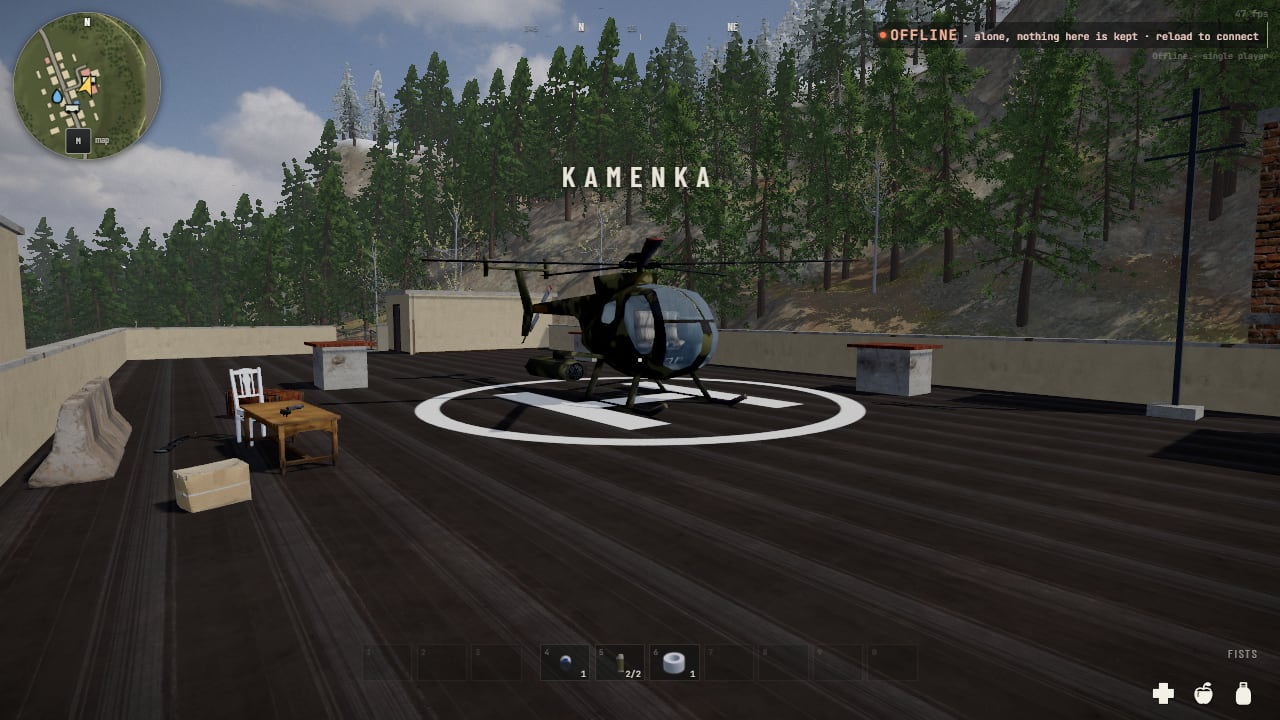
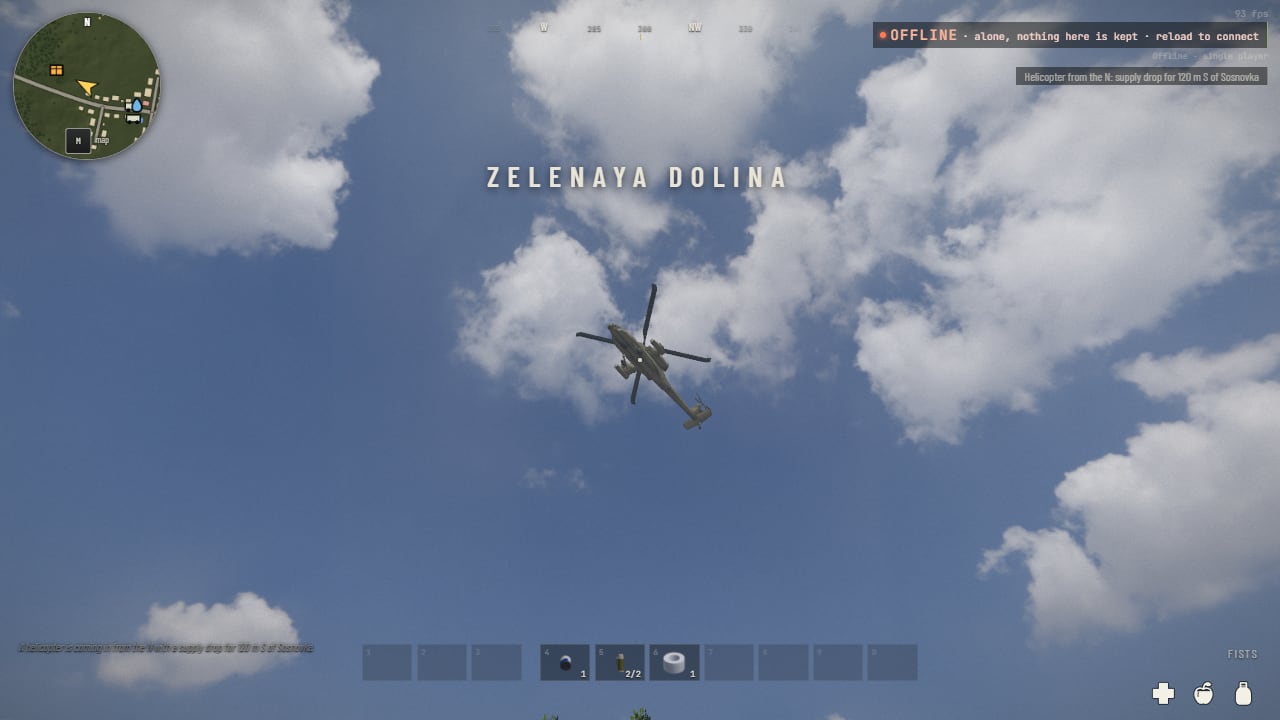
The supply drop comes in under an Apache gunship now. And there are two MD-500s to fly: one on the roof of the district hospital in Kamenka, one on a pad at the foot of Orlinoye.
Off to Orlinoye at a hundred kilometres an hour.The pad below the fort, by the cart track.On the hospital's roof in Kamenka, beside the sniper's nest.The drop's Apache, hovering over its drop.
Fly it. F at its door. Space climbs, C comes down, W and S tip the nose, A and D turn it, Q and E lean it. Let go of everything and it holds its height and brings itself to a stop. Its rotor takes a few seconds to come up to speed before it lifts.
It never flies more than 100 metres over the ground under it, so it can always be shot at; and its glass stops no bullet, so whoever is in it can be.
Two seats, pilot and co-pilot. Ctrl+1 and Ctrl+2 move you between them (in a car, Ctrl+1 to Ctrl+4), and a panel under your speed shows who sits where.
Come down hard and it is wrecked, and nobody in it lives. If the pilot is shot, or leaves the game, in the air, it falls: the co-pilot can take the controls with Ctrl+1.
The supply drop's helicopter is an Apache gunship, 27 metres from nose to tail: larger than life, so it can be told in the sky.
A parked car or helicopter that something runs into moves. It used to stand there like a wall.
Close the tab while you are alive in a game and you are asked first: Ctrl and W is the browser's own, and no page can take it from it. Settings, Game, Full screen makes the game fill the screen when you click in, and there (in Chrome and Edge) Ctrl and W, N, T and Tab belong to the game.
A keycard no longer keeps you on foot. Only a tag you took off somebody does: no car or helicopter with one of those on you.
The helicopters are by Duane's Mind (CC BY 4.0).
The fort turns to the road, a jeep burns at its gate, and the woods stand in the ground
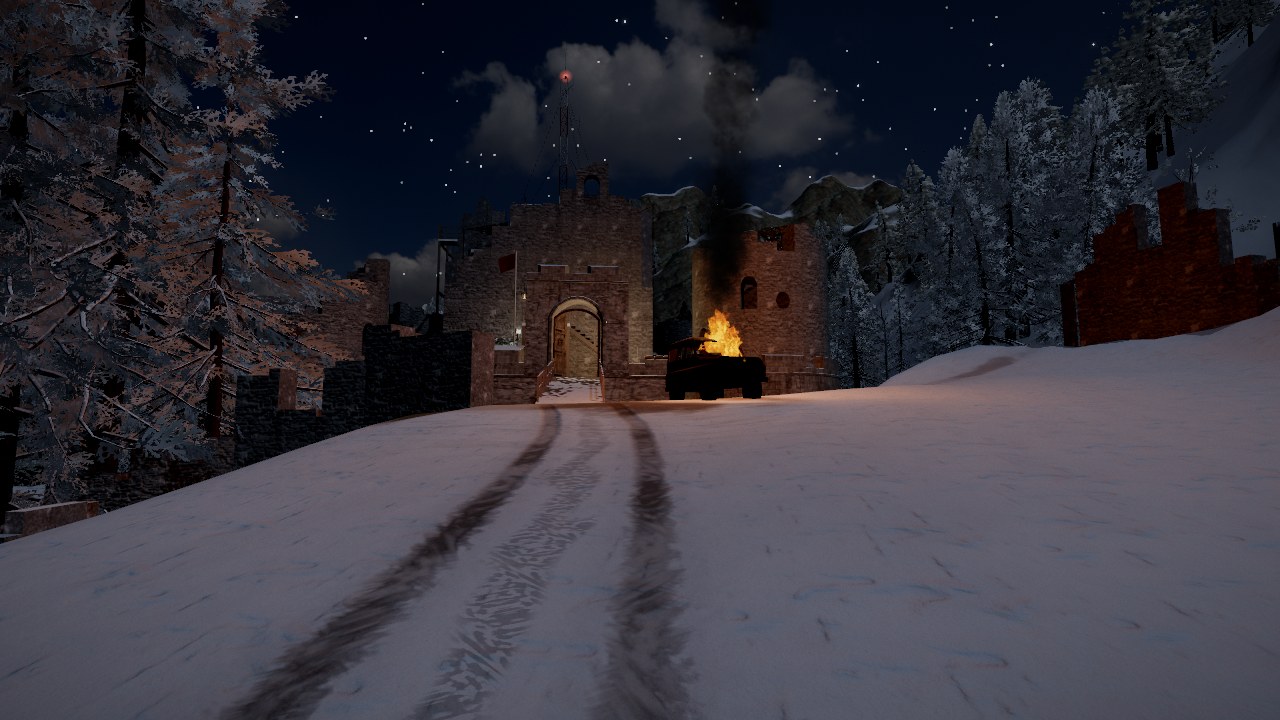
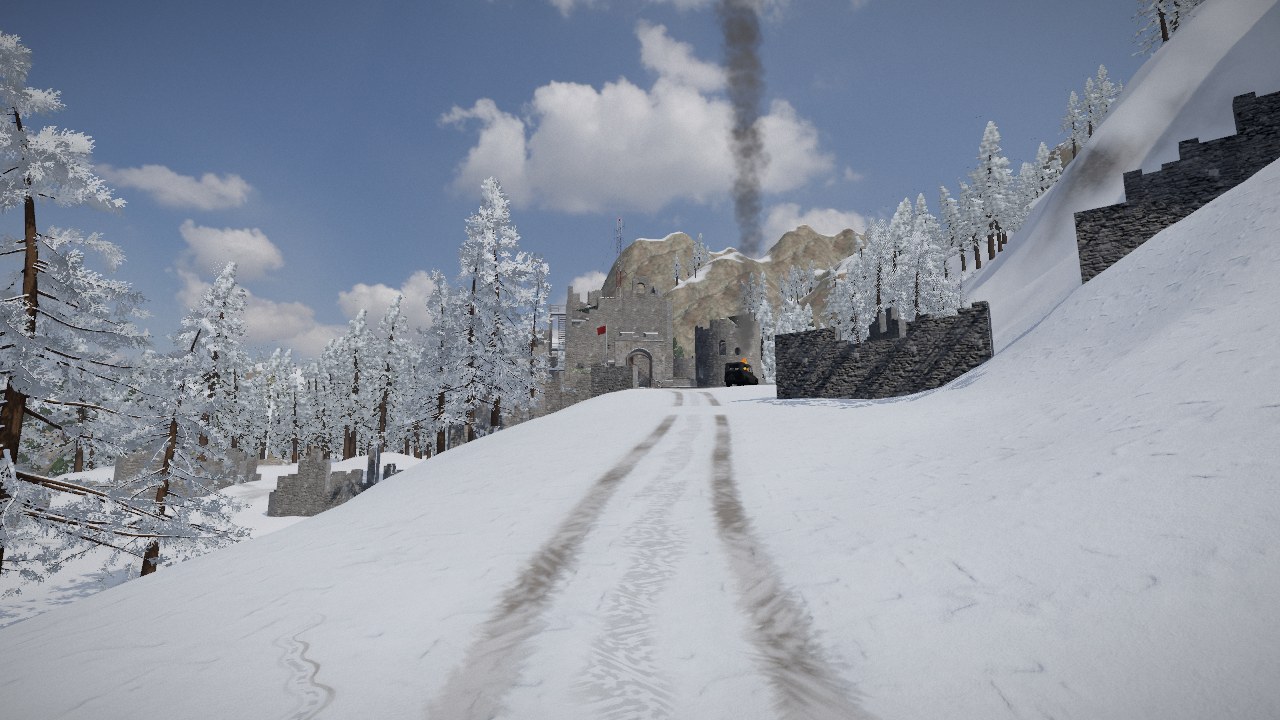
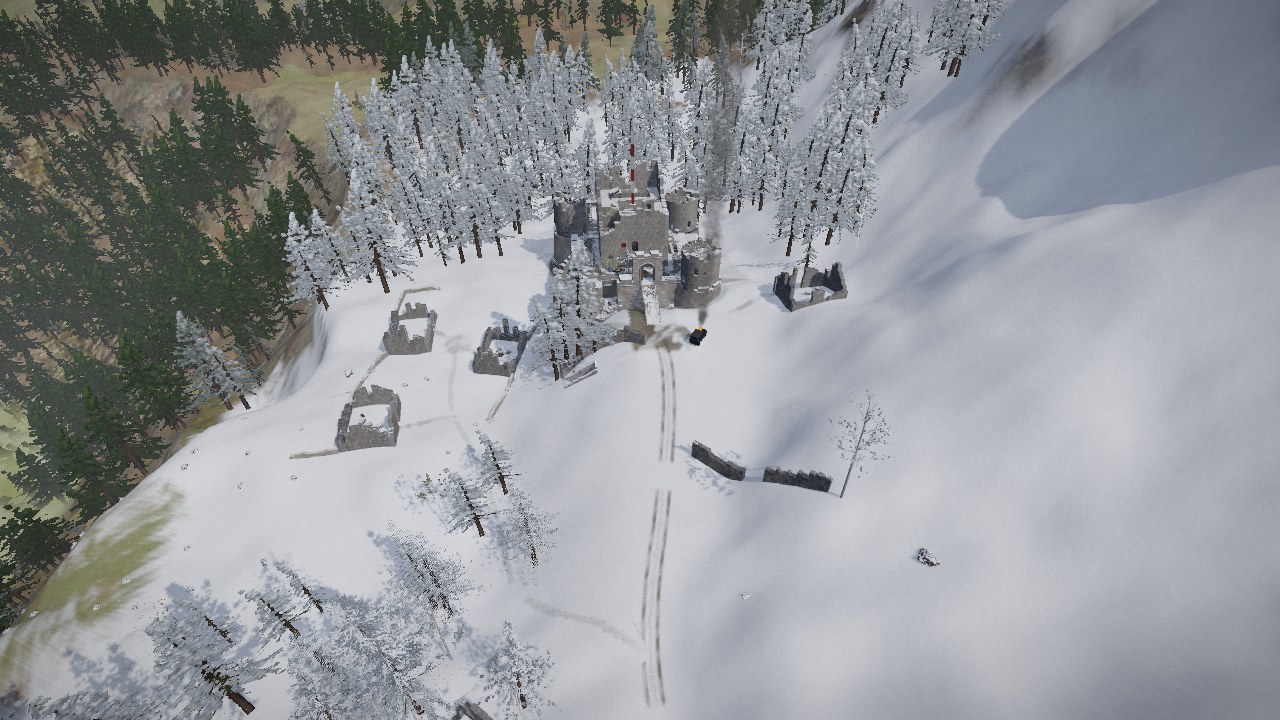
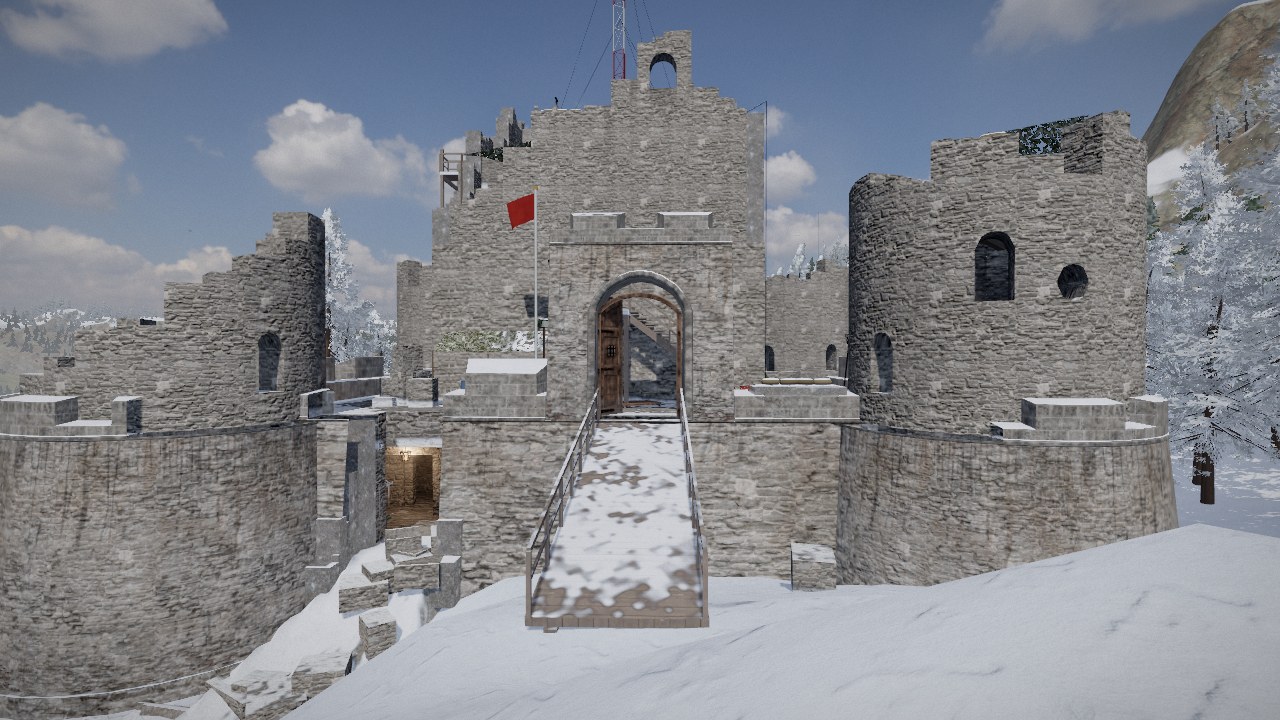
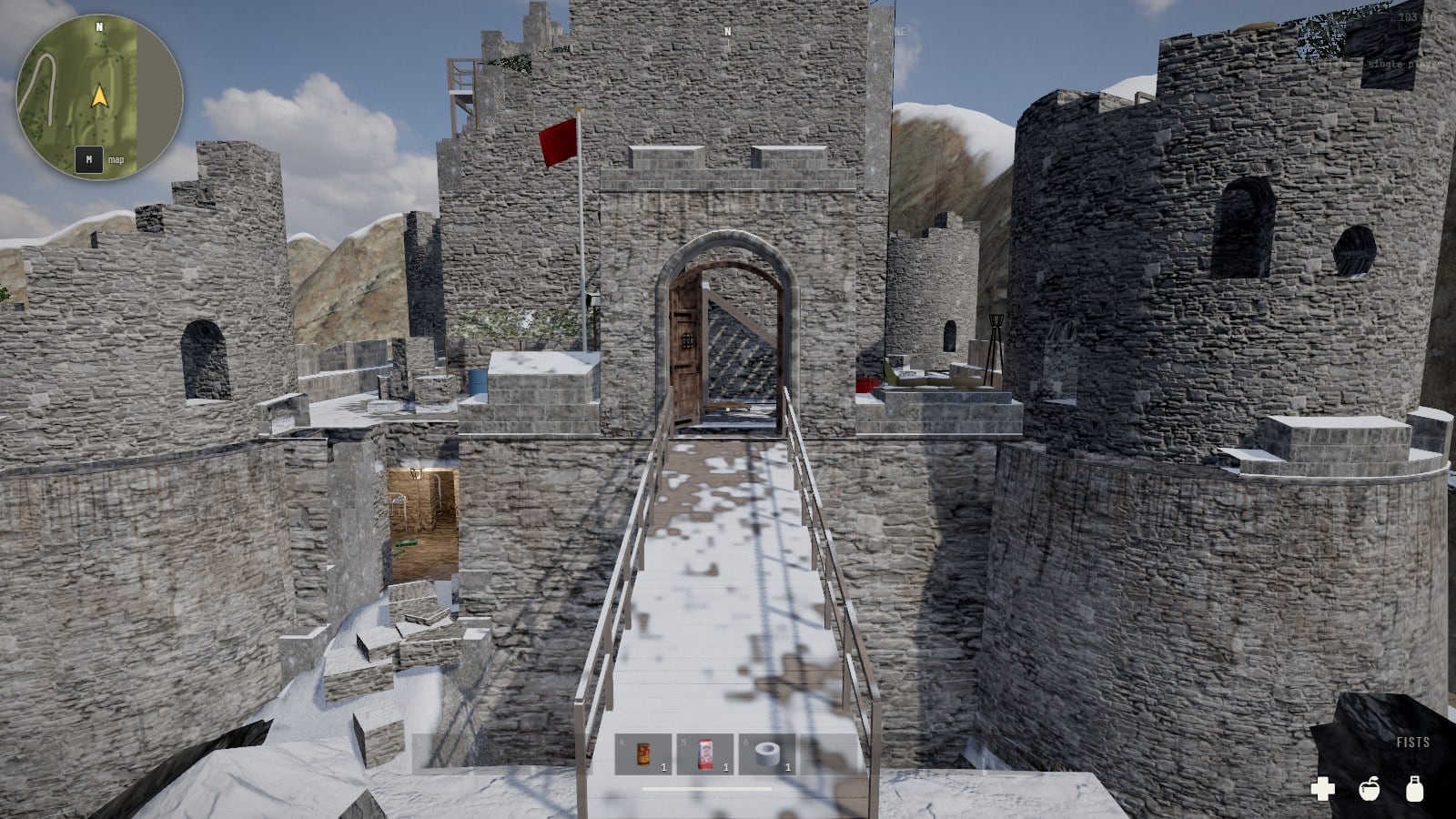
Orlinoye's drawbridge faces the way you come now: the cart track climbs a shoulder of the hill straight to its gate, where a wrecked jeep burns day and night. And every tree, rock and stump on the map stands in the ground instead of on it.
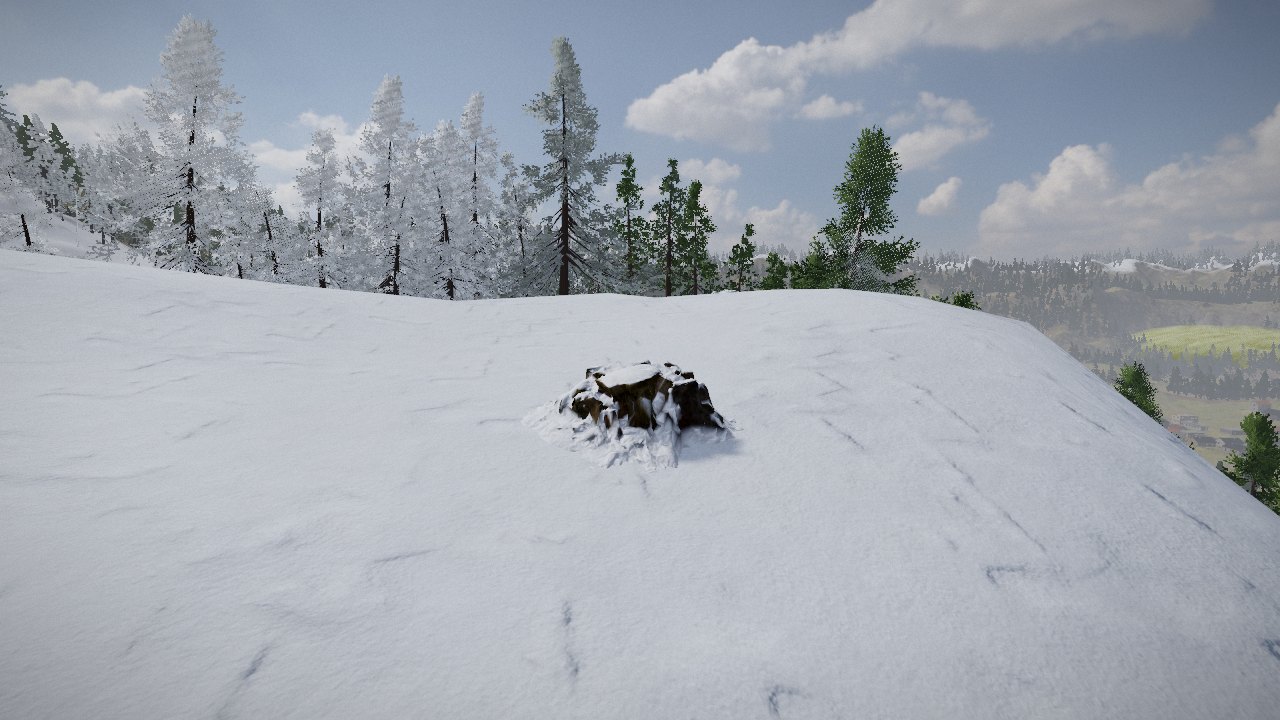
The gate by night, lit by the jeep that burns before it.The way in. Up the track, and the gate is ahead of you the whole way.From the air: the track, the gate, the jeep, and the ruined houses off to one side.A stump where the wood was felled, in the ground and under the snow.
The fort is turned to face the road. Its gate and drawbridge looked away from everybody who came; they look down the track now. The hill's foot runs out before the gate, and the track climbs it, 169 metres from the end of the mountain road to a trampled place at the foot of the ramp. A lane leaves it for the ruined houses.
A jeep burns before the gate, and never goes out. By night it lights the ramp, the gate's arch and the towers either side; by day its smoke is seen from the road. Stand by it and you mend as by a campfire. Touch it and you burn.
Everything stands in the ground. Trees, rocks, boulders, stumps and fallen trunks were set at the height of the ground under their middle, so on a slope their low side hung in the air. Of 23,225 of them, 23,081 had some of their foot over the ground. None has now: each is let down onto the lowest ground under it and sunk a little, the ones that lie are laid to the slope, and where snow lies it lies on them and against them.
At this update everybody is set down afresh, once, with everything they carried, because the ground has changed. A buried stash stays where it is.
The broken way up from the vaults to the terrace, over the medicine locker, stopped short of the terrace's edge: there was a gap to fall into. It meets it.
The ramp stood a hand short of the ground at its foot and had a lip at the gate. It meets both.
From under the towers you could see out through gaps in their walls and floors. They are closed.
The rocks round the fort stopped you short of their faces, or let you into them. They stop you where they are drawn.
The infected round the fort could start inside its stone or inside a house's walls, and stand there. They start on open ground.
The fort comes down to the rim, a fifth bigger, in its own snow; and grenades are cooked
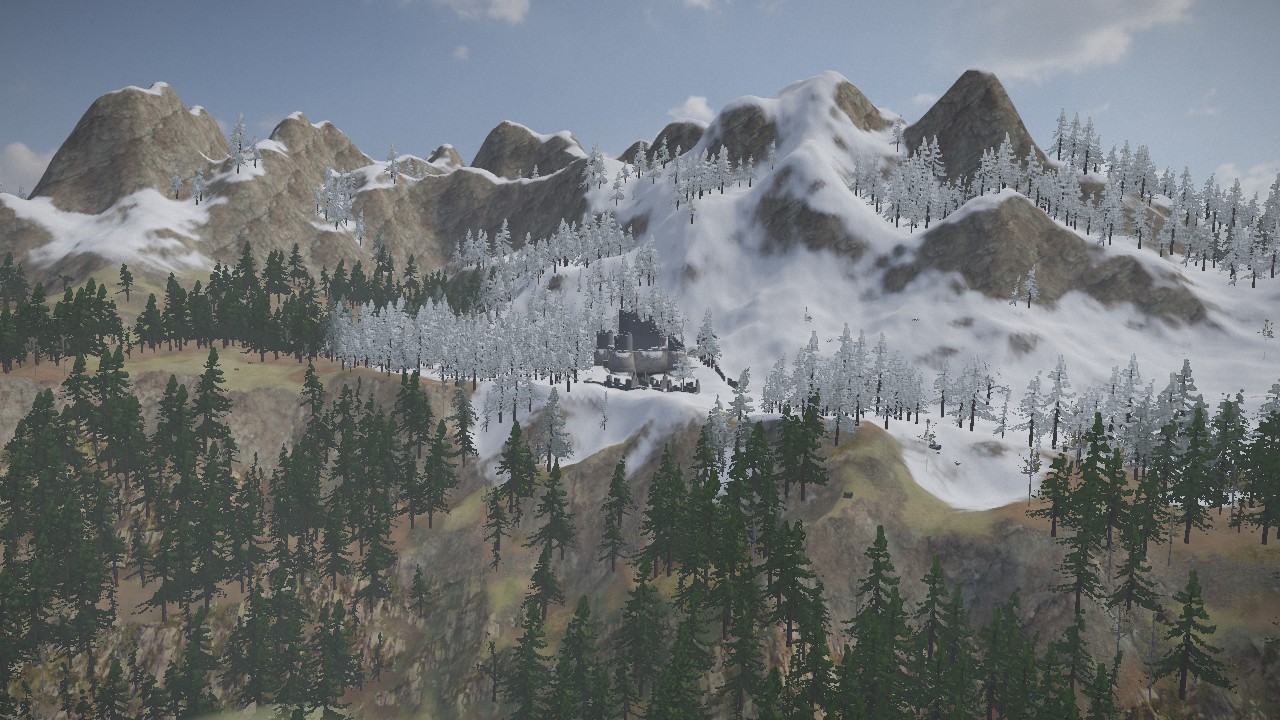
Orlinoye has left the mountain's crest. It stands on a shelf of the valley's east rim now, the same fort in every room and a fifth bigger, with snow lying round it and down its track though the shelf is under the snow line. There is a frag grenade, and both grenades are cooked in the hand before they are thrown. Packs and pockets hold more. And the way dog tags are paid has changed.
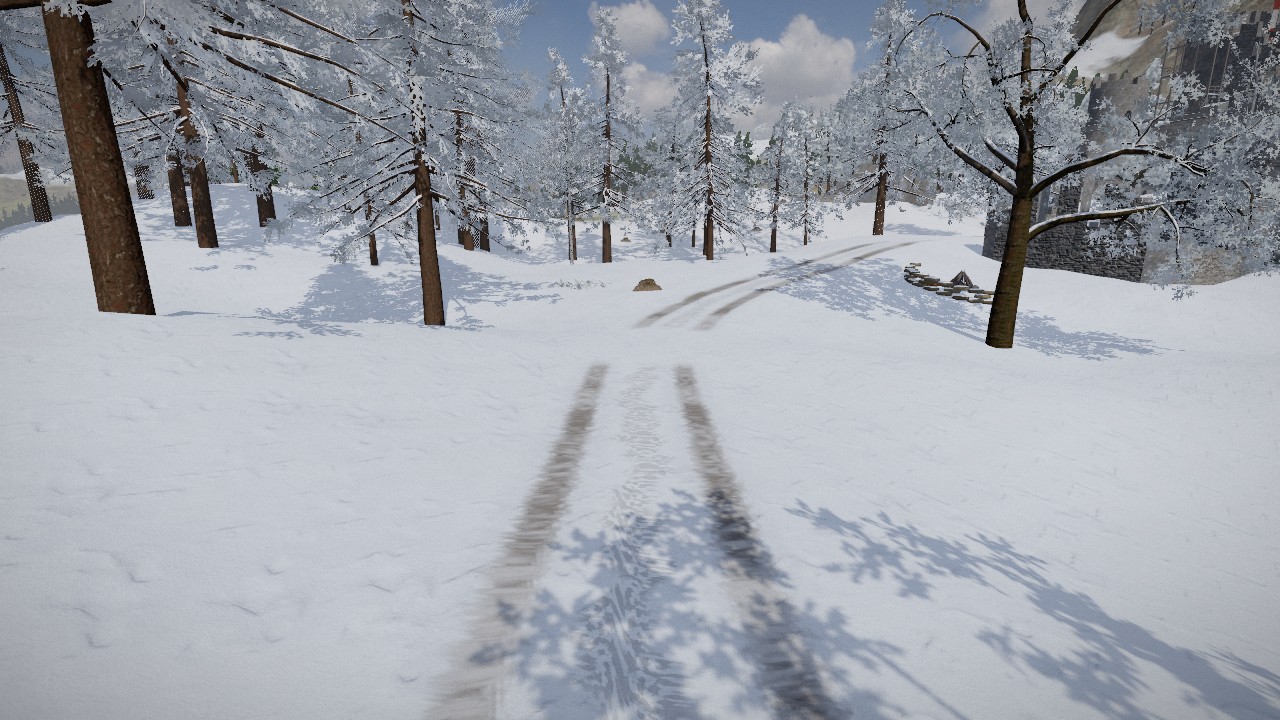
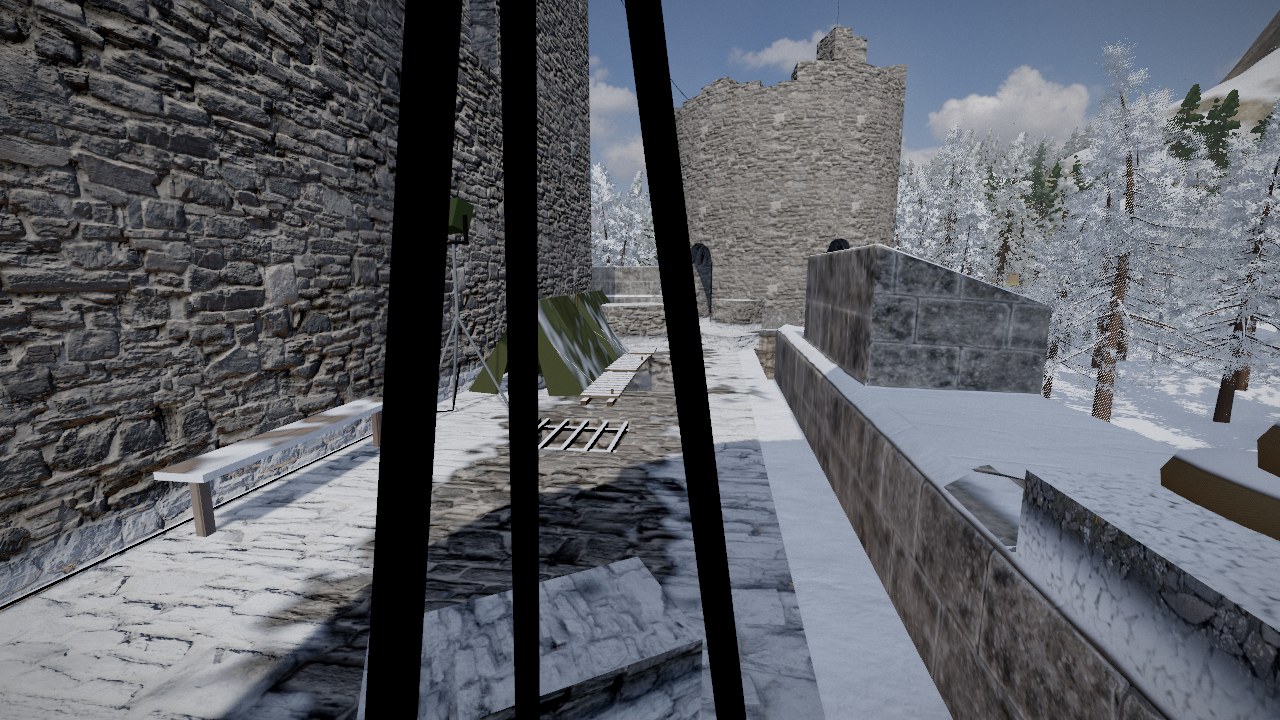
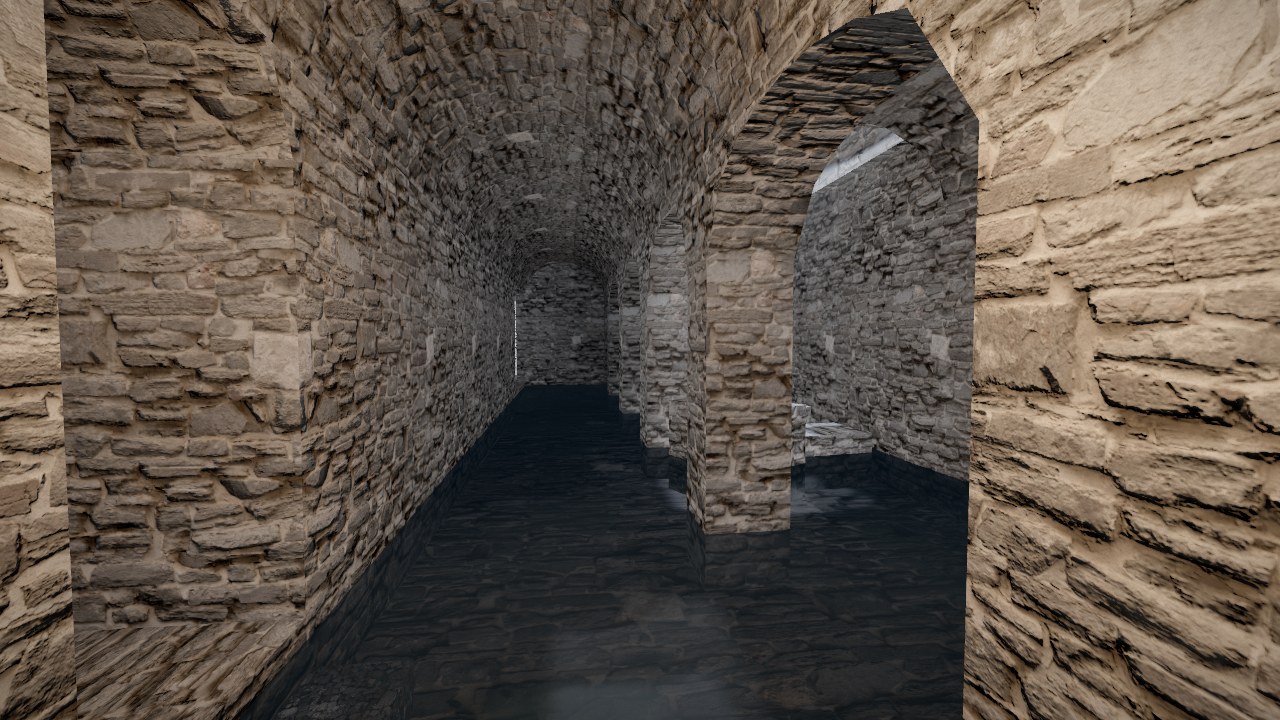
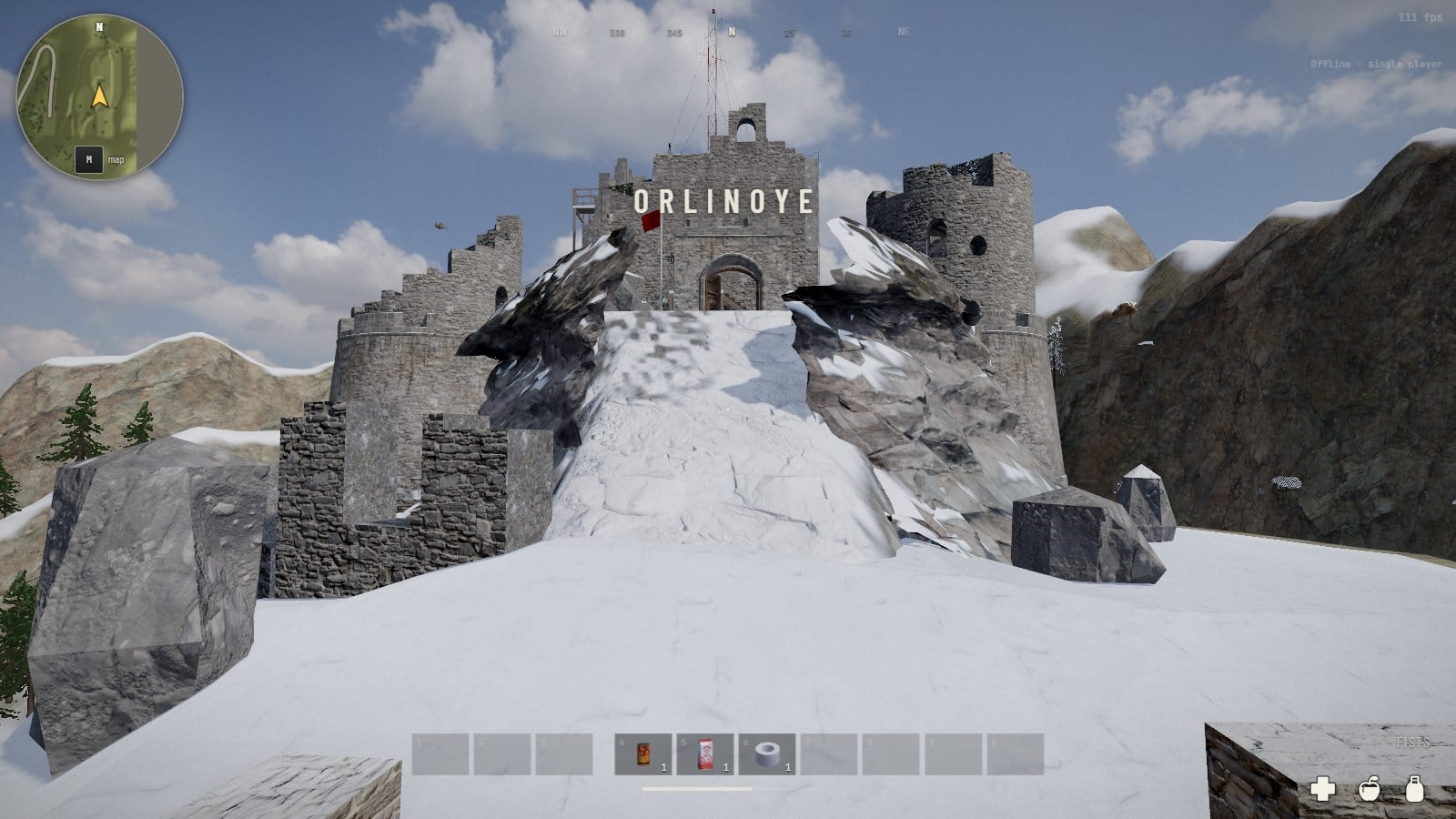
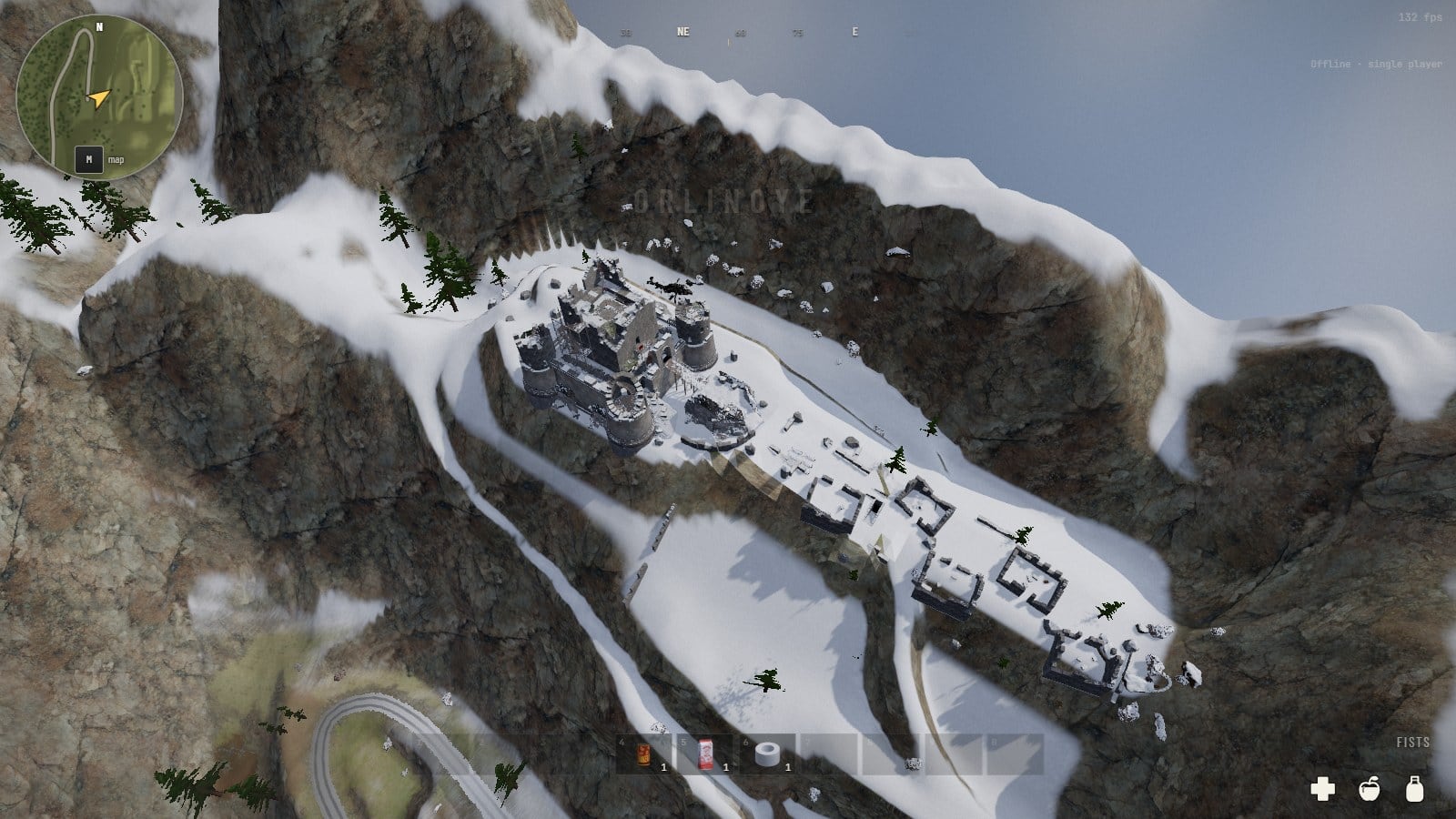
Orlinoye, where it stands now. The ramp lands on the hillside itself: no rock, no mound, nothing built up under the fort.From across the valley. One tongue of winter comes down from the peaks to the shelf, and the trees that stand in it are white from far off as they are from near.The track, from the end of the mountain road to the ruined houses: wheel ruts worn to the earth, and boot prints between them.The terrace. Every room, stair, vault and way in is where it was, a fifth further apart.The cistern, lit for the picture: it is dark down there but where the day comes in.Cooking a grenade. Hold to pull the pin, let go to throw. The seconds run from the pull.The frag grenade beside the stick grenade, a tin and a magazine: the size of the real thing.
Orlinoye has moved. It was on the crest of the north-east mountain, at the end of a climb on foot. It stands now on a shelf of the valley's east rim, a hundred metres up, under that mountain. It is the same fort: four towers, the keep and its three floors, the terrace, the breach, the fallen wall, the postern, the vaults and their cistern, armoury and cells, every piece of the signals post. Counted part for part against the fort it was: 877 parts, none missing.
A fifth bigger. The square between its towers was twenty metres across and is twenty-four; the vaults lie 4.6 metres under the terrace where they lay 3.8. What is sized to a body is not bigger: tables, racks, bunks, rails and the furniture of the post are as they were, and a drop inside the fort hurts as it did before.
The way to it. The mountain road is 440 metres now and ends lower, at 85 metres; the gatehouse at its old end is gone with the crest's village. From the road's end a cart track runs 185 metres to a few ruined houses, where carts turned; from there a foot path climbs the hillside, 65 metres, to the foot of the ramp.
It can be seen from the valley. A wedge of the wood between its walls and the brink is felled, a field of fire with its stumps left: from the village about half of its valley side is in view, where under a third was.
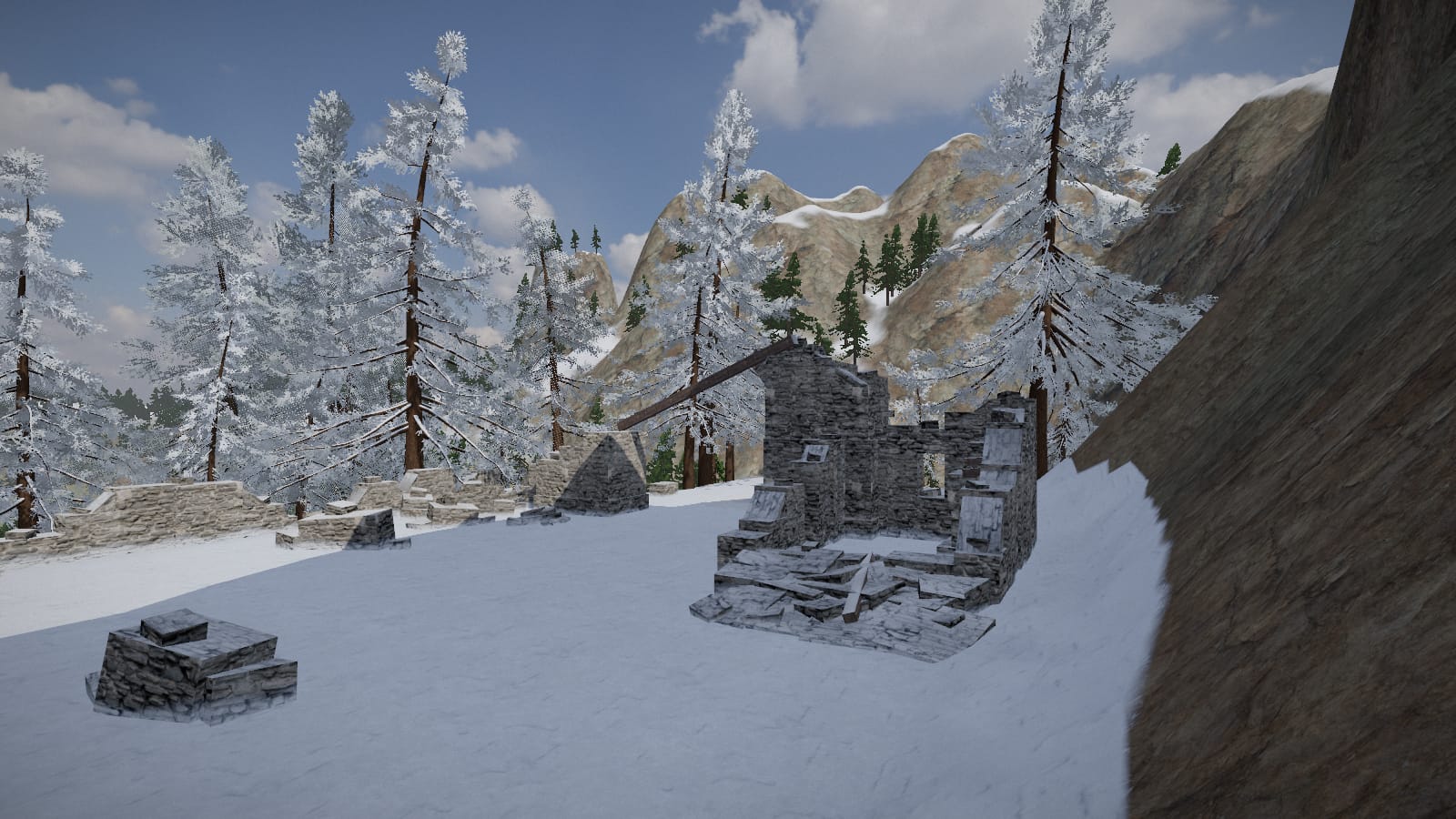
Snow where the fort is. The snow line is at 132 metres and the shelf is under it. Snow lies there all the same: round the fort, along the track and up the hill behind to join the mountain's own. Its lower edge thaws out over thirty or forty metres: browned grass, snow in the hollows and on ground that faces north. Against the fort's walls the wind has scoured one side and drifted the other.
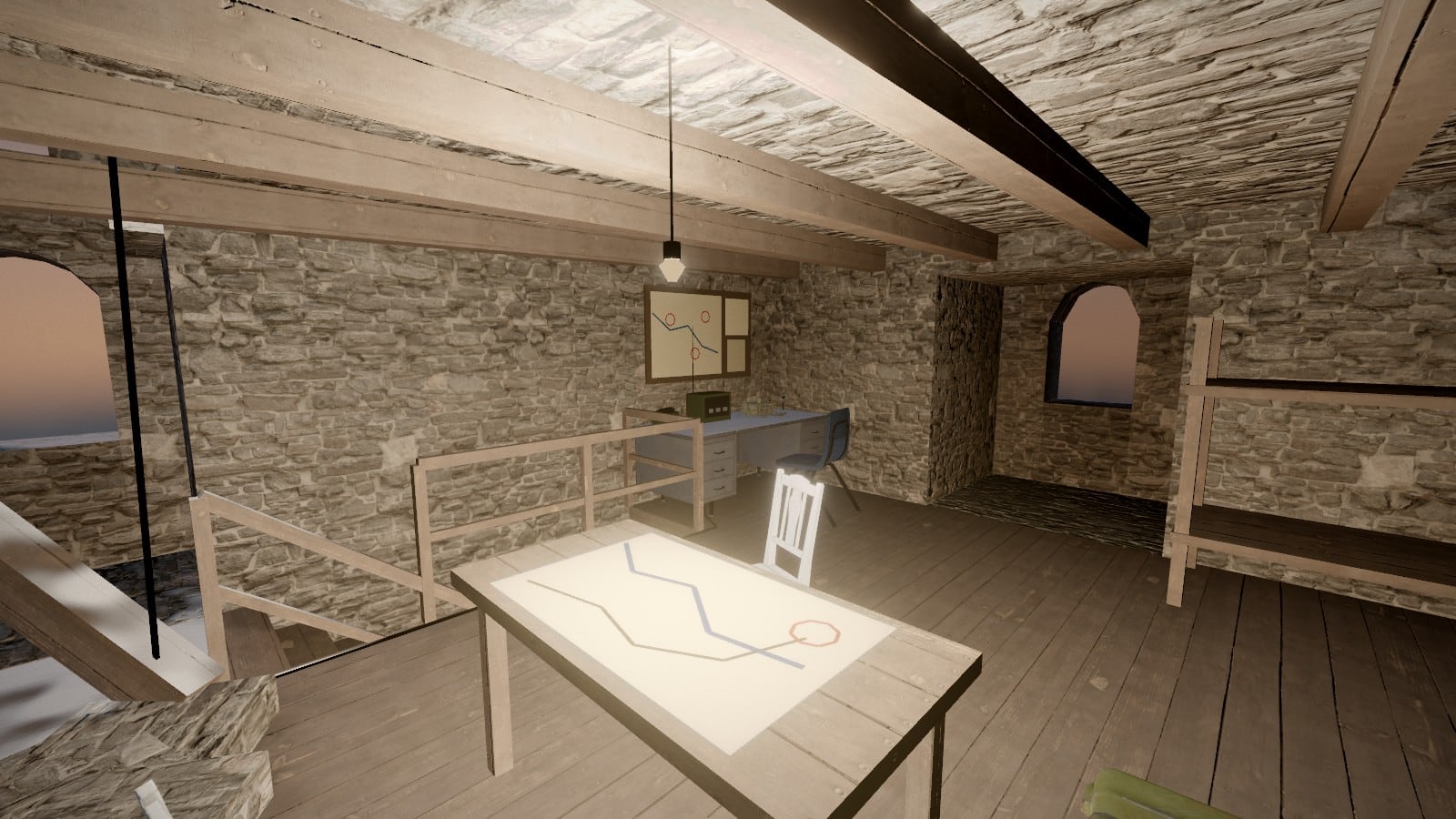
The cellar hatch is on the hillside by the ramp now, behind a curved wall and a clump of firs, out of sight of the walls. Its passage is 25 metres, under the gate wall to the sally port's stair. The ground over it is the hillside and nothing else.
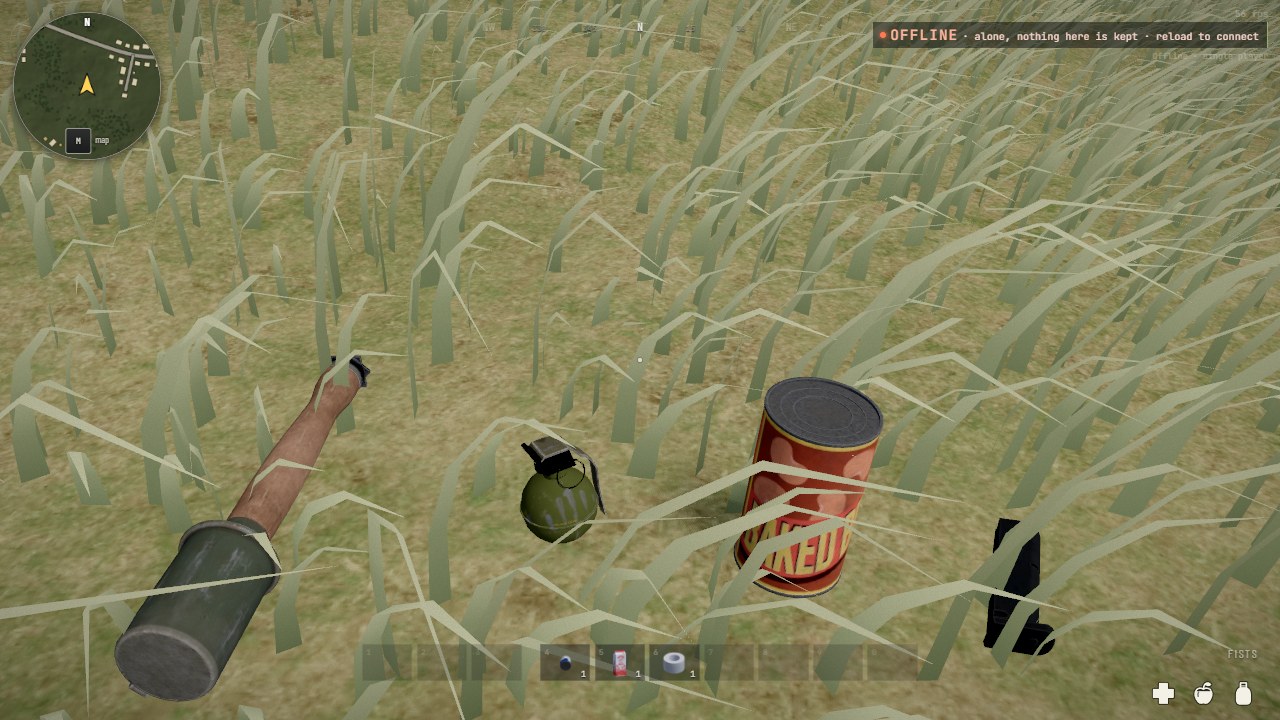
The frag grenade. One square in the pockets. 200 damage at its middle and a reach of 10 metres, where the stick grenade has 150 and 9; one frag wrecks a car, where it takes two stick grenades. Found where the army was: military places, under the gas, in the bunker, and now and then in a supply drop.
Grenades are cooked. Hold the button and the pin comes out; let go and it is thrown. The fuse is four seconds from the pin, for both grenades, so one held for three goes off a second after it leaves the hand. Held to the end it goes off in the hand, and no armour helps. A quick press still throws at once. Once the pin is out there is no putting it back.
Whoever dies with the pin out drops it, and it goes off where they fell when its fuse ends.
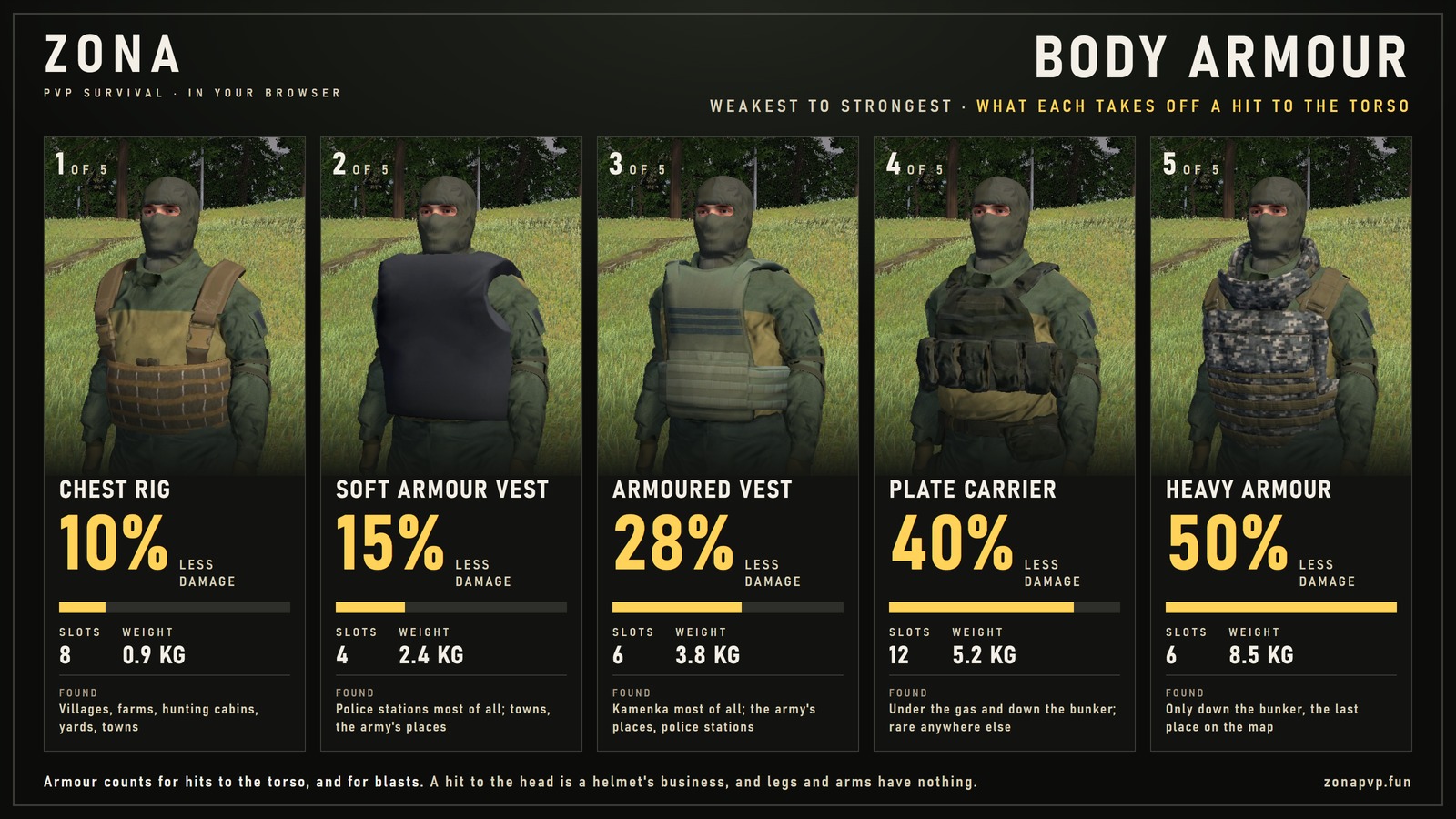
Packs and pockets hold more. The Field Rucksack is 9 by 7 (it was 7 by 6) and takes two rifles. Camping Backpack 7 by 6, Day Pack 5 by 5, Field Jacket 5 by 5, Field Trousers 5 by 4, Plate Carrier 5 by 4, Chest Rig 5 by 3, Armoured Vest and Heavy Armour 4 by 3, Soft Armour Vest 3 by 3.
A gun's picture is its side, flat and level, muzzle to the right, from end to end of its squares.
Dog tags are paid by a new rule. A tag pays 0.01 SOL, flat, whatever the treasury holds; and a wallet is paid when five of its tags are due, for all five at once. The list was cleared when the rule began: a tag cashed in before then that had not been paid was cancelled, and what was paid stays paid. The payouts page says the moment, and shows every payment.
At this update everybody is set down afresh, once, with everything they carried, because the ground has changed. A buried stash stays where it is.
Knife-edged ridges that ran in straight lines and crosses over the meadows are rounded off. The ground moved by a few decimetres across the map for it.
A rifle laid on a narrow shelf could hang off both edges. A thing is laid askew only where it fits askew.
The ground over the fort's passage was drawn twice, one sheet on another, with a hollow under it that could be walked into from the hillside. It is one ground, and solid.
The old suitcase was two suitcases side by side. It is one.
The road all the way round, and a fort on the mountain
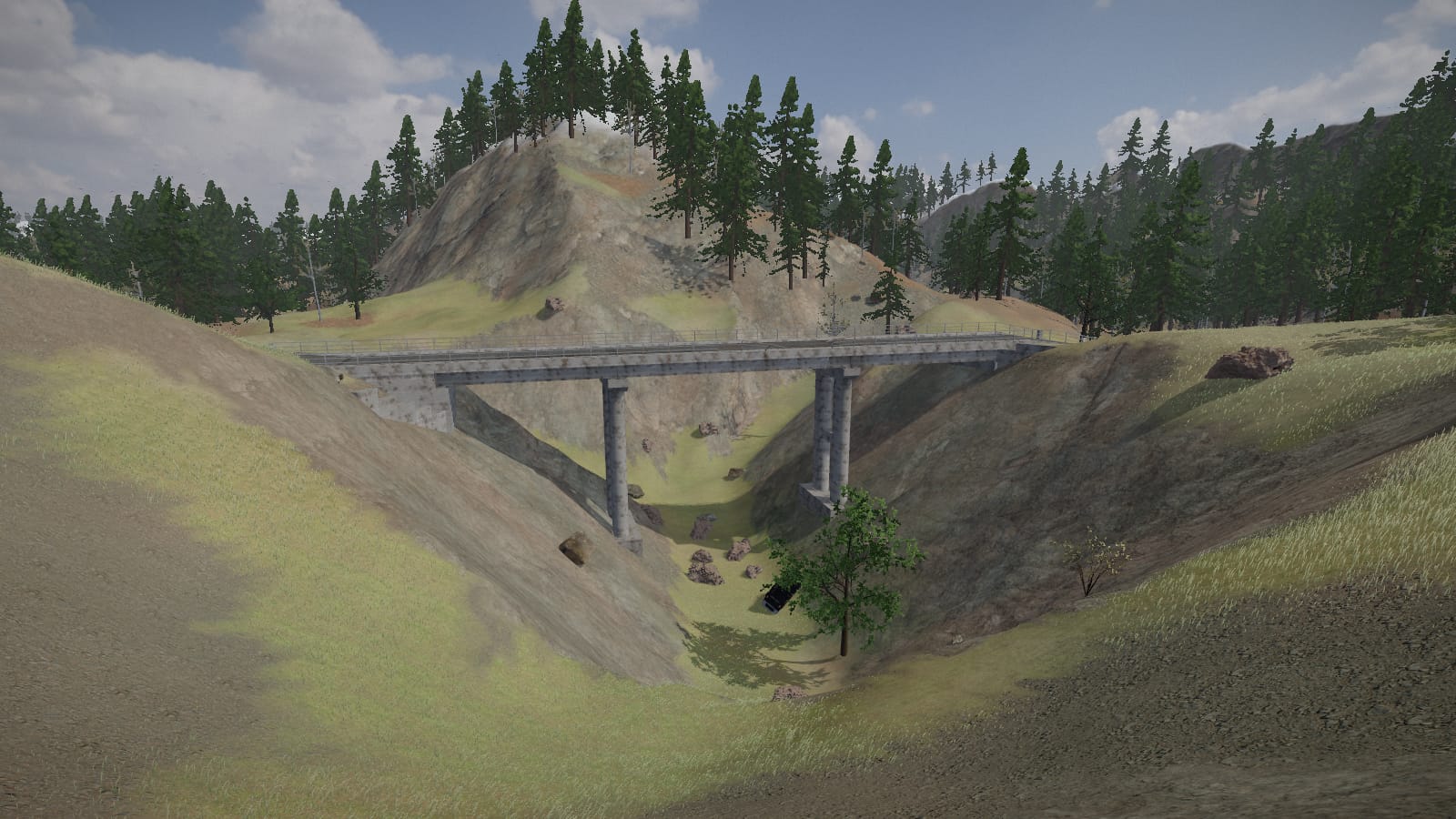
Since this was written the fort has moved off the crest and the mountain road is shorter: see 14 October, above. The road is a loop now: out of the far end of Kamenka, over a bridge, round behind the Chemical Works and home by a second pass. A second road climbs the north-east mountain to a ruined gatehouse, and on the crest above it stands Orlinoye: an old fort the army held to the end, with vaults under it and more than one way in.
Orlinoye, the Eagle's Nest, as you come to it along the crest. Its terrace is 226 m up: eighty over the end of the road, and over the last of the trees.The map now. The loop, the mountain road, Orlinoye in the north-east, and the Zona's line taken out round all of it.The gate. One timber ramp, eight metres long, under two towers. It is the front door. There are others.The crest. The path comes up among the shells of an old village, and their street runs to the gate. Bottom left, the hairpin of the road.The postern, on the side away from the gate: a doorway in the foot of the wall and a stair down the outside of it. Two paths come round to it.The bridge: 66 m from bank to bank on two piers, its deck 22 m over the bed of the cleft. A car went through the railing. It lies below, with what it carried.From the side: three spans over the cleft. The bed under it can be walked, by a gully from each end.The mountain road, on its way up through the pines to where the snow begins.The gatehouse, where the road ends. From here it is on foot.The keep's roof. A radio mast twelve metres tall with a red light at its top, and an observation position looking out over the valley.The command post, in the keep's upper room: the best of the fort above ground.The cistern, under the terrace: a vault standing in black water, lit where the walk above fell into it. The stair from the keep comes down to it.The armoury, behind a grille in the vaults. One door. A gun taken off one of its racks is there again in 25 minutes.
The road is a loop. It goes on out of the far end of Kamenka's street, over a bridge, west along the high ground south of the valley, round behind the Chemical Works, and comes down into the valley by a second pass, onto the old road's west end. Two kilometres of new road.
Kamenka has a second way out, through a second gap in its rim at the far end of the street. And the first pass is laid back: for 75 metres either side of the road the hill rises one in five, so the top can be come at from the side.
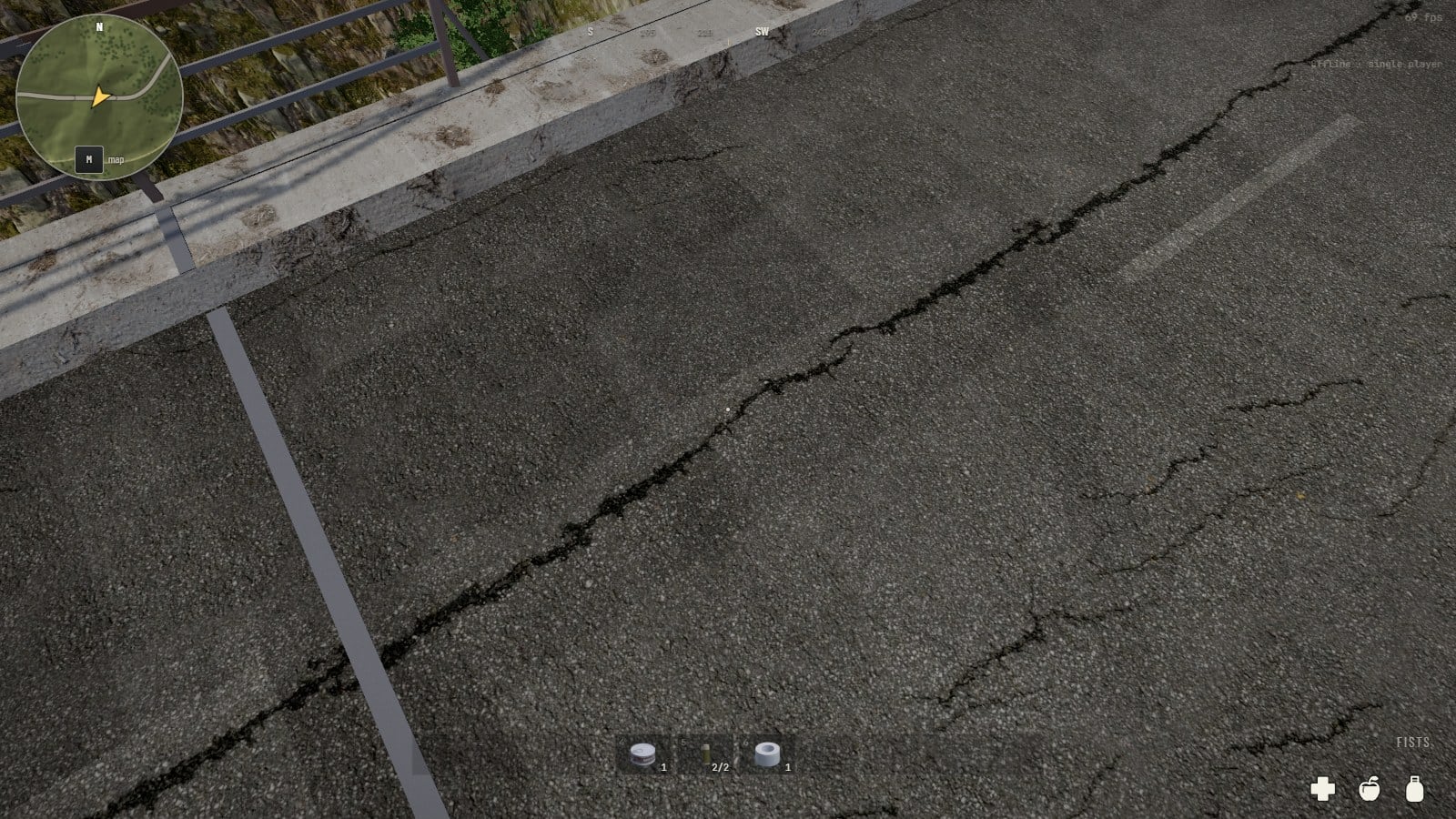
The bridge is 66 metres long in three spans, with a footway and a railing each side, 22 metres over the cleft it crosses. There is a gap in the railing where a car went through. The cleft can be walked: a gully leads down into it from each end of the bridge.
A lay-by on the lip of the Chemical Works: level ground beside the road, from which all of the works is seen from above.
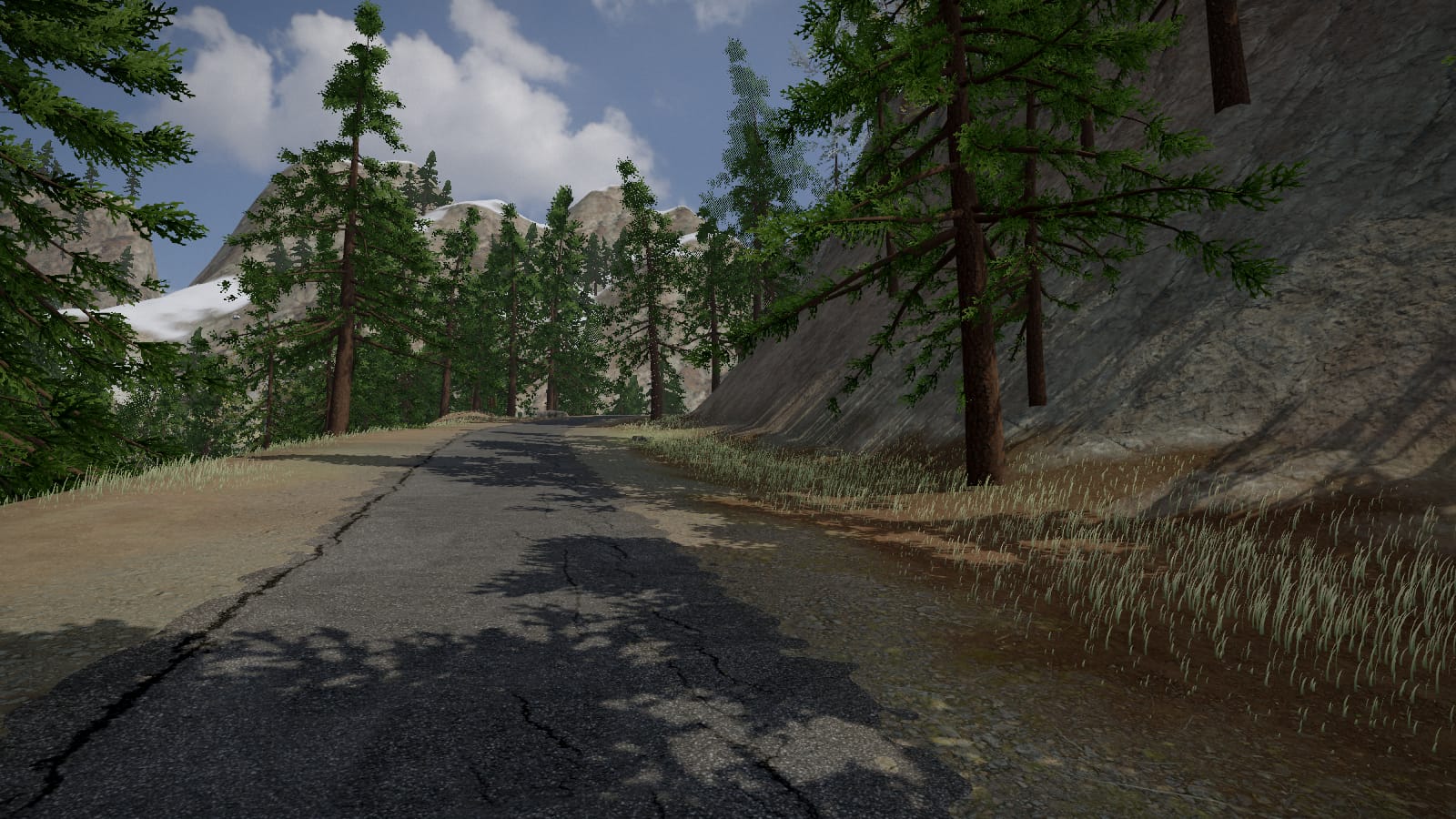
The mountain road leaves the pass just outside Kamenka and runs north along the high ground: 950 metres, through the pines, up the foot of the mountain and round one hairpin, climbing 75 metres. It ends in the yard of a ruined gatehouse where the snow begins. It is a dead end.
Orlinoye, the Eagle's Nest. From the gatehouse it is on foot: a path up the face in three slants, then along the crest through the shells of a village. The fort is four round towers at the corners of a square twenty metres across, a square keep of three floors in the middle, and a paved terrace between. The army took it for a signals post when the Zona was sealed, and never left.
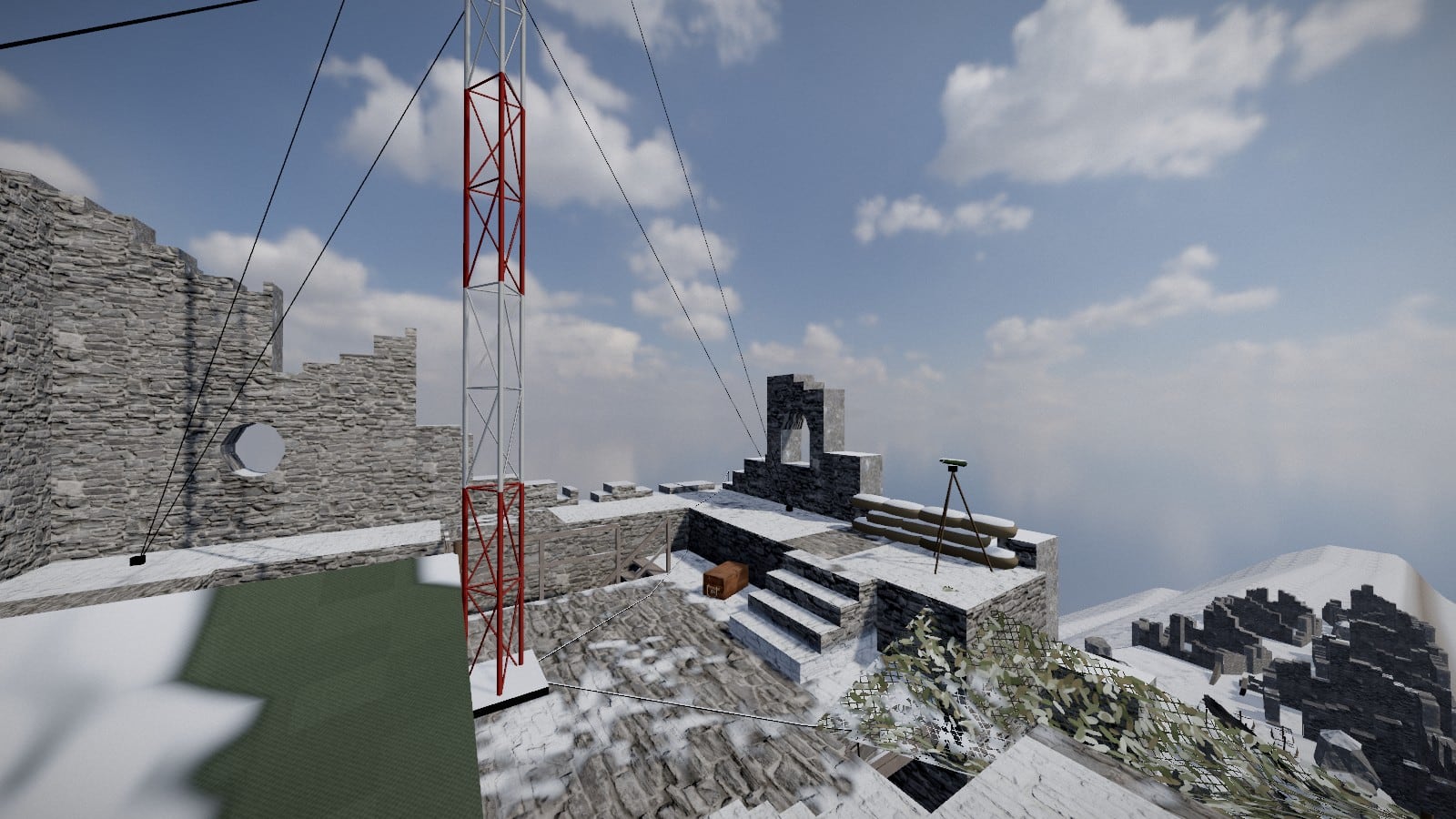
What they left above ground: a radio mast on the keep's roof, a command post in its upper room, a mess with a wood stove in its hall, a generator and drums of fuel in its store, tents and a supply dump on the terrace, a sniper's nest in one tower.
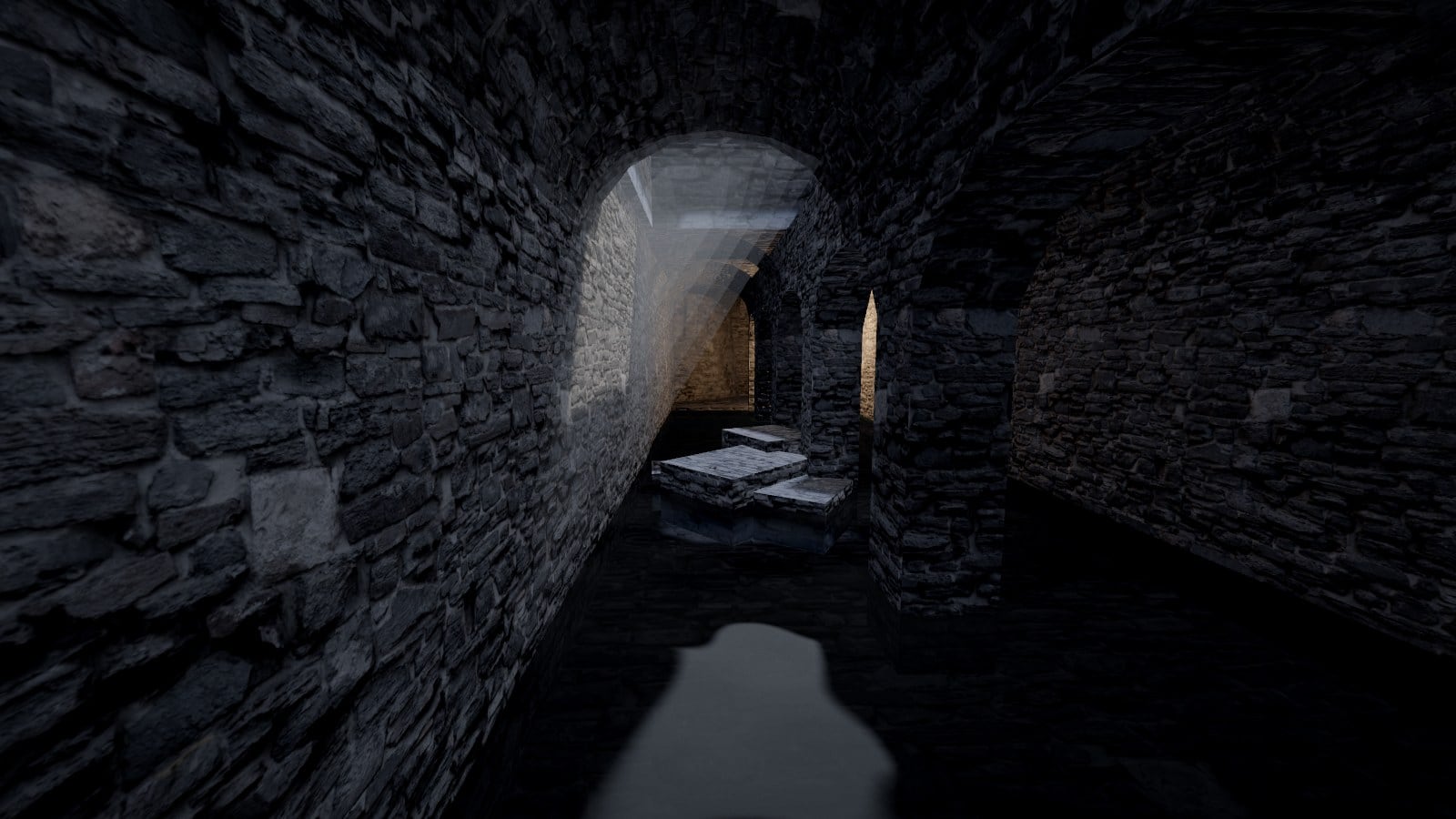
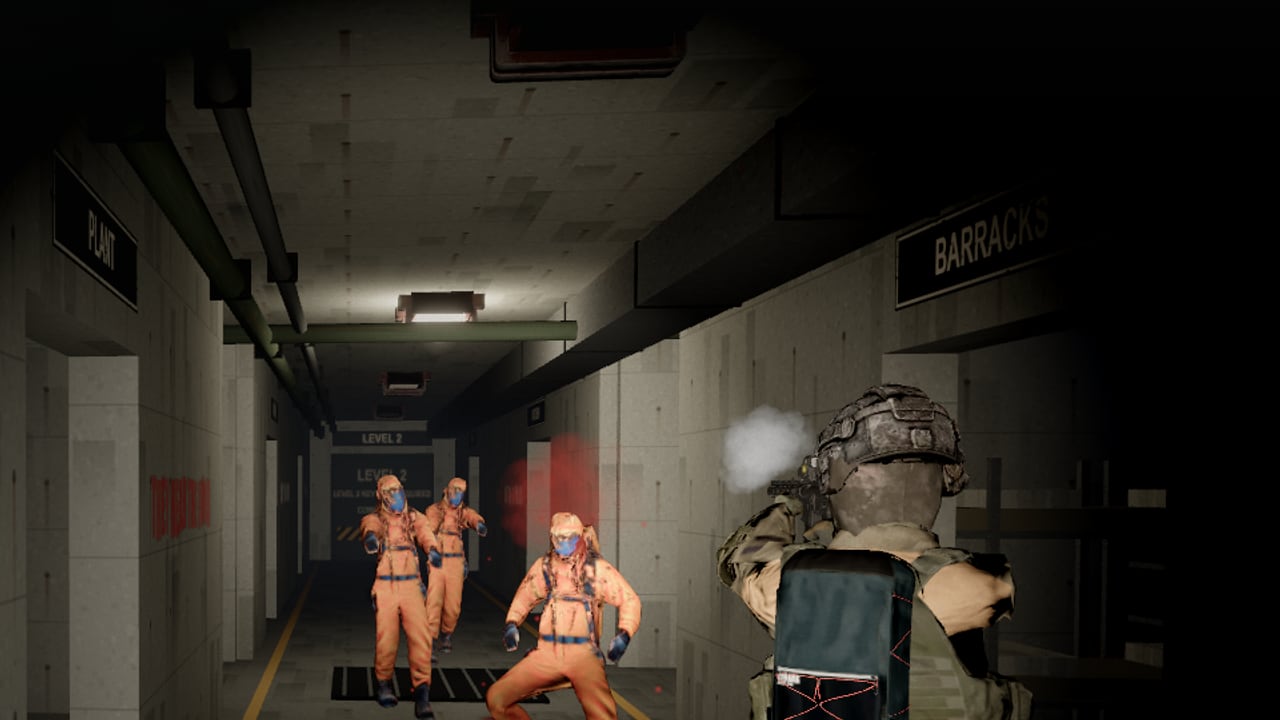
The vaults. A whole level under the terrace, 3.8 metres down: a cistern standing in black water, an armoury behind an iron grille, an aid post in the old cells, and a sally port whose stair goes down to a passage under the wall. A few lamps burn down there, and it is dark between them.
More than one way in. The gate, over its ramp. A breach in the wall with rubble heaped up to it. A length of wall that fell out, down to the floor of the cellars. A postern in the foot of the wall, with a stair down the outside. And a storm-cellar hatch behind the first house of the village, with close on fifty metres of passage from it to the foot of the sally port's stair.
Two ways round the back: one in the lee of the crest, down through the hollow behind the fort and along the foot of its cliff; and a goat path across the valley face, in plain sight of the whole valley. Both come to the postern.
A helicopter lies in the hollow, under the two towers on that side: the supply flight that did not make it. Things lie about it.
Loot by how hard it is to come at. The ruined houses on the way are the second tier: a hunter's leavings. The fort from its gate to its hall is the third: what a garrison lived on and fought with. Under the terrace, the command post and the wall top over the roof are the fourth, the rifles' tier. The armoury's racks hold an MPA30, a sniper rifle, an AK, an AR-15 or an M9. The aid post is medicine of the fourth tier.
The infected have the village and the vaults. Not the terrace, the keep, the towers or the roof: those are for whoever holds the fort and whoever comes to take it.
The Zona's line takes it all in: the loop, the ground between it and the valley, ninety metres of wood outside the road, the mountain road and the fort. The Zona is 1.5 square kilometres where it was 0.7, so a tag carried up to the fort has not been carried out of the Zona.
One mountain to steer by, and snow. In the north-east the mountains stand to 270 metres, where the rest of the rim is 130 to 180. Snow begins at 132 metres and everything is white above 150, but for faces too steep to hold it. The trees thin out from 190 metres and stop at 215.
At this update everybody is set down afresh, once, with everything they carried, because the ground has changed. A buried stash stays where it is, and is set on the new ground.
Two medicine cabinets in Kamenka's hospital, one over the other on two floors, were one cabinet to the server: what was taken out of one was gone from both. Each is its own.
Somebody who had just passed the bot check could be left where its range stands, high in the sky, with nothing under them: they fell, and some were put off the server or kept off it for it. Nobody is left there now, and nobody is put off for having been.
The passage under the fort from the cellar hatch had no floor, walls or roof for its last 2.7 metres, and gaps at its bends. It is closed all along. Stone that flickered where two faces lay in one plane is mended in most places.
The infected under the fort walked into its walls: they stand outside it now.
An admin was not told they were one on coming in. And the admin panel's Bans page can be searched, and shows who the checks are keeping off, with a button to let them back in.
Ground that does not repeat
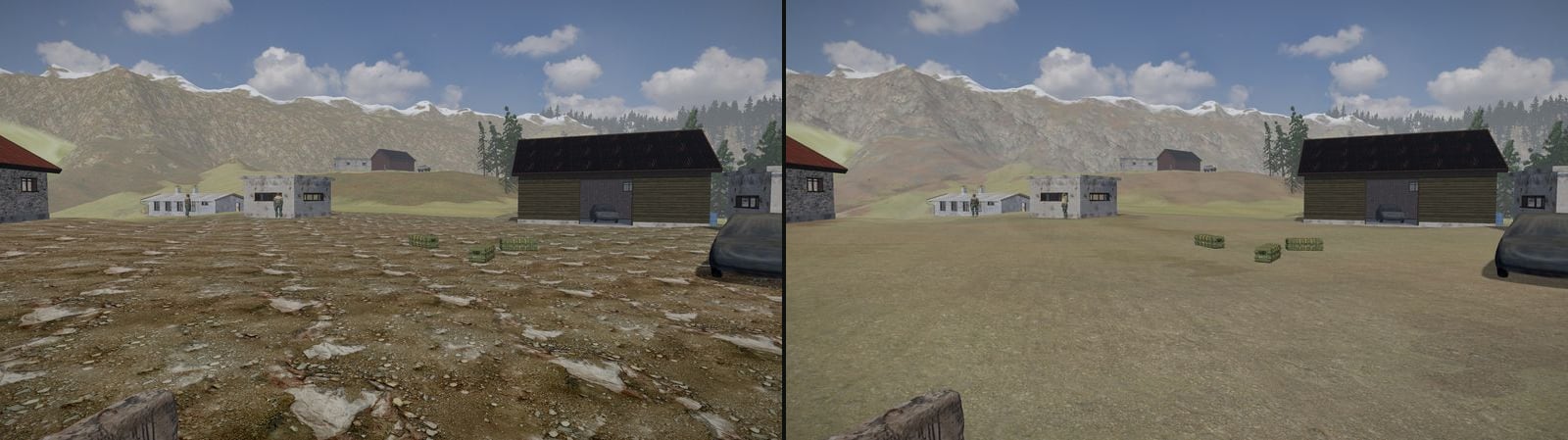
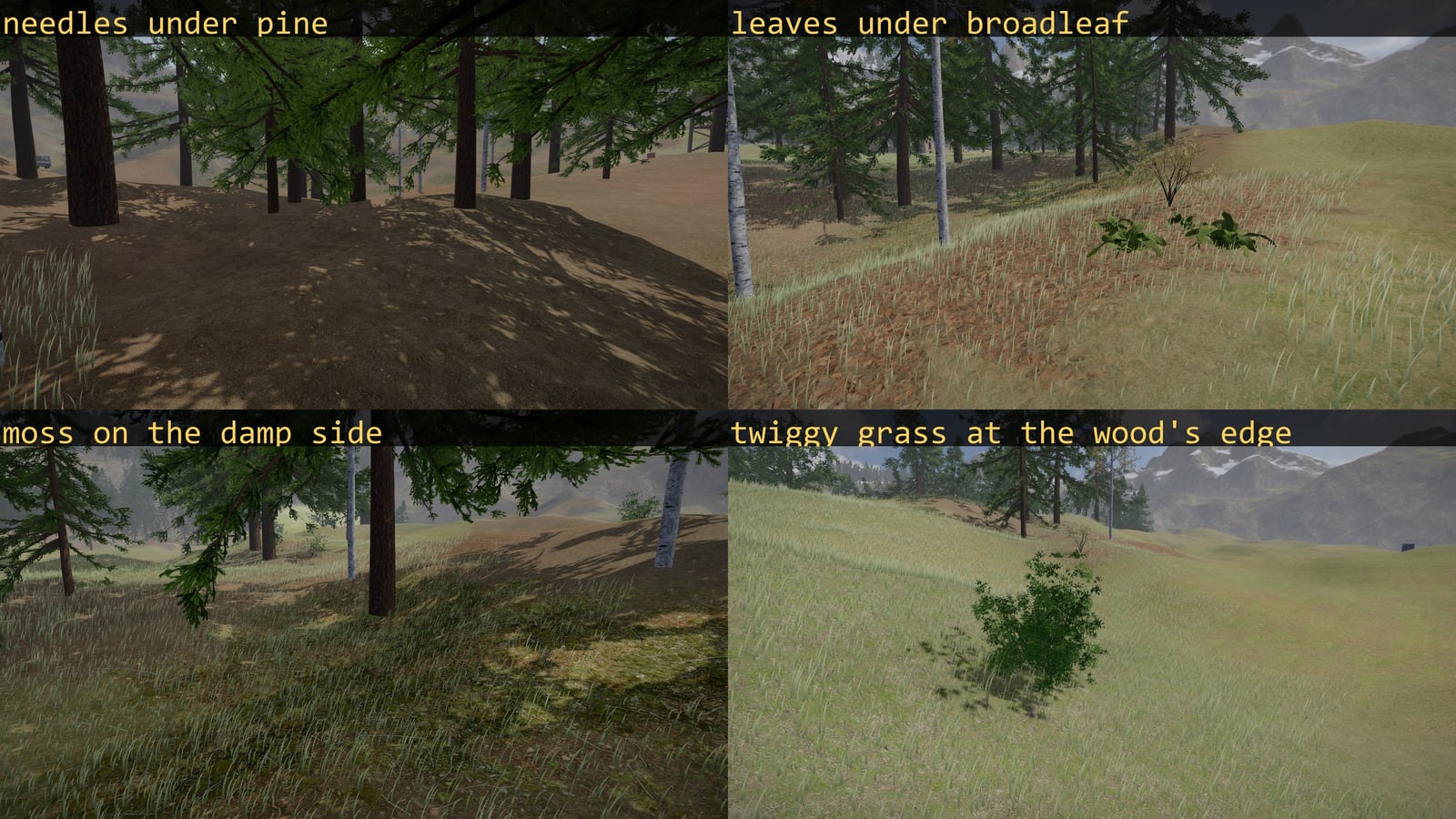
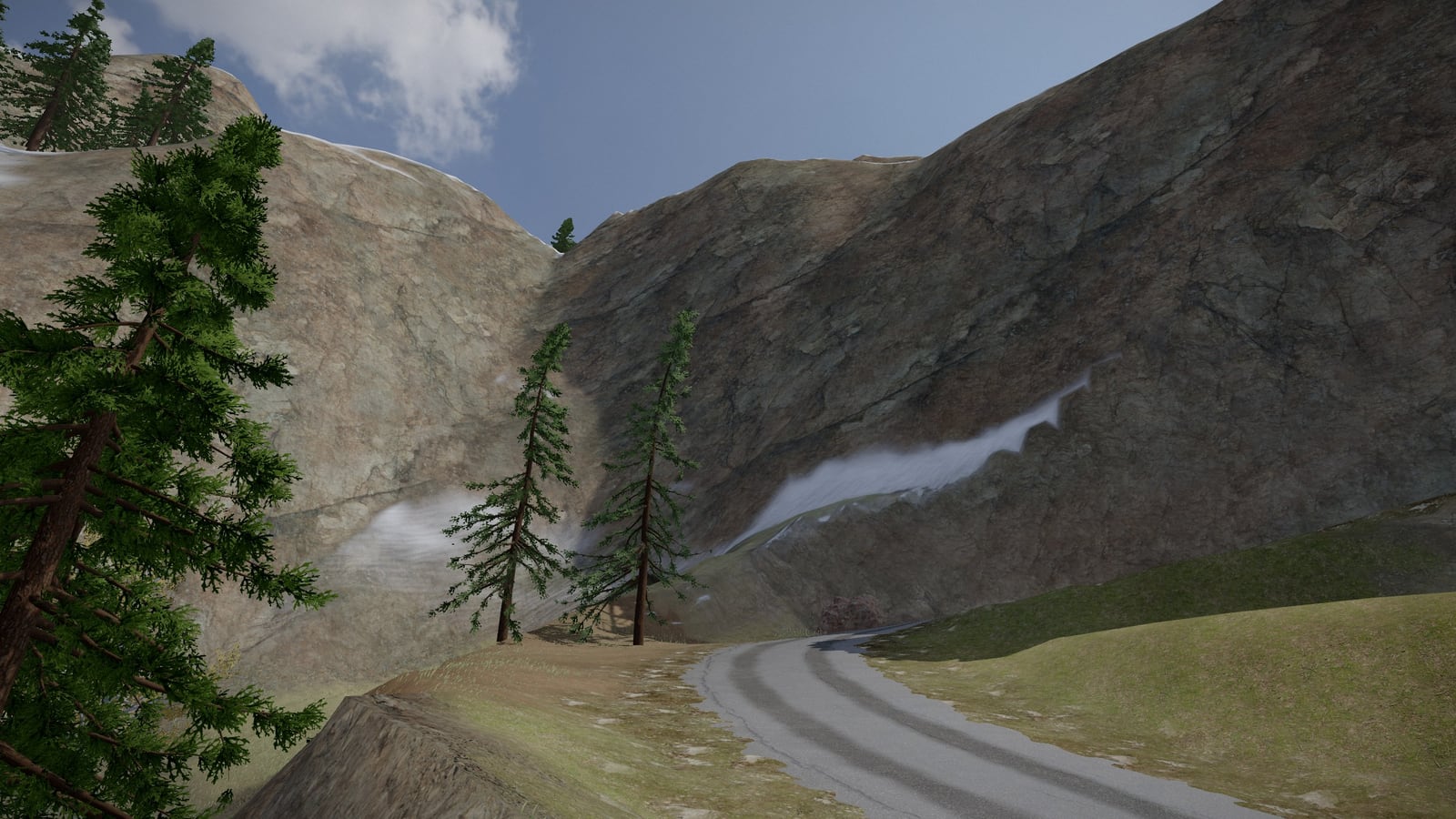
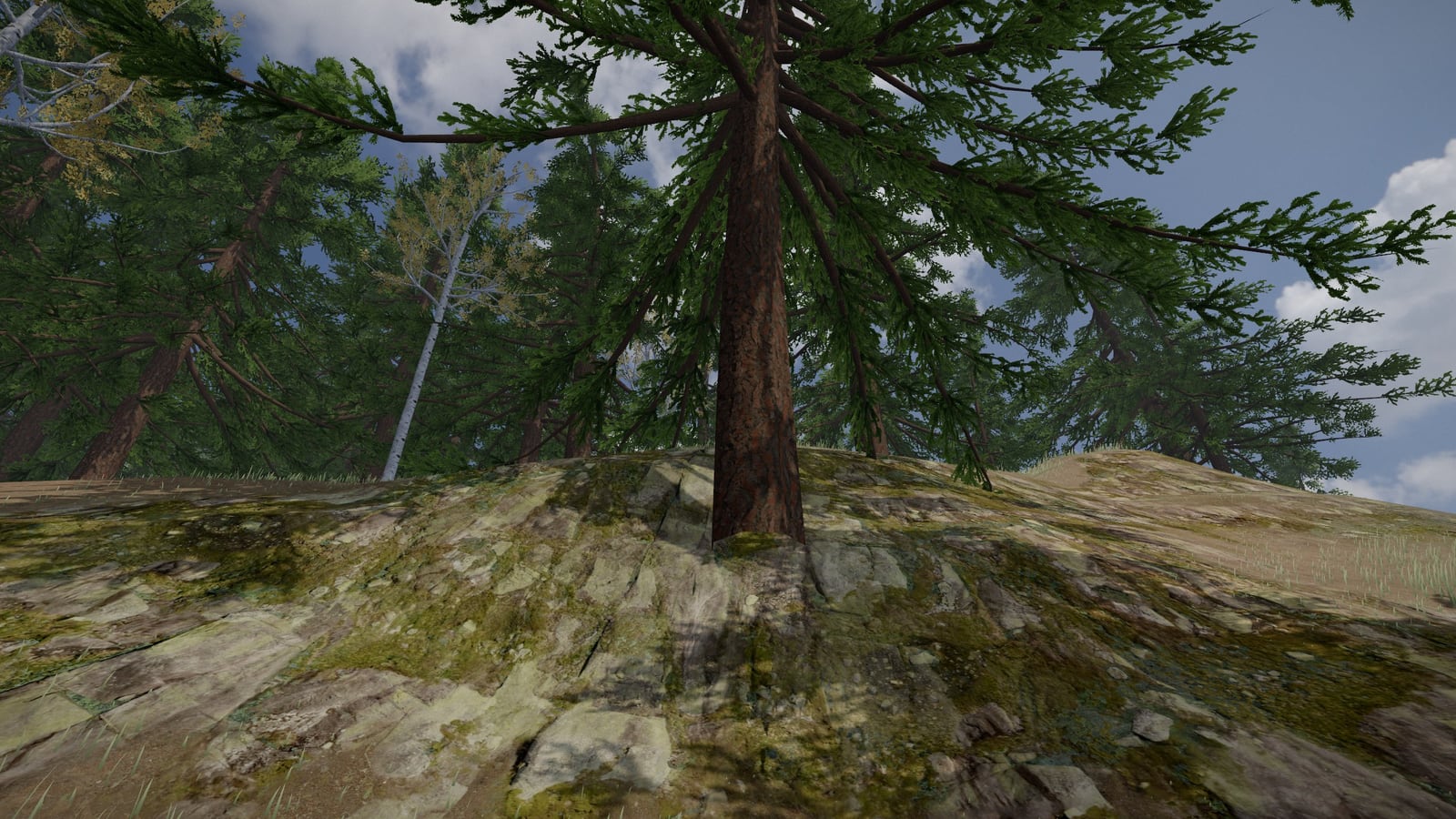
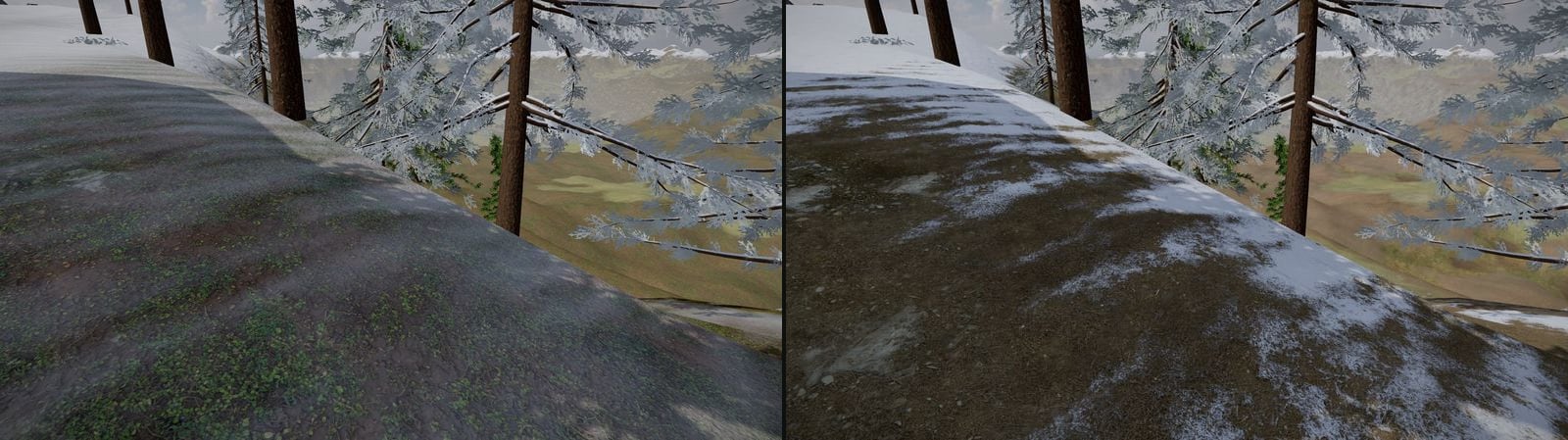
The ground was four pictures laid in rows, and from any rise you could count the rows. It is twelve kinds of ground now, each laid where it belongs: by what grows there, how steep it is and who walks on it. A steep face is rock. Snow has form when you stand in it.
A yard in the valley, as it was and as it is. The rows are gone, and the far hillside has crags.The floor of a wood goes by the trees over it: needles under pine, leaves under birch, oak and ash, moss in the damp shade.A steep face is rock, laid by the way the face stands. It was a photograph from the air, smeared down the slope.A bank in the woods: slabs breaking through turf and litter, moss grown in the joints.Where the snow begins, as it was and as it is: it lies in patches, broken by the ground under it.
No more rows. Each picture of ground is laid in patches, each shifted its own way and joined to the next along its own bumps. From far off it is laid large as well, so a distant hillside has grain.
Twelve kinds of ground where there were four: three grasses (lush in the hollows, turf over most of it, dry on the knolls and toward the snow), the thin grass of a wood's edge, four forest floors (needles, leaves, moss, dark earth), trodden earth, stony ground, bare rock, and the mossy slabs of a wood's bank.
Laid by what stands there. Needles under pine. Leaves under birch, oak and ash. Moss in damp shade. Trodden earth on a track, in a yard, at a camp. Stones under a bare face, where they came down off it.
A steep face is rock, laid by the face's own direction and not from above: nothing is smeared down a cliff any more.
Snow has form close to, within sixty metres of you, and its edge is broken by the ground it lies on.
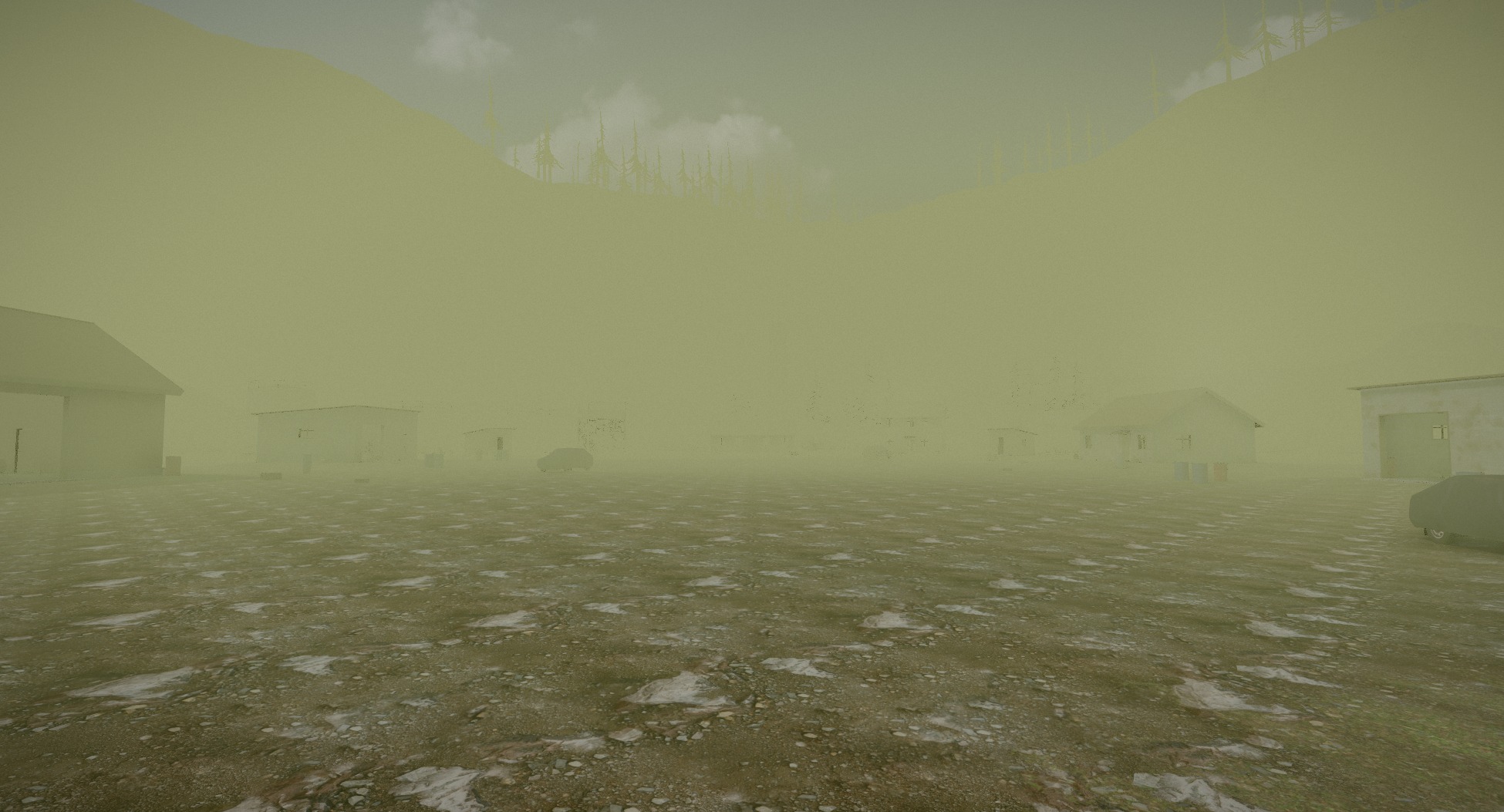
The gas hides whoever is in it. From outside it is six times as thick as it was: ten metres of it hide a body. To an eye inside it, it is nearly clear. The works' gas and the bunker's are one gas, drawn the same, with a soft broken edge and a ragged top. Warning boards stand round each, and beside the roads that lead to them.
On a phone the ground is as it was. The new ground is for desktops for now.
Steep ground: slow up, a slide down, never a wall
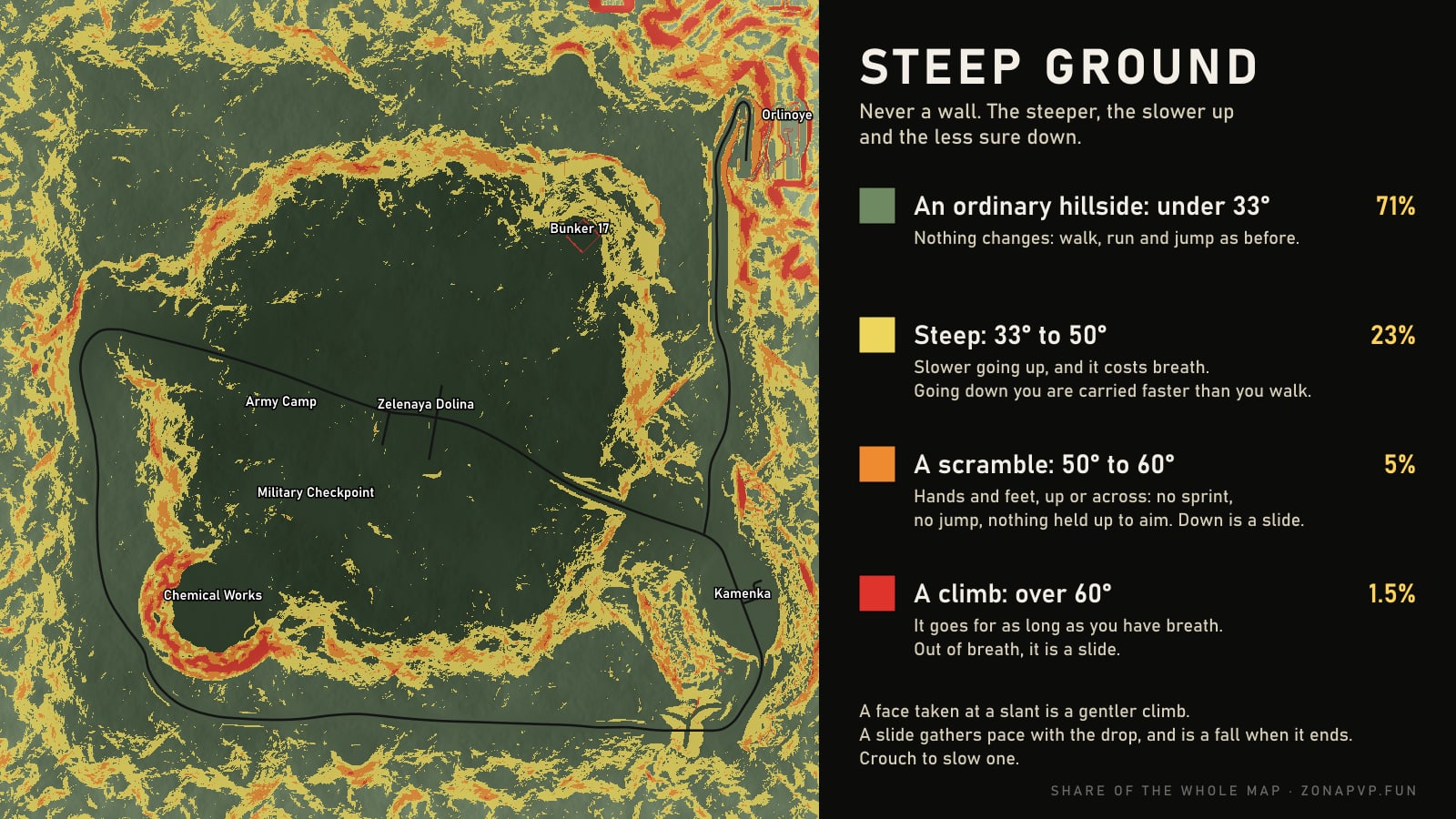
You walked up anything under fifty degrees at full pace, stood dead against anything over it, and came down a cliff at a jog without a scratch. Now nothing is a wall and nothing is a free way down. Seven tenths of the map are exactly as they were.
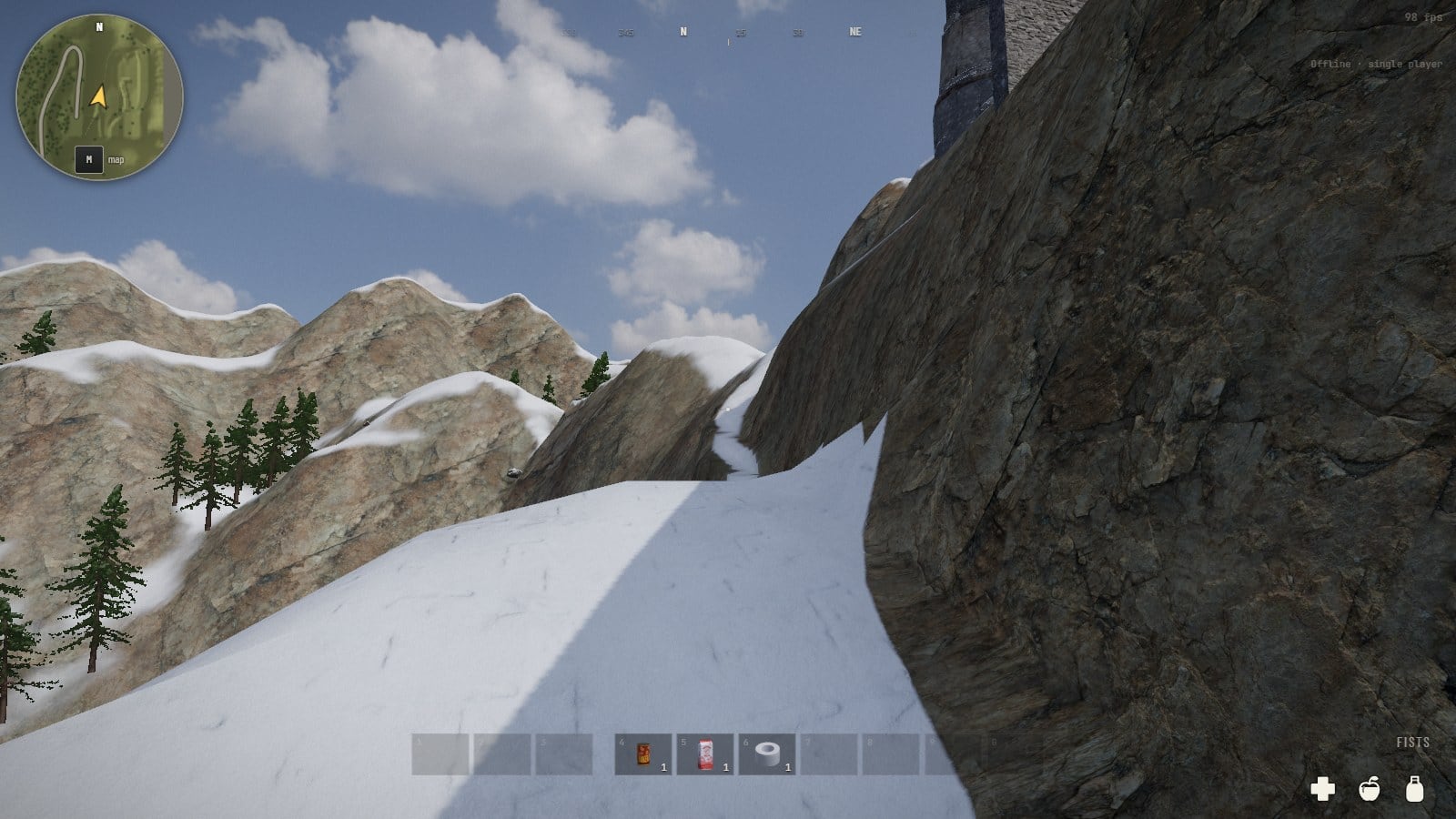
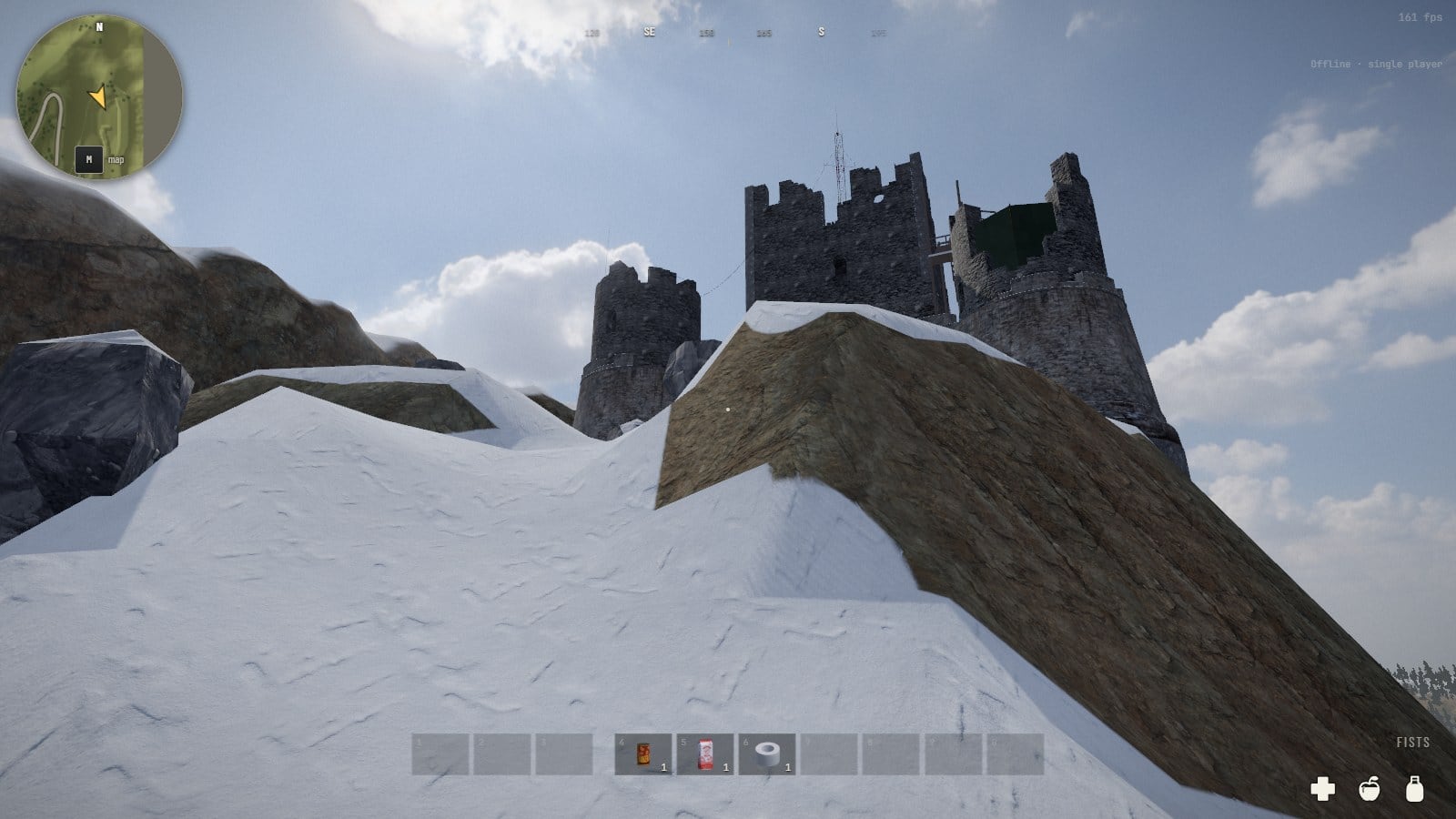
Where it bites. Yellow is steep, orange a scramble, red a climb. The valley floor is as it was. Its rim, the cirque of the works and the mountains are not.The goat path round to the back of Orlinoye, across the valley face.Under the fort. Taken at a slant, ground like this is a gentler climb than it is taken straight.
Under 33° nothing has changed. That is 71% of the map, and nearly all of the valley floor.
33° to 50°: steep. Going up, your pace is held to less and less, and it costs breath: a sprint is no faster than a jog by 42°, and a jog is cut from there. Going down you are carried faster than you walk and cannot stop dead; from 42° you cannot stop at all but by turning across the slope or going down on a knee.
50° to 60°: a scramble. Hands and feet, up or across: slow, hard on the breath, no sprint, no jump, nothing held up to aim. Going down there is no footing. It is a slide.
Over 60°: a climb. It goes only while you have breath, even to hang on where you are. Out of breath, you slide. No face is too steep: the steepest are gone up at half a metre a second.
A face taken at a slant is a gentler climb. What counts going up is how steep your way is, not how steep the face is: go up across it, as a path with hairpins does.
A slide gathers pace with the drop, and is a fall when it ends. A short one costs nothing. A long one down a cliff breaks a leg. Crouch to dig your heels in: it slows a slide to about half, and stops it on anything under 50°.
No slide goes over the ground faster than a sprint, however long the face.
What you carry counts on a climb as it does on a run, and a broken leg makes a scramble slower and harder on the breath.
The infected are slowed by the same figures.
Fire that burns, and blasts that throw the ground
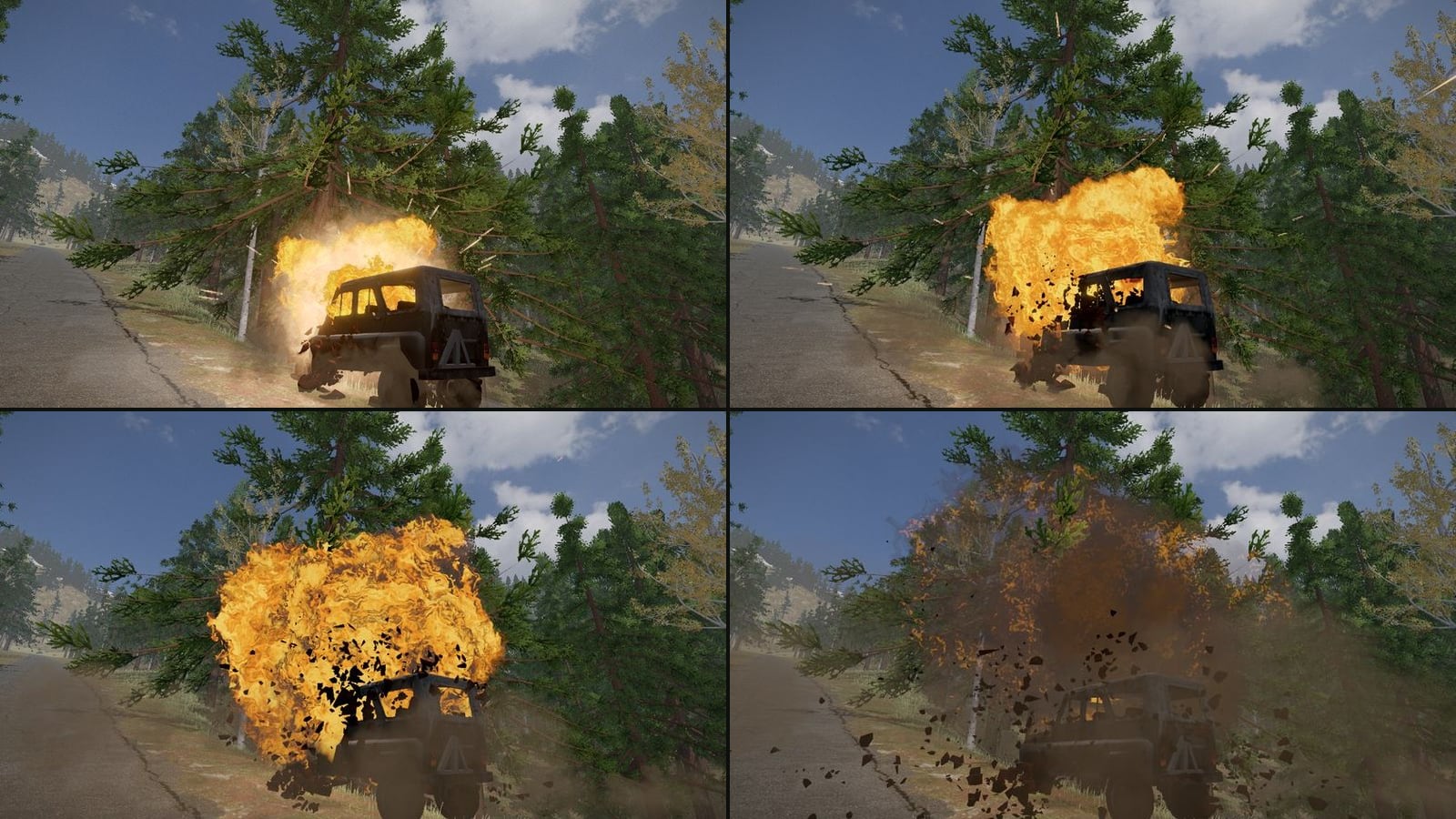
A blast was a heap of pale puffs, all in one frame. It is made in layers now: a flash, a ball of fire that boils and cools to soot, smoke, dust the colour of the ground, and the ground itself thrown up and coming down. Fires burn with photographed flames, and a wreck goes on burning.
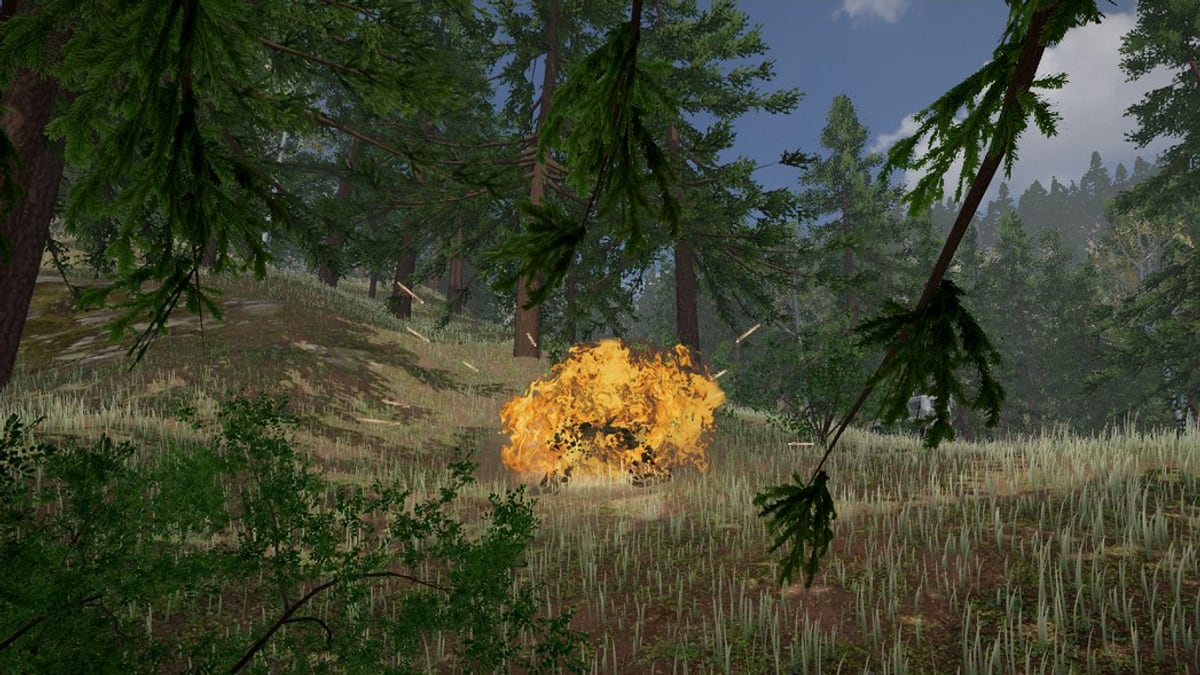
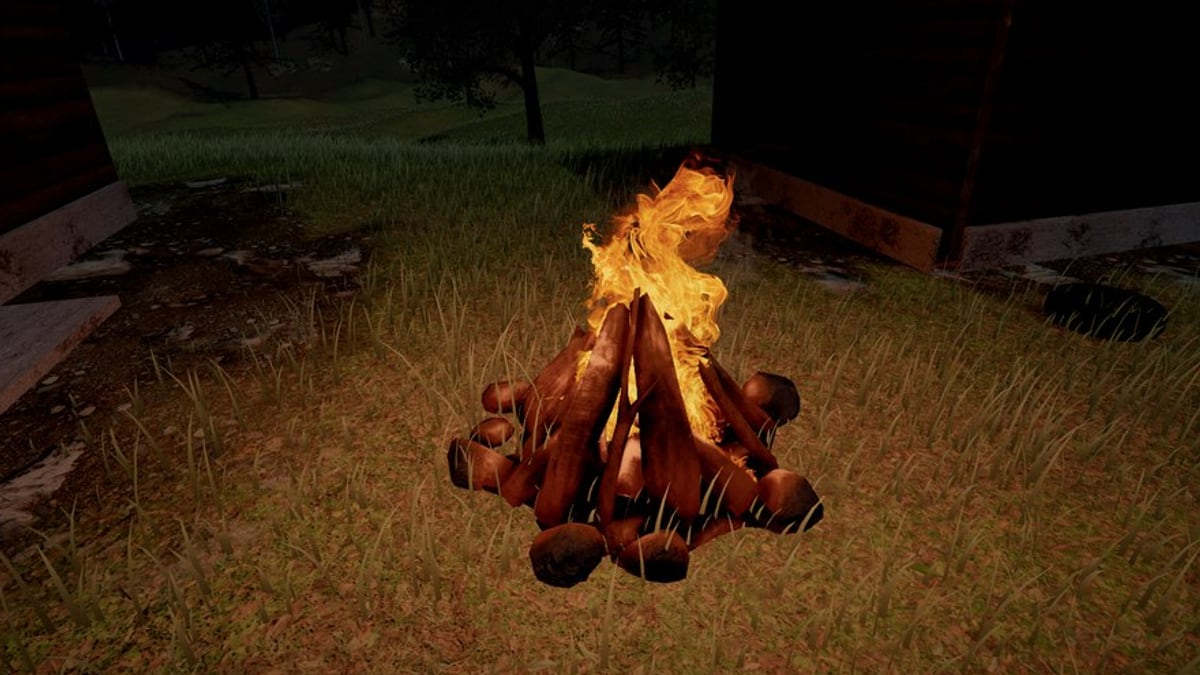
A car going up: 0.15, 0.3, 0.6 and 1.2 seconds after.A stick grenade, 0.15 of a second after it goes off.A campfire burns with the flames its own model came with: photographs of fire, moving.
A blast is made in layers. A flash, gone in a fourteenth of a second. A fireball that swells, rises, boils and cools. Smoke, lit by the fire while there is one and by the sky after; for fuel, a black column that stands for seconds. Dust rolled out along the ground, in the colour of that ground. Sparks, embers, and the ground left burnt.
It throws the ground it goes off on: 1,381 pieces of it, painted as that ground is, grass or forest floor, rock, gravel, asphalt, concrete or snow. A car throws dark metal. A wooden floor throws nothing. (Not on a phone.)
It shakes the view of whoever is near, and the shake comes with the sound: later, the further off you are.
In a room, a blast is kept in the room. Nothing of it is drawn on the far side of a wall.
A fuel drum reaches 14 metres where it reached 8, and does 180 at its middle where it did 140: 132 at 3 metres, 73 at 7, 35 at 10, nothing at 14. One drum still sets off the next within 5.2 metres.
A car takes three times as much: 5,400 where it took 1,800. And no bullet takes more than 47.5 off it, so the heaviest round there is needs a hundred and one to set it alight. The AR-15 needs 114, a 9 mm 140.
Two stick grenades take a whole car. A fuel drum takes a fifth of one.
A wreck goes on burning. At its fiercest for 18 seconds after it blows, settled by 70 to a steady fire under black smoke, which it keeps for as long as it stands. One you come upon already burned is burning too.
The campfire burns with its own flames: the 29 photographs of flame and smoke that came with its model, each on its own time, so the fire burns level and does not pulse. A burning car burns with the same ones.
Fireplaces have new models, one cold and one lit: the one is changed for the other when the fire is lit.
The supply drop comes by helicopter
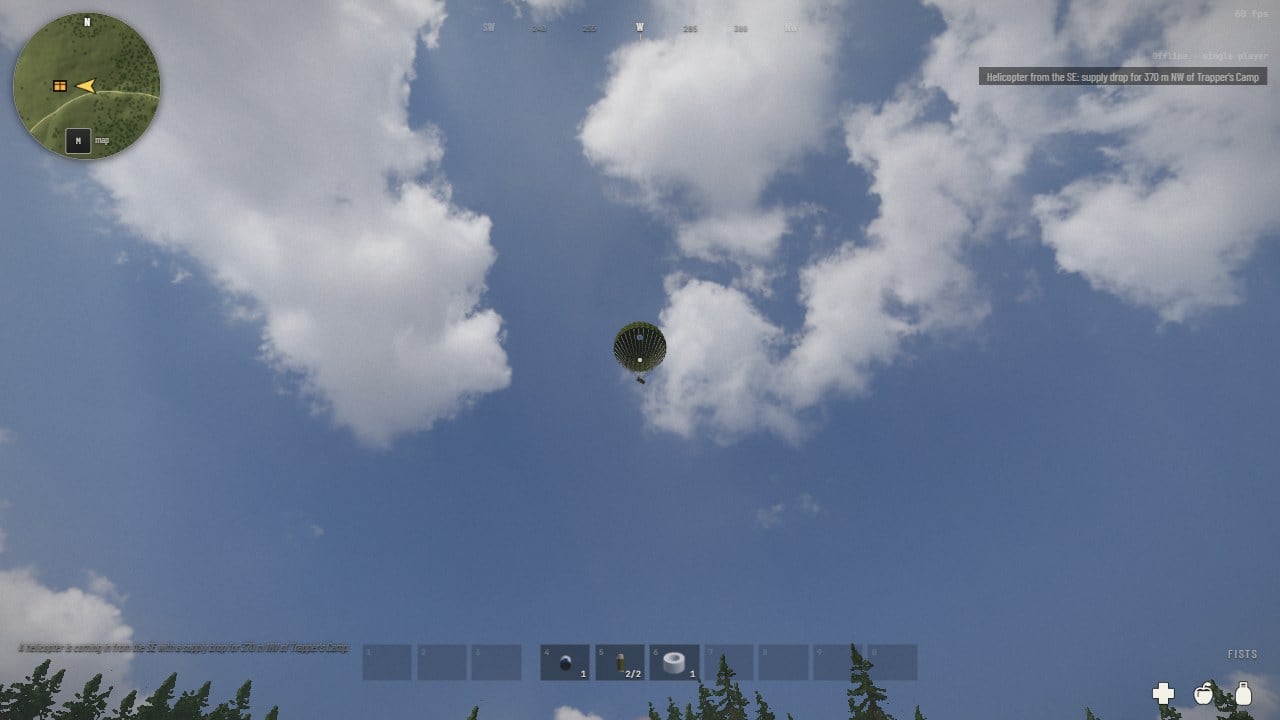
A drop used to be there, all at once. Now a helicopter comes in from the edge of the map, holds over the place, and lets the crate down under a parachute. You hear it coming for half a minute. So does everybody else.
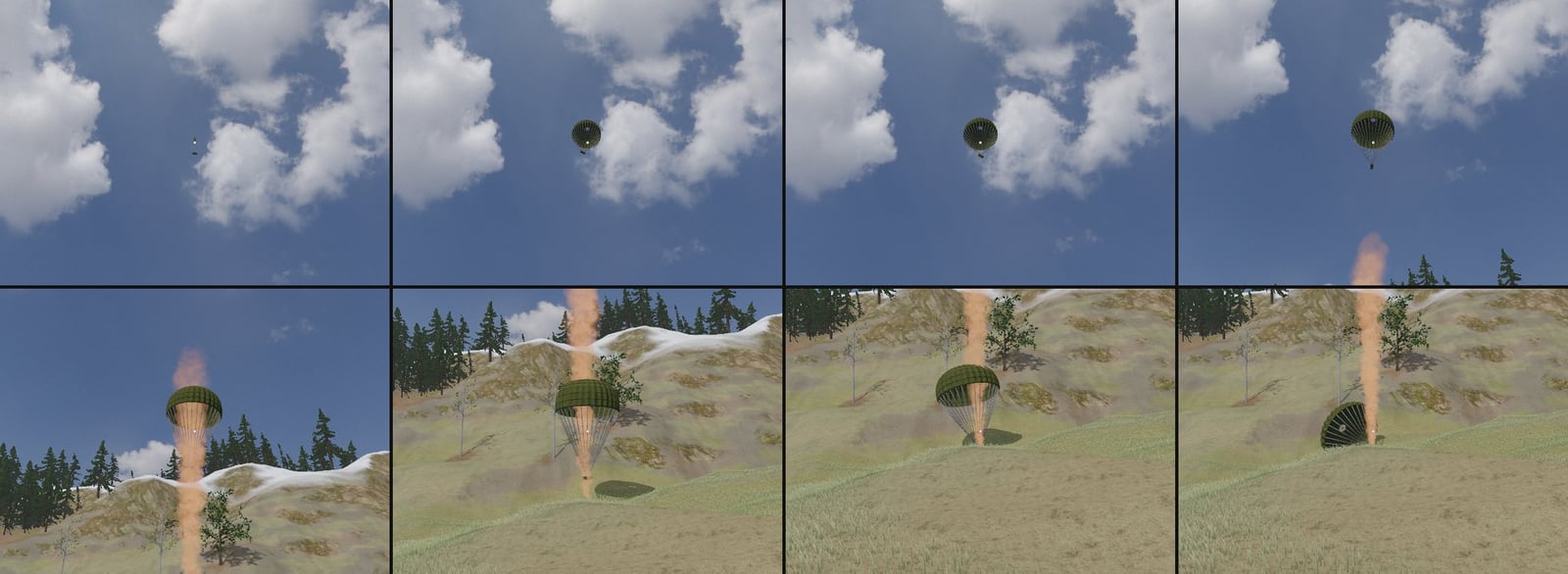
Everybody is told where it is for, which way the helicopter is coming from, and how many seconds until the crate is down.Down in about a quarter of a minute from 90 m: a second of free fall, the canopy open in another, then 4.2 m a second onto its smoke.From 320 m, by day and by night. There is no helicopter to look at yet. By day it is its sound and the crate. From dusk it is four lights.
The flight. It appears on the map's edge a long way from the place, flies in at 40 metres a second (144 km/h), never nearer the ground than 45 metres, slows to a hover 90 metres over the place, and three seconds later the crate leaves it.
The parachute. The crate falls free for 1.2 seconds, the canopy opens in 0.9, and it comes down at 4.2 metres a second, swinging less with every swing: about twenty seconds from the helicopter to the ground. It cannot be opened until it is down.
Then it leaves. The helicopter stays over the place for half a minute after the crate has gone, turns away, never back along the way it came, and flies out over the map's edge.
It is loud. After a shot and a blast it is the loudest thing in the game, and it is heard right across the map. From far off it is lower and duller, the thump of the blades and little else. Under a roof it is muffled. Down in the bunker it is nearly gone.
You are told where the drop is for, which way the helicopter is coming from, and the seconds until the crate is down. It is marked on the map, as before.
A drop called on a field radio comes the same way. It was 45 seconds, flat. It is 40 to 75 now, by how far the helicopter has to come.
There is no helicopter to see yet. By day you know it by its sound and by the crate. From dusk it carries four lights: a red one under it that flashes, a white one at its tail, red on its left and green on its right, so you can tell which way it is going. The aircraft itself is to come.
A drop called on a radio came down three paces in front of whoever called it: straight overhead, and not seen until it landed. It now comes down up to 14 metres in front, on open ground, and whoever is near is told to look up when the crate leaves the helicopter. The fall is slower: 4.2 metres a second where it was 5.5.
What you carry, and what you wear
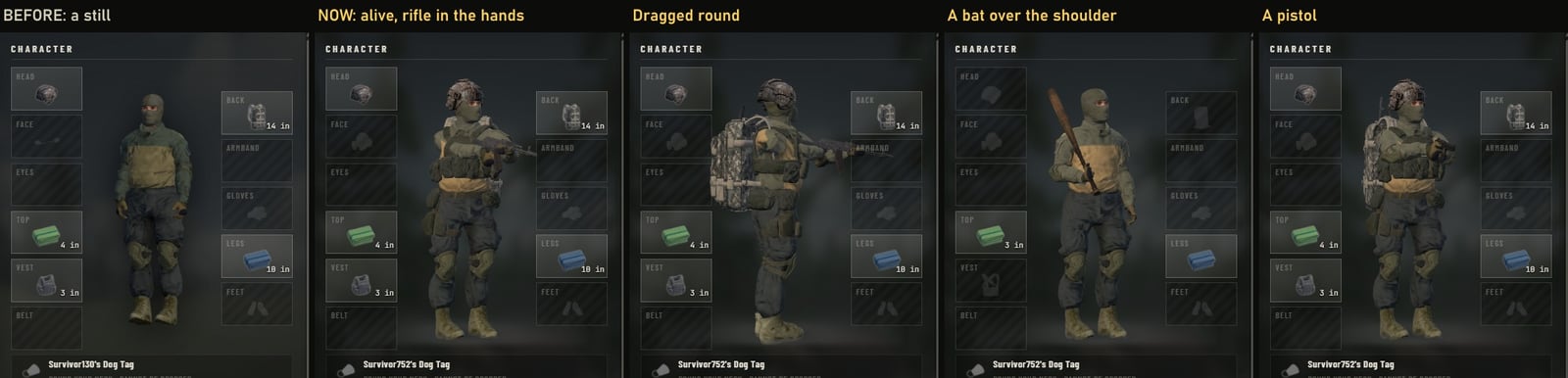
Weight costs how far you can sprint, not how fast you walk. The jacket and trousers you start in are things you can take off. The figure in your inventory is alive. And there is a new knife, a visor that comes down, a steel helmet, and lockers that open when they are searched.
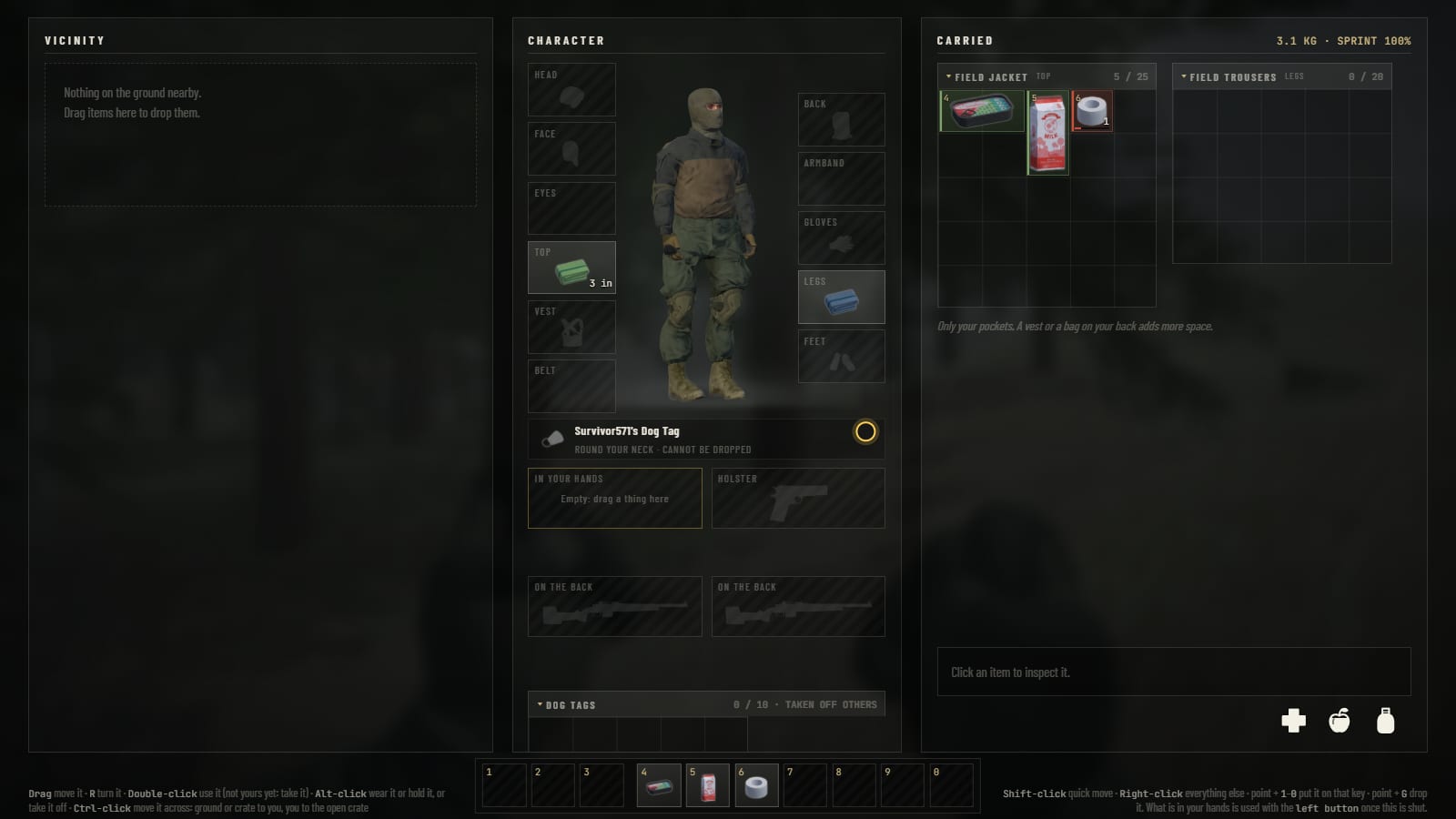
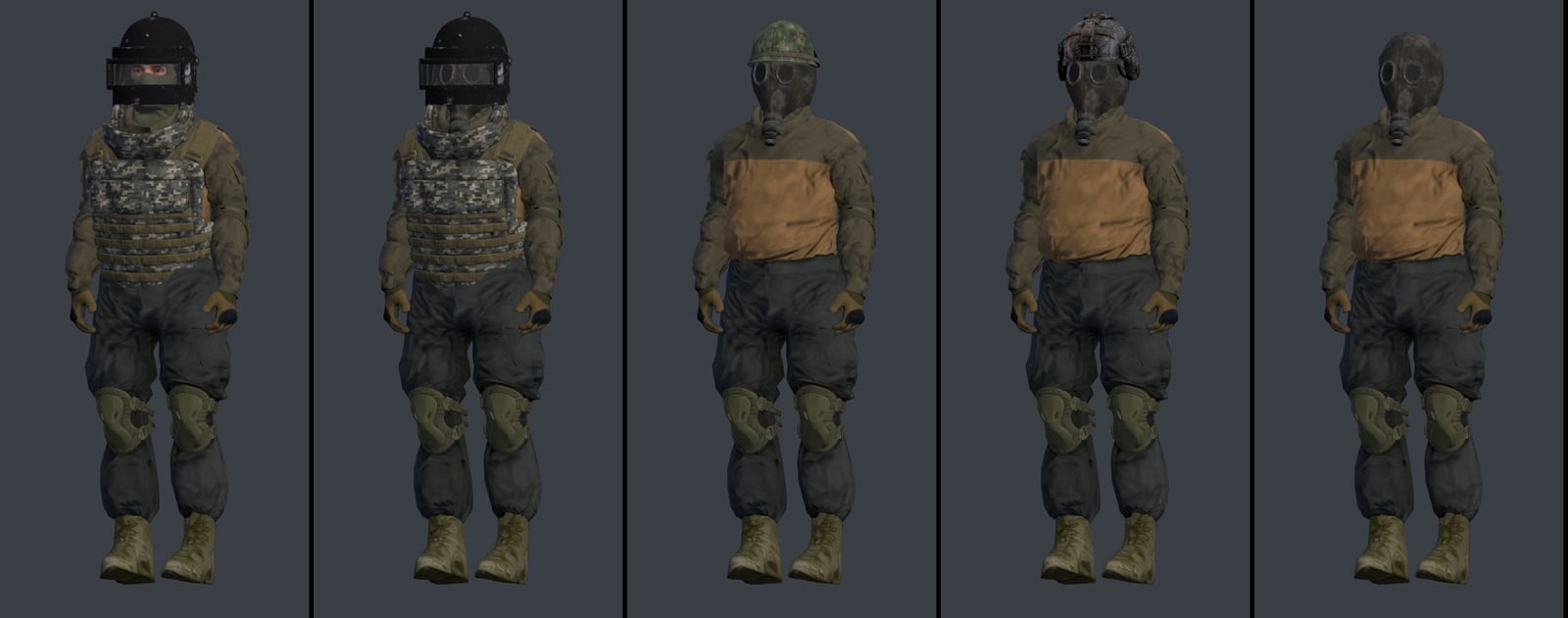
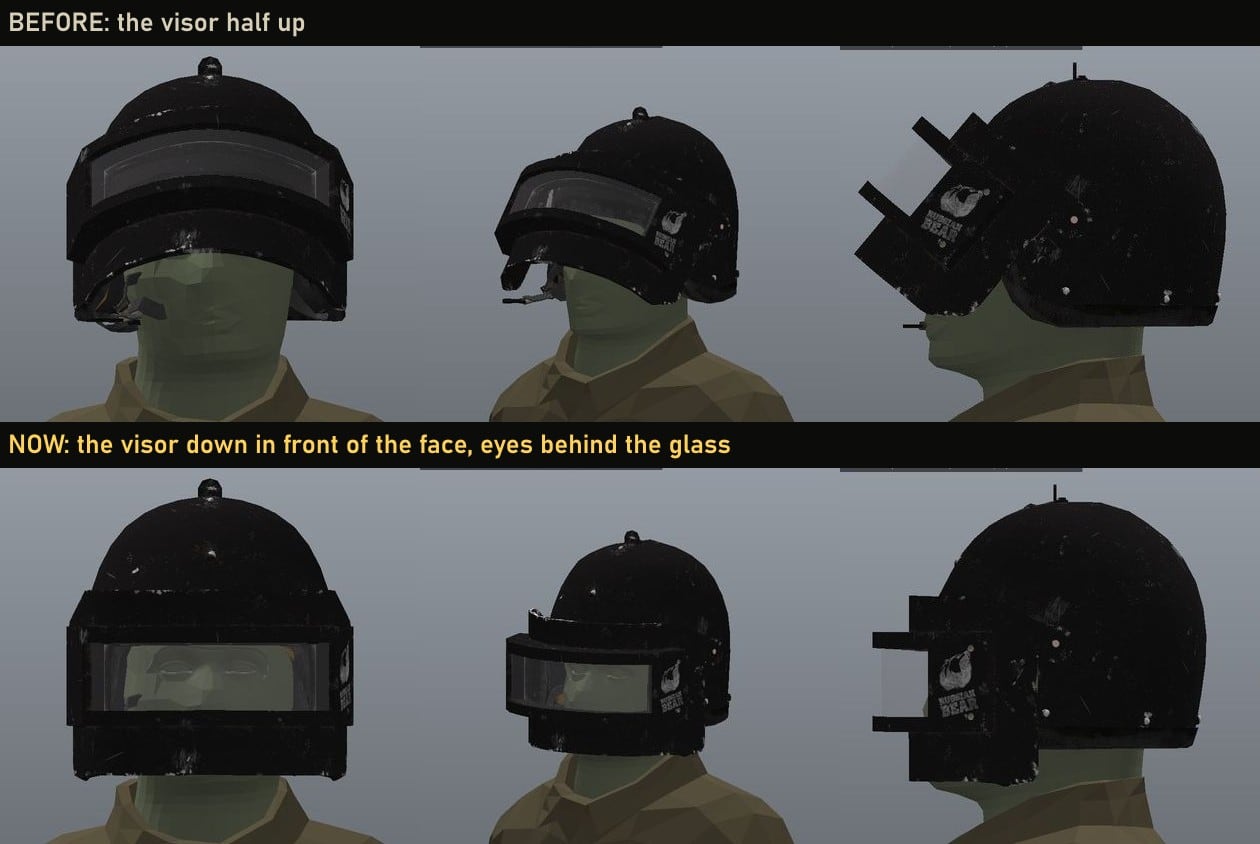
The figure in the inventory is alive: the game's own body, wearing what you wear and holding what you hold. Drag it to turn it. Either side of it, the eleven places to wear things.On the head. The K6-3 with its visor down, bare-faced and over a mask; the new Steel Helmet; the Combat Helmet; and the gas mask without its hose.The K6-3's visor is down, and stays down.The Combat Knife, beside the Fish Knife it takes the place of.Lockers open while somebody is searching them, and everybody near sees it.A crate's lid lifts while it is searched.Racks in shops, garages, sheds and barns, with things on their boards.A gun on the ground lies there with what is fitted to it and the magazine that is in it.New pictures for what is new or changed. The pink one is the Combat Stim.
Weight costs sprint, not pace. The first 8 kg are free. Every kilogram after that takes 1.25% off how far a full breath runs, and never more than 35%: from 36 kg up you sprint 65% as far as with nothing. You walk and jog as fast as anybody.
Breath comes back faster by the same measure, so somebody loaded who has run their shorter run is ready to run it again as soon as anybody else.
Only a load far past a fighter's slows the legs: from 60 kg, 1% of your pace a kilogram, never under 70%.
The inventory says it. Beside "Carried": your weight, and what it leaves of a sprint.
Rounds weigh about half what they did, and a bottle weighs less with every drink.
Eleven places to wear things, as DayZ has them: head, face, eyes, top, vest, belt, legs, back, gloves, feet, armband. Nothing is made yet for the eyes, the belt or the armband: the places are there, and empty.
The jacket and trousers you start in are things. The Field Jacket has 16 slots in its pockets and the Field Trousers 12: the pockets you had. Take one off, drop it or leave it on a body, and what is in its pockets goes with it.
A move that is refused says why, at the pointer.
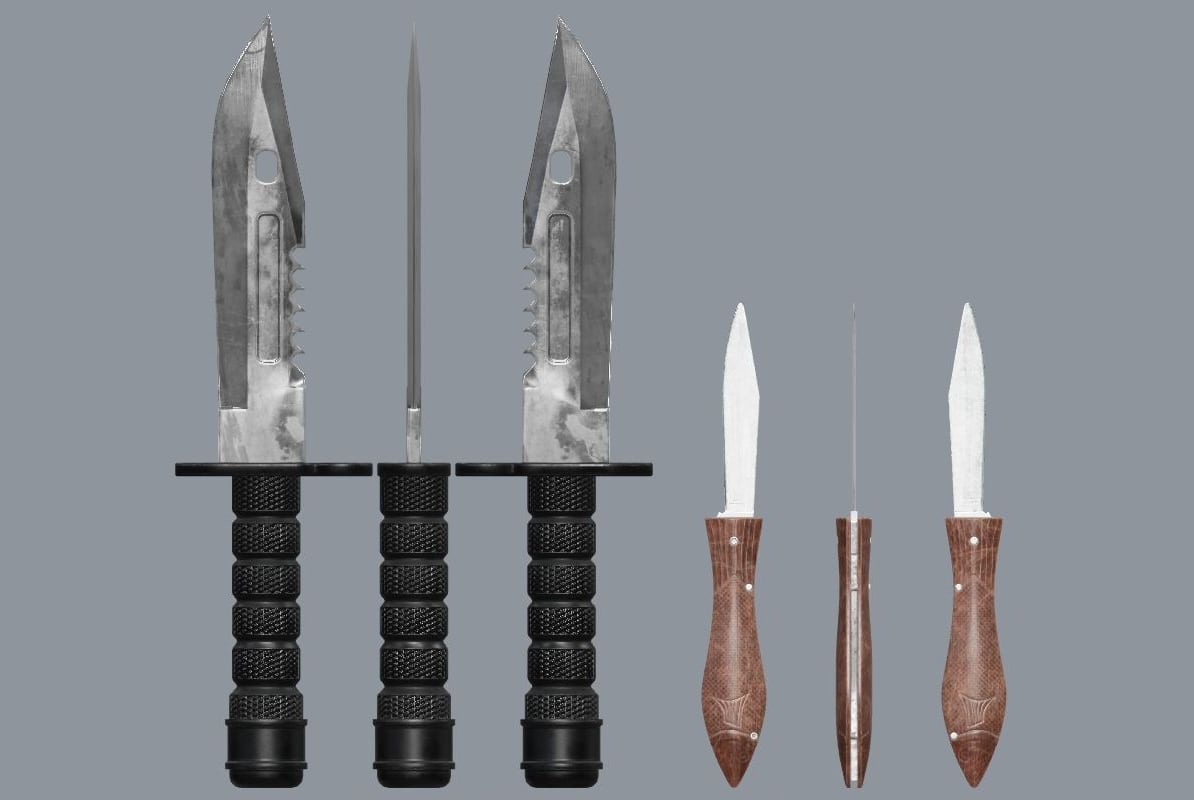
The Combat Knife takes the Fish Knife's place: an army bayonet-knife with a saw back, with movements of its own in the hands: a cut, a cut back, a thrust. What it does is as it was.
The K6-3's visor is down in front of the face, always, over a gas mask too.
The gas mask has lost its hose and its filter can. It is the same mask, and does what it did.
The Steel Helmet: an old steel pot under a camouflage cover. A fifth off anything that hits your head: twice what a cap takes, and short of the Combat Helmet's three tenths. It is the army's, on the second tier and the third.
The First Aid Pouch: two squares by two, four seconds to open. It stops bleeding, gives back 20 health and runs in 500 ml of blood over a minute. Found where the army, the police or medicine were, and one comes in every supply drop.
The Combat Stim, the pink one, is on the fourth tier and the fifth, where the army or medicine was. One comes in every supply drop.
A round goes into a magazine a quarter faster: 0.68 of a second where it was 0.85.
Lockers and crates open. A steel locker's doors swing wide and a wooden crate's lid lifts for as long as somebody has it open. Whoever is near sees it, and within 28 metres hears it. There are more than thirty such lockers and close on two hundred such crates.
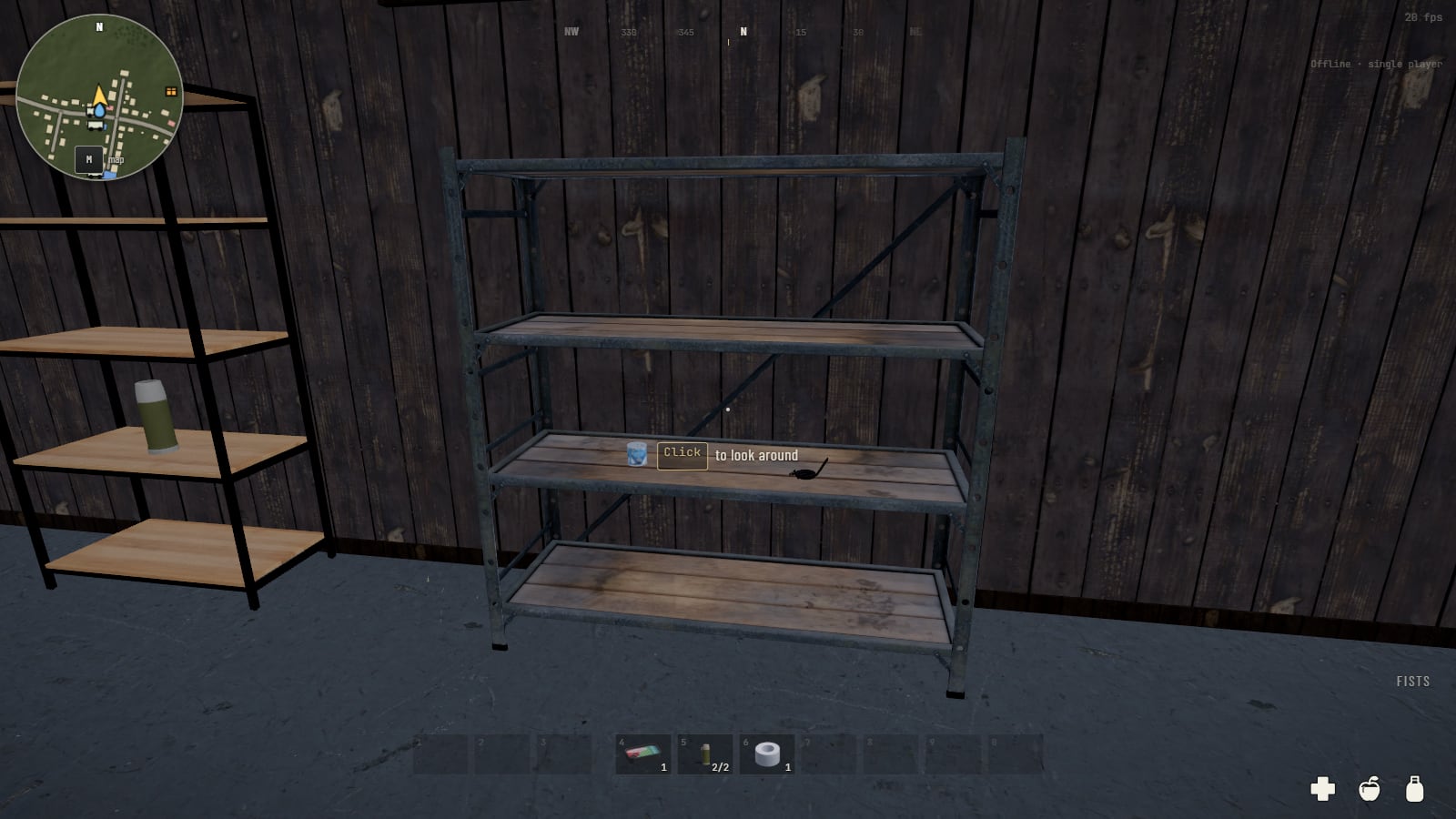
Racks stand in shops, garages, sheds and barns, with things lying on their boards.
A gun on the ground shows its parts: the magazine that is in it, its sight, its suppressor.
Settings in pages, five volumes, and a menu that is all the game
Settings are four pages: Controls, Audio, Video and Game. There is a volume for everything and four under it. Everyday things are recordings: a footstep, a thing picked up, a car's door. And every scene behind the main menu is the game itself, played live.
Controls is the first page: the two sensitivities, then every key.Audio. One volume for everything, and four under it.Behind the menu: the game itself, live. Here, Bunker 17.
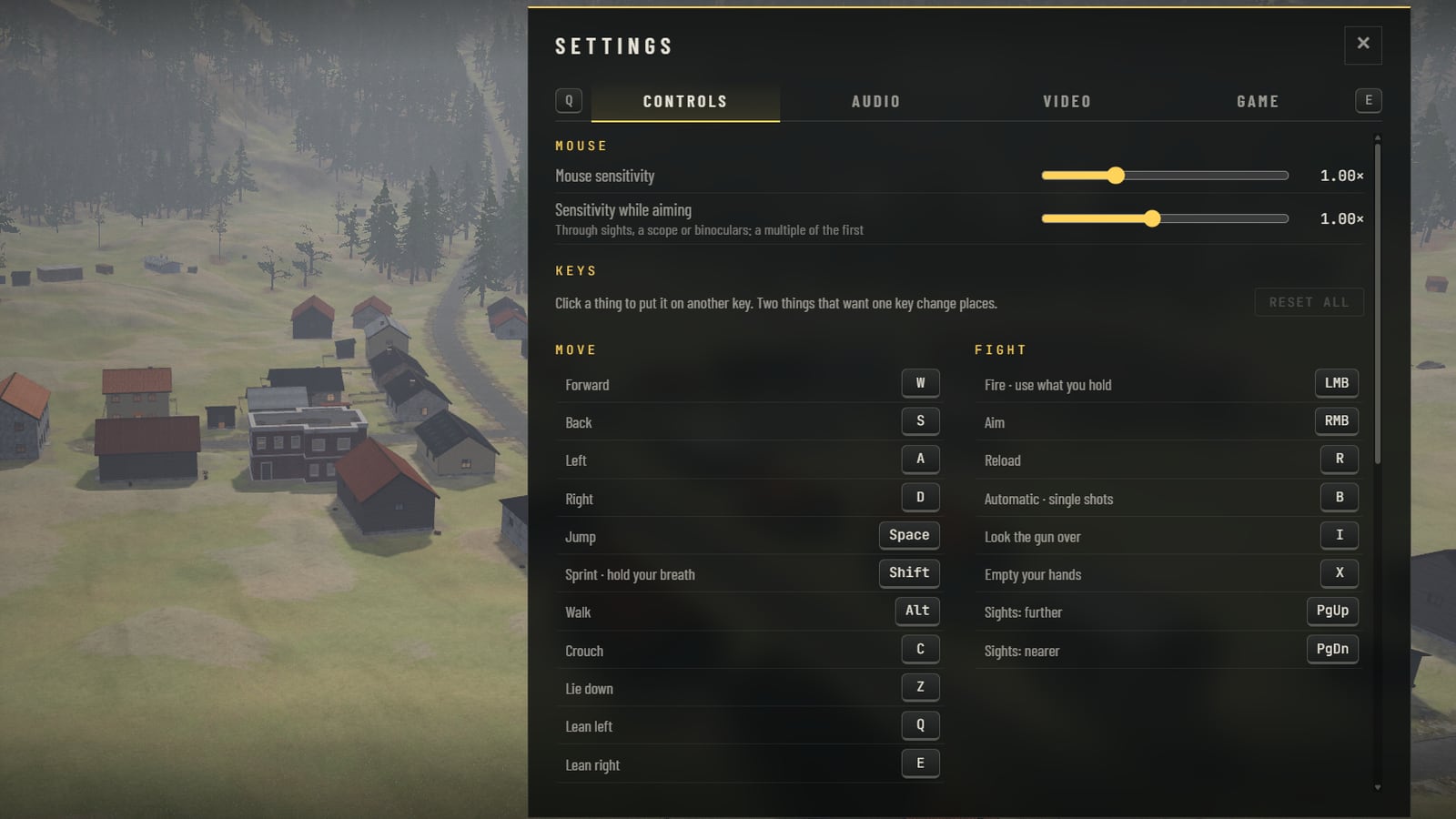
Settings have four pages: Controls, Audio, Video, Game. Q and E go from one to the next. The keys are on the first, under the sliders: Controls is no longer a sheet of its own.
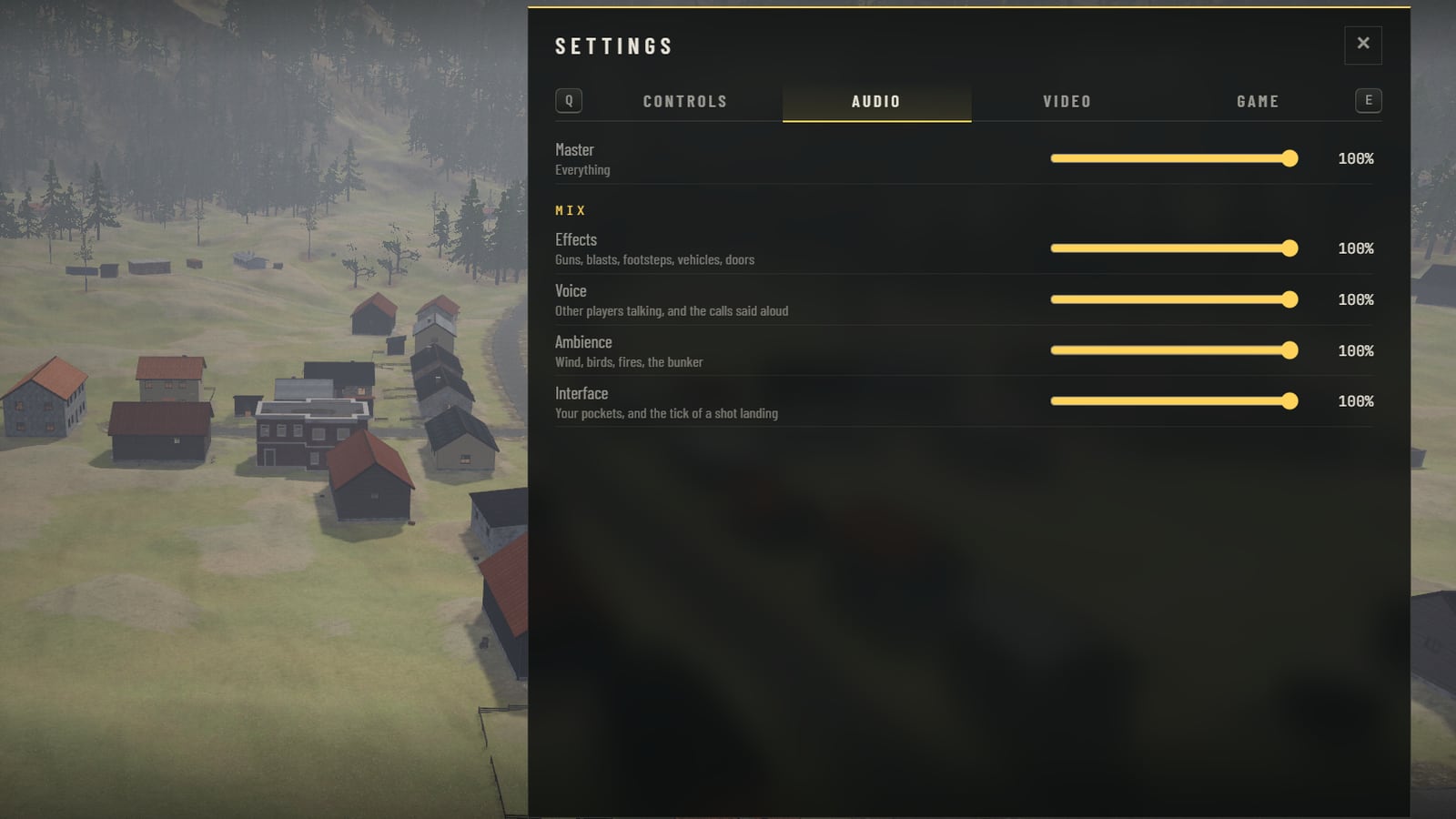
Five volumes. Master, and under it Effects, Voice, Ambience and Interface.
Sensitivity while aiming has a slider of its own: through sights, a scope or binoculars, from a fifth of your ordinary sensitivity to twice it.
Recorded sounds for everyday things: 85 recordings in place of what the game made up. Footsteps on grass, soft ground, concrete, wood, metal and snow. Taking a thing up and putting it down, by what it is made of. A body falling. A car's door. The spade. The cracks of a fire. A leg breaking.
The main menu is all live. Twenty-one scenes of the game itself play behind it, one after another. The recorded films are gone from it.
What you have not seen comes first. Your browser remembers which scenes it has shown you. Those it has not are played first, the newest first, and "New" is said before the caption of any that came since you were last here, or within the last fortnight.
Two of the scenes are new with this update: snow on the north-east mountain, and the gas standing over Bunker 17.
The Updates panel is folded into a small button until you open it, and says how many entries are new since you last did.
Your state, in symbols
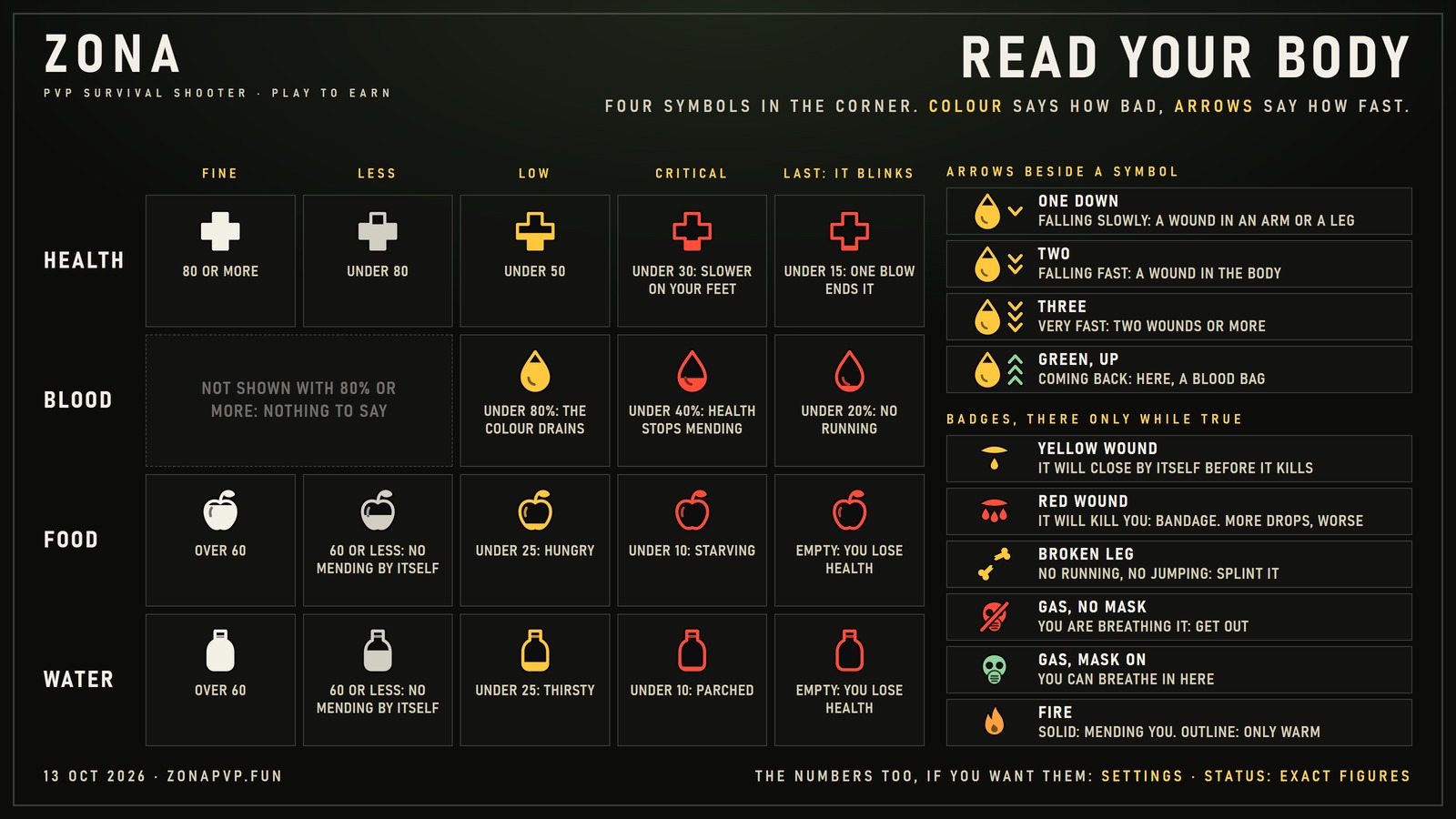
The four bars in the corner are four symbols now: a cross for health, a drop for blood, an apple for food, a flask for water. Colour says how bad it is. Arrows say how fast it is changing.
The key. Every look each symbol has, what the arrows mean, and the badges.
The symbol is the read-out. White is fine. Duller and part empty is less than full. Yellow is low, red is critical, and at the last step it blinks red and white.
Arrows say how fast. One, two or three beside a symbol: pointing down, in the symbol's own colour, while it falls; green and pointing up while it comes back.
Blood is shown only under 80%. With more than that it has nothing to say. That is also where the colour starts to drain out of the world.
Badges are there only while true. A wound: yellow if it will close by itself before it kills, red if it will kill you, with more drops the worse it is. A broken leg. Gas, struck through with no mask on and green with one. A fire, solid while it is mending you.
The words at the top of the screen are gone. Gas, fire and a broken leg are badges now. What to do about a wound is one line over the hotbar, with the key to press.
The numbers too, if you want them: Settings, "Status: exact figures".
In the inventory the same row of symbols stands at the foot of what you carry. Rest the pointer on one and it says what it means.
Blood, and loot that knows where it belongs
A wound takes blood now, and blood is not health: you have minutes to deal with it, not seconds. Every kind of building keeps its own kind of thing, and the guns that were strewn through Kamenka are back where they belong.
The figures. They are DayZ's, in millilitres. Neither bag closes a wound: stop the bleeding first.A wound, seen. Blood lands on the glass, oftener the faster you bleed. One line over the hotbar says what to do and the key to press, and the drop in the corner is your blood: yellow, and falling.
Blood is apart from health. A hit takes health; a wound takes blood, and no longer takes health at all. You have 5,000 ml and are dead at 2,500. A wound in the head or the body bleeds 6 ml a second, one in an arm or a leg 3.6, and a round takes 100 as it goes in.
Wounds add up. One, left alone, closes by itself in five minutes and leaves you weak but alive. Two in the body kill in about three and a half minutes, three in a little over two. One dressing closes them all.
Losing blood shows. The colour drains out of the world below 4,500 ml. Below 3,000 your head swims: you cannot run and your breath comes back at half speed.
It comes back slowly if you are fed and watered, not at all on an empty stomach, and never while a wound is open. Health mends only on good blood.
Two bags of a drip put it back faster: saline gives 750 ml over a minute and a half, a blood bag 1,500 ml in twenty seconds. Saline is in clinics and the hospital and with the army; blood is in the hospital before anywhere. A First Aid Kit runs in 500 ml over a minute as it treats you: some, and a bag of blood is still three times as much and many times as fast.
The stim is three things. The white one is for a wound: it stops bleeding and gives back 35 health. The yellow one is adrenaline: it fills your stamina, and for ten seconds nothing costs any. The pink one, the Combat Stim, is both at one press: it stacks to five where the others stack to three, and is found only on the fourth tier and the fifth, and in a supply drop. A stim you already carried is the white one.
A building keeps its own kind of thing. Clinics lean on bandages and stims; the hospital is where the first aid kits and the blood are. The shop is food, water and a light. Sheds past the outskirts hold tools, fuel, gloves and boots where they held next to nothing.
Guns by tier. No gun on the outskirts. Pistols in the village, with submachine guns at its big police station. Kamenka is the submachine gun's town. The AK, the AR-15 and the sniper rifle are under the gas; the shotgun and the Desert Eagle are the bunker's.
The new guns have left Kamenka's houses. There is one AK and one AR-15 in the whole town now, seldom with a magazine, and each is most of an hour coming back once somebody has taken it.
Every calibre where the police and the army were, from the village on: plenty of what the guns of that place fire, a handful of what the guns further in fire.
A looted spot is left alone for three minutes, and nothing is put down within fifty metres of anybody. What you took does not come back to the shelf while you are standing there.
The rifles climb more. The AR-15 rises about four tenths more with every shot and the AK an eighth; the side-to-side pattern is as it was.
The bunker's infected stay dead while its door stands open. They come back once it has shut.
Starts are fairer. You are not put down within 120 metres of another player, nor within 250 of where you just died, while there is anywhere else.
The Zona's edge is one line on the map, not a ring of dashes.
Players going through a body's pockets were being put off the server, and the second time kept off it for six hours, shown only as "offline". The check that did it no longer puts anybody off by itself; being turned away says why and for how long, at the menu; and an admin can lift it.
A restart could bring everybody back as they had been an hour earlier. The cause is found and fixed: the old server's last word was being written and then not read.
A crate with one thing left in it was never filled again. A shotgun shell that hit two people counted for one. The bunker door could be opened without a keycard.
Nothing stays buried: the new trailer
Two minutes and twenty-four seconds, filmed in the game as it is, with a score written for it. A man comes out of Bunker 17 with a case and buries it in the wood. Somebody watched him do it. Then everything added since the last film, at walking pace, and what has been paid.
Nothing stays buried. The whole film, 2:24, with its sound: press play.Somebody watched him do it. He comes out of Bunker 17 alive, with the best loot in the Zone on his back, and does not look behind him.Bury it. A case, a suitcase or a bag; five seconds with a shovel; out in the country, away from walls. It is kept through every restart of the server.What one shovel buries, another digs up. Anybody who saw where, and has a shovel of their own. Everything in the story is a rule of the game.One building, four levels. The hospital, walked slowly: the wards, the morgue, the roof 9.8 m up, the steel stairs with a door from every floor. Then the police headquarters, and the place under its stairs.The bot check. Everybody shoots their way in: four figures that walk behind walls, thirty seconds, judged by the server shot by shot, and a different range every time.Paid. 2.245 SOL for 111 dog tags, to 23 wallets, as it stood on 12 October: $240 with SOL at $107. Every payment is on the chain, and listed at zonapvp.fun/payouts.
The film is in three parts: the story of a buried case; the hospital, the police headquarters and the village walked through slowly; and boards of what was measured and what was paid. It ends on what is being built and is not in the game yet.
The bot check, which is at the door since 12 October: before the server lets anybody in, they shoot a range. All four figures in thirty seconds, and a shot counts only if the sights were on the figure when it was fired. The server lays the range out and judges every shot. Passed, it is not asked again for some hours.
Shots of the film play in the main menu, without its words, between the menu's own scenes.
The payouts page is laid out again: how the money moves from the coin to your wallet, what was paid each day, the best-paid wallets, and the ledger of every tag with its transaction, which can be narrowed to paid, waiting or not paid, or to one player or wallet. It has a way back to the game at the top.
Payouts has a button of its own in the menu, top right, and it says what a tag pays at that moment.
The roadmap is brought up to date: the third phase stands at fifteen of sixteen. The military base moves to the fourth, which now begins with the industrial zone, ladders and a radio tower, and the road all the way round.
The figures on the film's boards are the ones on this page: the stops and the loading are measured on one laptop, in the entries of 11 and 12 October, and yours will differ.
Your keys, and rifles with a pattern
Every key can be put where you want it and the mouse has a sensitivity slider. The AK and the AR-15 kick in a pattern that can be learnt, and the sniper rifle does what a sniper rifle should.
Controls. Click a thing, press the key you want it on. Two things that want one key change places.Mouse sensitivity, at the head of Settings: from a fifth of what it was to three times.The AK and the AR-15 held open. Where each round throws the muzzle, standing and not aimed, with nothing done about it. It is the same string every time, give or take a little: it can be learnt, and pulled against.
Every key can be moved. The menu's Controls sheet lists everything you can do, and each can go on another key or mouse button. What the screen tells you to press is the key you chose. Reset puts them all back.
Mouse sensitivity has a slider in Settings.
Ctrl no longer crouches. Crouch is C, or wherever you put it.
The AK and the AR-15 kick in a pattern. The first rounds go up hard and nearly straight, and then the muzzle snakes as it climbs: the AK right, left, right; the AR-15 the other way and half as wide. Both jump more in the hands than they did.
The sniper rifle, loud: one round to the body ends anybody but the wearer of the heaviest armour at a distance. With its suppressor on: one round to a bare head is the end, a helmet saves you, and the body takes two. An arm or a leg takes less than either.
Arms are hit as arms. A round in the arm was counted as a round in the chest.
Admins and moderators have a chat channel of their own, can see what a player carries and take a thing away, and can play without the tag before their name.
In the morgue a covered body hung in the air over its table. It lies on the floor.
The long stops are gone, and nobody jumps about
Nothing looks different. The game no longer stands still when a lamp is first lit or night falls, and other players are drawn where they were when they moved, not where the news of it happened to find them.
Measured on one laptop, the same scripted session before and after: an RTX 3070 Ti with 8 GB. Yours will differ.
Lighting a lamp no longer stops the game. The first time your own light went on, or the street lamps at dusk, everything in sight that had arrived since the game loaded was made over for lamplight in that one frame: 4.6 seconds on our test laptop with a jeep and three bodies in view. It is made ready ahead now, a little at a time: 0.1 of a second.
Other players run, they do not jump. Each report of where somebody is carries the time it was true, and they are drawn by that. Before, a report held up on the way, or waited for behind a slow frame, was a runner who stopped dead and then leapt. Watching a runner over a connection made to behave like one across an ocean: stood still in 13 frames of 100 before, 1 in 200 now.
The first jeep, the first of the infected and the first player you meet are made ready before they are shown.
The map opens at once. Its sheet is drawn while you play, not in the frame you first press M.
Putting gear on no longer draws the figure in your inventory inside a frame. A whole kit put on at once was a stop of 1.1 seconds; it is a third of one.
The server is in one place, the west of the United States. From far off, what you see of others is a little later than it is for somebody near; it is no longer uneven.
A player who died could be seen standing again over their own body, looking about, until they pressed Respawn. They lie down, and stay down.
A hospital, a headquarters, and streets in the village
Kamenka has a district hospital and Zelenaya Dolina a police headquarters: two big buildings of several parts, each with more than one way up and more than one way out. The village is laid out on streets, with thirteen more buildings on them and a fenced yard behind each house.
Kamenka's hospital. Three floors, forty-six metres long. A drive comes in off the street to its doors, through a gateway in the wall round its grounds.The wing behind it has a stair of its own and a terrace on its roof.Steel stairs at each end, a door onto them from every floor above the ground, and on up to the roof.The police headquarters, across the foot of the village's middle street. The cells are in the block on the left, the garage in the one on the right.From above. Two stairwells inside, steel stairs up each end, and the roofs can be walked from one to the next.Zelenaya Dolina on streets. Every building faces one. The fences behind are to the knee: jump them.A block of four flats, a kind of building the village did not have. There are three of them. No two houses are faced and roofed alike any more.
The hospital stands in Kamenka: wards, a theatre, a morgue, offices, on three floors, with a wing behind and a block built out before the doors. Two stairwells from the ground to the roof, a third in the wing, and steel stairs outside at both ends. It is medical loot from top to bottom, and on the roof there is always a sniper rifle with its scope, suppressor and wrap, and rounds for it.
The police headquarters stands in Zelenaya Dolina: a main block of two floors with a wing of cells and a garage, round a court. Two stairwells, steel stairs outside each end and up the side of the garage.
The village has streets. The buildings it had stand on them, each facing its street, and thirteen more have been built: houses, and three blocks of four flats. A second clinic and a second shop stand at the two ends of the road.
Yards. Behind each house is a yard with a low fence of boards round it. It stops a walk and not a jump.
Walls, roofs and floors have fourteen more surfaces to be made of (brick red, whitewashed and rendered; plaster bare and painted; iron bare, painted and rusted; slate), and each house keeps its own.
Less to fetch before the menu: 73 MB where it was 133. Things on the ground are made when you come near them, and the menu's films come after the game is up.
Two things change places in the inventory when you let one go on the other. A pile is split by a right-click on it.
I looks a gun over: every gun now, the rifles and the shotgun turned in the hands.
The MPA30 takes the foregrip, and the AR-15's own light switches on.
The steel lockers are searched (F), in the hospital and in the headquarters: medicine in the hospital's, what a constable carried in the police's.
The hospital holds four times the medicine it did: stims, dressings, first aid kits and splints, on top of everything that lay there before. The headquarters holds about a third more of what the police kept.
A round goes through a curtain, and through a door of boards. It leaves its hole and flies on. A steel door still stops it.
Smoother, and nothing else changed. The same picture is drawn with less work: one pass no longer draws the whole scene twice more each frame, and a thing lying far off is drawn with a lighter copy of itself until you are near. Measured on one laptop at 2560x1440: the village crossroads from 56 frames a second to 75, the street before the hospital from 47 to 61, the middle of Kamenka from 40 to 56.
Hearts and comments. Under every entry on this page: give it a heart, open the comments and say what you think or what should come next.
An empty M9 held still: its slide jumped about. It stands back at its lock and stays there. Its hammer lies down when the slide is home, and is back only for the shot and while the gun is empty.
In the morgue the cold chambers were a wall of doors standing free. They are cased in steel to the wall behind. The console in the boiler room faces the room, and a bed's frame no longer goes from under its mattress at the far end of a ward.
Going up a stair with a shoulder on the wall or the rail, you could stop dead. A step that leans on a wall is taken along it now.
A dog tag kept waiting by the three-a-day rule could grow too old to be paid while it waited. It no longer can: a tag taken in is paid when its turn comes.
Space to come back, and gloves that lie flat
A handful of small things asked for by players: a key for the Respawn button, gloves that lie on the ground as a pair of gloves does, and furniture, bodies and scorched earth put where they belong.
Dead, Space is Respawn. Not in the first second, so nobody who died jumping misses what killed them.A pair of gloves, lying down. They stood on their cuffs like two hands before.
Space respawns on the screen of the dead, as the button does.
A stash is dropped, not placed. A stash case, a suitcase or a black bag is let go of like anything else (drag it out of your inventory, or G), and lies where it lands with what is in it. There it is opened, picked up again, or buried with a shovel. There is no Place any more.
The tactical gloves lie flat, backs up, one half over the other, on the ground and in their picture.
Gloves and boots fill their squares when you wear them, and the boots stand the right way up. Rubber boots take two squares by two in a pocket, not two by three.
What the mouse buttons do with the thing in your hands, a magazine to load or a bandage to put on, is shown at the bottom left now, clear of your health.
In Kamenka's brick blocks the white shelves and the cabinet stood in the walls and across the windows. Each stands against a bare stretch of wall now, and what lies on them has moved with them.
A body, a pool of blood or the scorched earth a fuel drum leaves could hang in the air over a slope. Each is put on the ground under it, and lies along the slope.
Bury it
A stash put down out in the country can be buried with a shovel. Nothing is left to see but a patch of turned earth, and anybody with a shovel who finds the patch can dig it up.
What is left to see. With a shovel in your hands, hold the left button on the patch for five seconds.
Bury a stash. Put it down, take a shovel in your hands, look at it and hold the left button for five seconds. Let go early and nothing happens. Under the ground it is not opened and not picked up.
Anybody with a shovel digs it up, the same way. It is buried and dug up as often as you like.
Out in the country only. Not in a town or a camp, not in a building, and not within fifteen metres of one.
Left standing, a stash does not last for ever. One nobody has opened or moved for a week is cleared away if it is empty, and after two weeks if anything is in it. A buried one stays until somebody digs it up.
Two more things to keep things in, beside the stash case: a suitcase, found in houses, and a black bag, found in sheds and yards. Each is dropped like anything else and lies where it lands, as the case does. It holds what you put in it (the suitcase less than the case, the bag less than the suitcase), is buried like the case, and is picked up again (G) with whatever is in it. Full, it goes into the pack on your back or is carried in your hands; it goes into no pocket.
Nobody leaves the Zona by closing the window
Your body stays in the world when you do not. Behind another tab it can be killed. Shut the window without logging out and it sits where you stood for five minutes, to be killed and searched. Log out from the pause screen, wait a minute, and it goes with you.
Esc, then Log out. Sixty seconds, standing where you are. The same button calls it off.The count, while you wait. Moving, firing or being hit stops it.
Tabbed out, you can be killed. A game behind another tab stops answering, and until now nothing could kill the body it left standing. The server keeps that life now. What hits it comes off the health it last had, through the armour it wears; an open wound runs; and at nothing it is dead. Back in the tab, your game is told what you have left.
Close the window and your body stays. For five minutes it sits where you stood: seen, shot and killed like anybody, with everything you carried on it for whoever kills it. Come back within the five minutes and you are back in it, as you were.
Log out to leave safely. Esc, then Log out, then sixty seconds without moving, firing or being hit. When the count ends you are out of the world with what you carried, and you come back where you stood.
A dog tag's ten minutes run on in a hidden tab, and it is cashed in from there when they are up. The ten minutes are time in the world: time spent logged out is not counted.
A map you can read, full pockets, and stims where they belong
M opens a printed sheet of the Zona, with every building outlined in the colour of its tier. A thing can be taken into your hands when you have no room for it. Stims are common from the village on, and bandages and stims are carried in piles.
The sheet. Contours every five metres, a hundred-metre grid, woods, the road, the wells, the cars, the trader, the line round the Zona and the gas. Each tier is switched on and off along the top.Brought near. The wheel, or two fingers, takes it nine times closer; a drag moves it. Point at a building and it says what it is, its tier, and the kind of loot kept there.No room, and held all the same. Sixteen and twelve places full, and a first aid kit off the ground in the hands, to be used from there.
The map (M, or a tap on the corner map on a phone) is a sheet you look into. The wheel or a pinch brings it nearer, a drag moves it, Me brings it back to where you stand, and X, M or Escape puts it away. You can walk with it open.
Where the loot is, by building. Every building with anything in it is outlined in the colour of its tier. Pointed at, it says what it is and what kind of loot it keeps: residential, medical, military, police, industrial, farm, hunting, food and supplies.
Into your hands with no room. Drag a thing from what lies nearby, or out of a crate, onto In your hands. With full pockets it is held and carried nowhere: eat it, drink it or put it on with the left button. A double click does the same when your hands are empty, and so does F on a thing on the ground. Put away, it goes into a pocket if there is room by then, and onto the ground at your feet if there is not. A gun, a blade and clothes still need a place of their own.
More stims. Three times as many in the village and at the army's places, half as many again in Kamenka and under the gas. They lie in houses there as well as in the clinic, the police station, the shop and the army's posts, and a clinic's shelf is twice as likely to have one. There are still none on the outskirts.
Bandages are carried five to a place, stims three. Each is still found one at a time, and one is used off the pile.
The weapon light fits the AK, the MPA30 and the Desert Eagle as well as the guns it fitted before. On the MPA30 it is clamped to the rail down the right side of the fore-end, clear of the hand that holds it.
On a phone: a microphone button to hold while you talk, and the buttons stay in sight with a scope at your eye.
A gun in a pocket or a pack shows its parts when you pick it out in the inventory, as a gun on your back does.
Somebody sunk into the ground could not be shot, and could wait there with the tags he had taken. Under the ground nobody is hit from, nothing is picked up and no tag is cashed in; tags held there for ten seconds are void, as they are over the line; and whoever stays there is put off the server. If you fall through the ground yourself, you are put back on your feet in two seconds.
The server has admins and mods now, who can put a player off it, keep them off for up to an hour, or ban them for good. A ban is of the game that was played and of the connection it was played from, and it outlasts the server's restarts.
One player to a connection: a second game from the same address is turned away while the first is on.
In the chat, an admin or a mod has it written before their name: [ADMIN], [MOD].
Somebody who has been killed no longer stands on their own body. (The last position their game sent before it knew could reach everyone else after the death did, and stood them back up.)
Smoother, quicker to start, and the armoury on film
The game holds less than half of what it held on your graphics card, and draws the same picture up close. It starts on less, asks again for a file that fails, and does not fetch again what has not changed. The new guns have a film, and a place in the main menu.
FilmThe armoury, in forty-five seconds. Each new gun with its parts going on, a gun looked over, a box of rounds torn open, a magazine filled a round at a time, a bandage, an injector, the police car, and the four guns fired. Nothing in it is run faster than it is done in the game.Before and after. Measured on one laptop (an RTX 3070 Ti with 8 GB, at 2560x1440), the same walk both times. A card with less memory gains most; yours will differ.
Full-size pictures where you are. The gun in your hands, the thing you are looking at and the house you stand by are painted as sharply as before. What is far off is painted with lighter copies, and takes its own pictures back as you come near.
Less to fetch before you play: 160 MB where it was 491. The sky no longer holds the start up: the game opens under a soft one, and the sharp one takes its place when it has come.
After this update, an update fetches only what it changed. Until now every update had everybody fetch every file again.
A file that fails to arrive is asked for again, four times, and afresh if the line goes quiet. One dropped request used to leave the loading bar standing for good.
If the game cannot start, it says so, on the loading screen, with what went wrong and a button to try again.
Phones are given far less to hold: small pictures for what is far, the full ones for what is near or in your hands, and the files unpacked two at a time. A phone the game has once failed to start on is given less still the next time. We have no iPhone to try it on: if yours still will not start, tell us what the loading screen says.
The new guns are in the main menu: each alone in a lit room, its magazine, sight, suppressor, grip and light going on one at a time, between the menu's other scenes.
A bandage is held as a roll in the palm. It was held as the first aid kit is, a box a foot wide, with the fingers closed through it.
A game with cars about, played alone, stalled every frame. It does not.
Magazines, four new guns, and hands that hold them
Guns are fed the way they are in life now: rounds go into a magazine by hand, and a magazine into a gun. There are four new guns, an AK, an AR-15, a submachine gun and a Colt 1911, and the pistols are held in new hands that walk, run and look the gun over. For now the new guns and what goes on them are easy to find in Kamenka: go and try them.
The MPA30. A submachine gun in 9 mm, thirty rounds in the magazine up its grip. It fires for as long as the trigger is held; B changes it to single shots. It takes the holographic sight and the pistol suppressor.The AK. 7.62x39, thirty to a magazine or seventy-five in the drum. It kicks up and to the right. It takes the holographic sight, a suppressor and the drum.The AR-15. 5.56, thirty to a magazine or sixty in the long one. Faster and flatter than the AK, and each round does less. Its sight, suppressor, foregrip and light are each a thing of their own.The Colt 1911 has taken the place of the Pistol 43. It fires the .45, seven to a magazine: fewer rounds than the M9, and each hits harder. It takes a suppressor, a holographic sight and a light.Along its own sights. No cross is drawn over a gun's sights, and no mark or tick tells you a shot landed: what you see of a hit is what it does to whoever was hit.I looks the gun over. A pistol or the submachine gun is turned over in the hands and looked at. Whoever is near sees you do it.Carried at a run. A pistol or the submachine gun goes muzzle up in the one hand when you run, in your own hands and as others see you.Magazines are things. Each is found, carried and filled. Loose rounds lie thirty to a place; a box is one place and holds twenty-five.
Rounds, magazines, guns. Hold a magazine and hold the left button: rounds go into it one at a time from what you carry. The wheel changes that to taking them out. R changes the magazine in your gun for the fullest you carry of the same kind; the round in the chamber stays. A gun with no magazine fires what is in its chamber and no more.
Boxes of rounds are unwrapped in the hands, the same way: hold the box, hold the left button.
Keys 1 and 2 are the two guns on your back and 3 your sidearm; 4 to 0 take anything you drag onto them. What is in your hands is used from there, and a small mouse in the corner of the screen shows what each button does with it.
What is fitted to a gun has a place of its own on the gun in the inventory: magazine, sight, muzzle, grip, light. A part is put on or taken off with the gun in your hands: if it is not, it is drawn first.
Shots lose speed as they fly, and do less the slower they are going. Every gun kicks its own way. PgUp and PgDn set a rifle's sights for the range.
What others see of you: what is slung on your back with whatever is fitted to it, a drum where there is a drum, a suppressor where there is one.
For now, Kamenka has the new guns. The AK, the AR-15, the MPA30 and the shotgun, with their magazines, rounds, suppressors, sights, grips and lights, are common in the town's houses; gas masks and bunker keycards are there too. This is so that everybody can try them. It will not stay: they belong down the bunker, and that is where they are going back to.
Supply drops come down outside the Zona now, in the wild country past the dotted line, and bring twice as much: among it one of the new guns, loaded, with two magazines and rounds. Mind what you carry: a tag you took is void after fifteen seconds outside the line. A helicopter's cargo still comes down inside it.
Cars take three times as much before they burn. Five more jeeps stand about the map, thirteen now beside the two police cars: at Lugovoe Farm, the Old Sawmill, Kamenka Farm, and one at each of the two places out in the wild country. A car left under the gas with nobody near is stood back where it came from two minutes later.
Cartridges are brass in your pockets, each kind its own shape. What you hold in your hands is drawn at the full size of its pictures.
Closets. A cupboard under the stairs of the two-floor house and one in the cabin, each with something in it.
The wall upstairs in the two-floor house ran into its window. It stands clear of it.
A door was heard at its full loudness from across the village. It falls away over a yard's width, and is quieter.
Back the Zone on X, and the police car put right
The menu now asks you for a like, a reply and a repost of the game's newest post, and says why: the treasury that pays for dog tags is topped up from the fees on $ZONA trades, so what brings people to the game is what fills it. And the police car looks as it was made to look, with whoever rides in it sat in its seats.
Back ZONA on X. Over the news on the menu: like the newest post, repost it, reply to it, or follow. Each is one click into X, with the post open and the thing ready to be done. Every post under it has the same.Asked again when there is a moment. On the death screen and on the pause menu, and in a line of the chat ten minutes in and every twenty after.On a phone it is a bar under the way in.Sat in the seats. The car with its near side cut away. In front, on the seat with your legs out to the pedals; behind, knees up and lying back, under the roof. Nobody's head is through it and nobody's feet are under the floor.
Why it is asked. A like, a reply and a repost cost nothing, and they are how new players find the game. The reward treasury is topped up from the fees on $ZONA trades, and every dog tag you cash in is paid out of it.
The news on the menu has the newest posts: the police car, how loot is laid out, and voices.
When a tag of yours is cashed in, the chat says where its money comes from, and what you can do for it.
The police car's white doors and roof were drawn black, with the letters on them showing lighter; its seats, its dashboard and its light bar were see-through, and its tyres were bare metal. Its white is white, its inside is solid, its tyres are rubber, and its black paint has a shine on it.
Whoever rode in the police car sat a third of a metre behind their seat, through its back, and whoever sat behind had their head through the roof.
Five tiers, an army camp, a police car
Every place on the map is now on one of five tiers, and every kind of thing is kept on the tiers it belongs to: what you find at the edge is not what is kept down the bunker, and the way from one to the other is the game. The map tells you which is which. There is an army camp of tents west of the village, a police car beside each police station, and a helmet that stops a sniper's round.
Where the loot is. Every dot is a place a thing can lie, in the colour of its tier. Tier 1, the outskirts: melee weapons, lights, food. Tier 2, the village: pistols, and the gas masks. Tier 3, Kamenka: armoured vests and helmets. Tier 4, under the gas: sniper rifles, plates, keycards. Tier 5, the bunker: the best of everything.The Army Camp. Four tents and a watchtower in a clearing south of the west road. Tier 2: pistols and the army's kit, now and then an armoured vest or a helmet, and a gas mask if you are lucky.The tents are gone into. Cots, a table, a weapons case, and a pistol always left in one of them.K6-3 Helmet. Tier 5, the bunker's own. Two thirds off anything that hits your head: a sniper's round there leaves you 3 of 100.The police car. One stands beside each police station, the village's and Kamenka's. Four seats, like the jeep.A road car. Faster than the jeep on the road, and quicker to get there. Off it, slower than the jeep, with less hold and little room under it.The shovel. Found on the outskirts with the rest of what you hit with. Held and swung as the bat is, in both hands; heavier, a little slower, and it hits harder.The Day Pack. The small pack has a look of its own now. The army's rucksack, the biggest, is not found below tier 4.
The map says what each place holds. Point at any place on the menu's map, or tap it: its tier in that tier's colour, and what is kept there.
Melee weapons are on the outskirts and nowhere else, and no gun is. What is always left at an outlying place is something to hit with.
Pistols from the village on: the police station, the army's places, now and then a house. The gas masks are still in the village's police station.
The sniper rifle is rare in Kamenka and common under the gas. One may be in a helicopter's cargo.
The bunker's own: the shotgun, the Desert Eagle (it was the gas's), the heavy armour and the K6-3. The keycards that open it are under the gas.
Food is in the shops before anywhere, dressings in the clinics and the shops. Ammunition is on every tier.
The Desert Eagle hits harder: 70 at the muzzle where it did 50. Two to the body end it for anybody not in plates.
Smoke and dust are drawn as real puffs, each its own.
Doors sound like doors: a wooden door opened and shut, and the bunker's steel door drawn open, pushed to and slammed, are recordings now. The bunker's klaxon is gone.
Voices still came through broken on a poor connection, or when either game stopped for a moment: whatever arrived late or all at once was thrown away. Nothing is thrown away now, and more is kept in hand where the line is uneven.
Voices, water, and lying low
Hold a key and whoever is near hears you. There is a well in each town, and a bottle holds more than one drink. And you can lie down in the grass.
Proximity voice. Hold V to talk. Whoever is within 45 m hears you from where you stand, fainter with every step away. The browser asks for the microphone the first time, and nothing is sent unless the key is held.Wells. One in the village and one in Kamenka, marked on the map. Drink your fill at one and every bottle you carry is filled.Lying down (Z). Low, slow, and steady: a gun sways under two fifths of what it does standing. Everybody sees you lying, and what of you can be hit lies with you.Sit down. On the wheel (T), for a rest by a fire or a wait for somebody.Closets. In the bedroom of the small house and of the brick house: a door, and room for one to stand inside with it shut.Headlights. A jeep's lamps are on while it is driven, and after dark they light the road ahead of it.
A bottle holds more than one drink: the jug four, the flask three, the thermos two. A line along the foot of it in your pack shows what is left.
Hunger and thirst tell before they kill. Under a quarter you are told, your breath comes back slower and, hungry, your aim shakes. Under a tenth it is worse, and parched you sprint slower.
The pack has a bar over each pocket and bag: its name, how full it is, and a click folds it away.
A call from the wheel is said in words, in the browser's own speaking voice.
The made-up voices are gone, of the wheel and of the infected. The infected have their recordings and nothing else.
Lying down, you get up with Z or the space bar, and to a crouch with C. There has to be room over you.
Voices came through broken up and could not be understood: speech was being cut into scraps and laid end to end with gaps between. It is now one unbroken sound.
A call from the wheel was too quiet for the people it was called to.
Tags, and fair play
Two holes in the rule about new arrivals and their tags are shut, and the server asks more questions of what each game tells it.
What the server checks. For now it only writes down what it would refuse.
Nobody alive less than five minutes leaves a tag of their own: not the one round their neck, and not an older one of theirs that they took back off their last body. What they took off other people is on them as before.
A thing lying in the world is taken from beside it.
The server checks more of what it is told about where a player is, what they carry and what they have been hit with. For now it only writes down what it would refuse.
A tag of somebody who had only just started again could be found on them, and paid.
A tag was left on whoever came back under another name, however long they had lived.
The road over, and a fall is a fall
The hill between the old valley and Kamenka is cut down along the road, so the road can be driven. There is a second injector. And nobody dies of a fall they did not take.
FilmThe new ground in fifteen seconds. The road over, Kamenka, the trader, the armour, a helicopter down in a meadow.The road over. Through a cutting, with a wood on its sides: 23 in a hundred where it was 105.
The road to Kamenka can be driven. It climbs 23 in a hundred from the floor of the old valley to the town, through a cutting with a wood on its sides. It was a wall: 105 in a hundred at the worst of it.
Adrenaline Injector. The injector with a yellow barrel: your stamina is full, and for ten seconds nothing you do costs any.
An injector is taken into the hand, then used. Its key brings it out; a click uses it; the wheel puts it away.
The mouse wheel breaks off what you are doing: a meal, a drink, a dressing, an injection, a reload. Nothing is lost by it. On a phone, the weapon button.
A helicopter's cargo is four or five things of the kind kept under the gas.
The bunker's door is heard by everybody on the map, from where it is.
The brick houses and the plank houses are drawn with their pictures at the size they were made.
Players died of falls they had not taken (it was reported at doorways). A fall is now measured by how far you really came down, and says so when it kills.
A helicopter came down with no cargo beside it.
A thing used out of an open crate, and broken off, was lost.
The map grows: Kamenka
The ground is 1536 m across where it was 1024, with the old map as it was in the middle of it. The road is carried on out of the valley, over a pass, to a second town in a valley of its own. And the rules for dog tags have changed.
Kamenka. Twenty-six buildings down one paved street: eight brick houses of two floors, three plank houses on piles, four long huts, a police station, a clinic, a shop. Better stocked than the village, and the place where armoured vests are kept.The street. The road from the old valley ends here.New kinds of building. All of them can be gone into: rooms, stairs, a ramp, a roof.Two floors. The brick houses have a stair that turns and a balcony over the door.The long hut. A lobby, a store room and a room of six beds. There is one at the depot, one on the track to the works, one by the trader, one in the village, and four in Kamenka.Shipping containers open. A door at each end, a crate inside, and room to shut yourself in.A helicopter comes down. Every quarter of an hour, somewhere open: a wreck, black smoke seen from far off, and the army's cargo beside it for ten minutes.The trading post. A trader behind a counter east of the village: he buys what you bring, sells so many of a thing a day, and has three jobs every day.Armour in five weights. The heaviest is in the bunker and nowhere else.
Dog tags are earned inside the Zona, the dotted line on the map. Carry a tag you took over that line and a count of fifteen seconds starts on the screen: still outside at the end of it, the tag is void. Your own tag is yours wherever you go. Kamenka and the road to it are inside the line.
Nobody has a tag in their first five minutes alive.
The country outside the line is for stashes: mountains with a wood on them all round the new edge, a squatters' house far to the south, a logging camp far to the north.
Nobody starts by the bunker, nor between the valley and Kamenka: 17 of the 24 starts are left.
A field radio calls a supply drop to where you stand, once in five minutes.
Hats under the helmet (a patrol cap, a boonie hat: a tenth off a hit to the head), work gloves, and three packs of 16, 30 and 42 slots.
The jeep rides heavier: softer springs, damped as a heavy car's are.
A quarter more of the common things on the old map, for the buildings added to it.
You could walk or drive off the edge of the ground: there are walls there that cannot be seen.
The heavy armour was drawn as its straps and pads with no body to it.
Vests stood a hand's breadth off the back and over the shoulders: each is fitted to the body.
Reloads you can see, thinner gas, more guns
A second pass with nothing new in it, and three changes to how the Zone plays: the gas is a quarter thinner, there are half as many infected again in it, and pistols and rifles are easier to find.
The pistol hold, put right. At the eye a pistol was held further out than either arm could reach, so the hands stopped short and the gun stood in front of them. It is within reach, both fists are round the grip, and the first finger goes to the trigger.From every side. The same on the M9, the Pistol 43 and the Desert Eagle, each placed from the measure of its own grip.Reloads on other players. The left hand goes to the magazine, down to the belt and back up. A shotgun is fed a shell at a time, in step with its sound.The bolt is worked. Up, back, home and down. Before, the arm went out straight along the gun and stayed there.The gas, a quarter thinner. Still no place to be without a mask, but the works can be seen across.Parked cars lie to the ground. On a slope a car had one end in the bank and a wheel in the air. Each now stands on its four wheels.
More guns to find. 24 rifles and 26 of each pistol on the open map where there were 16, with the rounds to go with them, and all three likelier in an ordinary crate.
Nine infected keep to the Chemical Works where six did.
A bed can be jumped on.
Hands stay on the gun. Seen from outside, a pistol is held in both fists crouched, at a run, in the air and looking down, not only standing still.
Nothing changes in one frame. Other players lower a gun and raise the next, and let go of it to eat, dress a wound, wave or sit, where their arms used to jump from one pose to the other.
After using an item the gun came back into the picture in one frame: it comes up from below.
Other players stuttered at a run: fifteen position reports a second were going out as thirteen.
Pouring a jerrycan into a jeep was drawn as drinking from it.
What is left on a water barrel lay 3 cm over its lid: it is on the lid.
Seen from outside, a rifle reload and a shotgun reload showed no movement of the hands at all.
Hands, arms and beds
No new features: a pass over how things are held and where they lie. Other players now hold a pistol round its grip, keep their arms out of their own chests, and find what they are looking for on a mattress instead of in mid-air.
A pistol in the fist. Seen from outside, every pistol stood out in front of the hand that was meant to be round it. The hand is on the side of the grip and the fingers go round the front. (It was not yet right: see the entry above.)Arms out of the body. With both hands on a gun the upper arms used to pass through the ribs. Measured over 65 ways of standing and moving: they no longer do.Mattresses. A bed was a bare frame, and loot on one hung over the springs. All 47 beds have a mattress now, and things lie on it.Iron sights on the sniper. With the scope off there is a post and a notch to aim along, in place of a cross drawn on the screen.They stand on the gun: the notch on the scope rail, the post at the muzzle. With the scope fitted they are put away.
Attachments straight off the ground. Drag a part from what lies nearby onto a gun and it is fitted: it no longer has to go in a pocket first.
Pistol iron sights are centred again on the M9 and the Pistol 43.
A sprint is kept through a jump.
The red arc that shows where a hit came from pointed the wrong way for shots from in front and behind.
Far-off trees were bare: their leaves had not been drawn at a distance since night was added.
On a slow frame the gun in your hands could leave the picture for a moment.
The changelog's pictures did not load from the address without its last stroke, which is how it is usually typed on a phone.
The bunker opens up
Bunker 17 was a corridor with a dead-end room behind every door. It is now a place people lived in, with ways through from room to room, so whoever is filling a pack in the armoury has a second door at their back.
The main passage. Painted lines, warning paint at the door to Level 2, and what the last people down here left on the walls and the floor.New room: the kitchen. Stoves under a hood, steel tables, a pantry, and a door straight into the mess.Loot lies on the tables. Things kept on tables and beds in the bunker used to hang in the air over them.The sick bay. Beds have mattresses, every room has its rule on a plate, and the bare floors are furnished.Sights. One holographic sight on every gun that takes one, with an open window and more zoom; the shotgun aims along its own sights without it.FilmThe squad's map. Somebody's plan for reaching the bunker, with everything they learned on the way written over it. It now plays between the scenes on the main menu.
Ways from room to room. Seven new doorways between neighbouring rooms. Most rooms can now be come at from behind, the armoury included.
A kitchen beside the mess, with a way through between them.
Dressed rooms. Mattresses on the beds, tables and chairs out on the floors, shelves in the middle of Records, a bench in the wash room, a rule on the wall of every room.
A past. Painted lines down the main passage, warning paint at its two doors, old blood, and writing on the walls.
Empty hands are 20% faster at every pace, crouched and walking too, from the moment you press holster.
Aiming is 20% slower than moving without it. It used to drop you to a creep.
Holographic sight ported to the M9 and the Pistol 43, centred on the slide. The Desert Eagle sits properly in the hand. The shotgun's suppressor no longer shows through.
Sound. The sniper's bolt is heard again. A fist landing, a heavier blow, and a round on steel are recordings.
Main menu. A Discord button, the latest posts from X, this changelog, the film of the squad's map, and trees in full leaf in the menu's scenes.
More of the infected at the bunker, above it and in it, and the bunker has gas of its own: bring a mask.
No ball of white light on a player carrying a lamp. The infected stand flat on their feet. Flickering faces on roofs, eaves and rails are gone. Phones have a Light button.
The door to Level 2 says why it is shut: it needs a Level 2 keycard, and that is still to come.
Lights out: night, lamps and Bunker 17
The Zone has a night now, and something under it. A keycard found in the gas opens a door across the map, and behind it is one dark level with the best loot in the game.
Night. A day is thirty-two minutes, eight of them dark. The village has street lamps; everywhere else has what you brought.Two new guns. The Desert Eagle, the hardest-hitting pistol in the Zone, and the Benelli M3: nine pellets a shell.Bunker 17. No daylight reaches it. A flashlight in the hand or a light on the gun is the difference between looting it and dying in it.
Day and night, kept by the server so everybody sees the same hour.
Lamps. A flashlight you carry (L), a light that clips under a barrel, jeep headlights, street lamps.
Bunker 17. A stair down, a door a keycard opens, a dozen rooms laid out by rule, lockers and racks to search, and the infected shut in with it, in orange suits.
The keycard lies in the gas at the Chemical Works. You cannot drive with one: it is carried to the bunker on foot.
New guns and parts. Desert Eagle, Benelli M3, a holographic sight, a weapon light, a suppressor for the sniper, longer magazines, a flask.
A hurried crouch on Shift, and nobody shoots on the run any more: the trigger stops the sprint.
A burned jeep is back in three minutes. A door is heard from where it is, not across the whole map.
The Chemical Works and the gas
The map grew for the first time: a works in a cirque behind the checkpoint, sunk in gas. A mask lets you in, and what lies under the gas is worth going in for.
The Chemical Works. An office, workshops, stores, a sick bay, a tower and tanks, all under the gas. Helmets, plates and scopes are common here and rare everywhere else.A new mark. A gas mask over the biohazard sign, and a new banner.FilmBuildings worth walking into. Houses of two floors, a watchtower, shops and a clinic with their own signs.
The gas zone. Without a mask it kills. Masks are found at the police station.
The richest loot on the map is under the gas. A scope comes in every supply drop.
Campfires. Stone rings can be lit. A fire mends you and warms a meal, and its smoke gives you away.
Broken legs. A hard landing or a round in the leg leaves you limping until you splint it.
A new main menu: scenes from the Zone playing behind it and the game's own map, with a layout that fits a phone.
A combat helmet in place of the cap, and the rifle held with a hand on the fore-end.
The infected
The people who lived here never left. They see you, they hear you, they remember where you were, and a gunshot brings more of them than you have rounds for.
FilmThree bodies. A policeman, a man and a woman, each with a way of moving. From the trailer made for the update.FilmThey come. Slower than a jog, and they do not stop.FilmStop the blow. A guard stops one for the moment a blow back needs. Melee was redone for it.
Sight and hearing. They see in front of them and hear footsteps, sprints and shots, each from its own distance. A suppressed 9 mm does not bring the street.
They live somewhere. The village most of all, the checkpoint, and a few about every outlying place. Killed, another comes when nobody is looking.
They use doors, beat on shut ones, and can be run down with a jeep.
Melee redone: a guard, blows that land when they look like they land, and a bat carried over the shoulder.
Every building dressed: chimneys, porches, doorsteps, eaves and shutters.
Guns, a jeep and automatic payouts
Tags cashed in are paid in SOL by the machine, with a receipt on the chain for every payment. And the game got its guns from real weapon packs, a jeep to cross the map in, and a soldier's body to do it wearing.
FilmThe UAZ-469. A driver and passengers, and it burns when it has taken enough.FilmThe sniper rifle in place of the old Mosin, with a scope you look through.FilmAutomatic payouts. What a tag pays, and where the money comes from. Every payment can be looked up on the payouts page.A soldier's body and field kit, on the same skeleton as before.The first payout the machine made.
Automatic payouts. A tag held ten minutes and cashed in is paid to your wallet without anybody pressing a button.
Three guns from weapon packs: the sniper, the M9 and the Pistol 43, held in the packs' own hands, each handling its own way.
Leaning with Q and E, seen by other players and able to be shot.
The jeep. Your own tag hangs round your neck, and taken tags have a pouch.
Recorded gunfire and a muzzle flash made from two packs.
Fifteen more buildings and two new places: Sosnovka and the Motor Pool.
Phones: every key has a button, and a weapon can be drawn, swapped and fired by touch.
Health, food and water are bars with numbers. Things on the ground can be eaten, drunk and opened where they lie.
Ten minutes, a wheel and fuel drums
A tag is held for ten minutes, not thirty. There is a wheel of things to shout, and red drums that go up when shot.
FilmThe wheel. Hold T: friendly, help, over here, and a dance.FilmFuel drums. Shoot the red ones. Not from beside them.FilmCashed in. Hold the door for ten minutes with everybody on the map able to see where you are.
The hold is ten minutes, down from thirty.
A wheel of calls and emotes on T, heard by whoever is near.
Exploding fuel drums.
The X account and the contract address on the main menu.
An echo that grew with every shot until the game sounded like a cave.
Floors that swallowed steps and doors that held people in their frames.
Supply drops, grenades and a new survivor
A crate comes down under smoke that everybody can see, and everybody wants it. Plus grenades, a minimap, a leaderboard and a new body for the player.
FilmSupply drops. Marked for the whole server the moment they land.FilmGrenades. For when everybody is standing round the same crate.FilmHunt, or be hunted. From the first trailer, with the first survivor and the first rifle.
Supply drops and a leaderboard.
Grenades, a use for every item, a minimap, and a list of payouts.
A new player character: a dressed survivor in place of the stock soldier.
Places to arm up near every start, and weapons everywhere.
A line for a full server: you wait your turn instead of being turned away.
From testers: pings when a tag is taken, faster respawns, pick up and drop, fists.
Other players' shots no longer land on the shooter. Hills and doorways no longer drag. The woods cost less to draw.
5 Oct: a performance and polish pass, and rewards counted in SOL.
First playable
A survival shooter in a browser tab: drop in with nothing, loot, fight other players, take a dog tag and stay alive long enough to cash it in.
FilmYou start with nothing. The Zone as it first looked.FilmTake their tag. The hold was thirty minutes then.
Multiplayer PvP on one server, with a loot economy, clothing and attachments.
Dog tags and the cash-in.
Chat, global and by distance.
Graphics options and the aerial main menu with a stamped dog tag.
Phones (2 Oct): touch controls and a landscape layout.
 ZONA